Maurice Maeterlinck Quotes
I knew that if I was captured by the Germans I would be shot at once, since I have always been counted as an enemy of Germany because of my play, 'Le Bourgmestre de Stillemonde,' which dealt with the conditions in Belgium during the German Occupation of 1918.
Maeterlinck, Maurice. Interview, The New York Times, 14 July 1940, p. 19.


The Ambassador of Bavaria represented an area where the politicians saw democrats and socialists as their great enemy, as did many of the leading right wing conservatives in all of Germany. They believed that a great war would give them a chance to crush democratic socialism in Europe. Bethmann warned that just the opposite might result, and indeed it did. He was correct. Many of the crowned heads of Europe were deposed and the democratic socialists emerged as a major political factor in the victorious democracies. Bethmann-Hollweg, however, was not a strong leader and could not prevent the Conservatives, the military leaders, and Kaiser Wilhelm from initiating WWI.

The Lusitania was an American passenger liner that was torpedoed by the German U-Boats. Edith Cavell was a British nurse who was assisting all wounded in Belgium, and Captain Charles Fryatt, was an English Merchant Captain who when his ship was attacked by a German submarine, fought back and rammed and sank the sub. In each case the German behavior was contrary to the then norms of civilized warfare.


1st Viscount Grey of Fallodon. He was advocating British entry into WWI in defense of the Neutrality of Belgium as was their treaty obligation.


After WWI, the Germans were reluctant to make the reparation payments that they had agreed to in the peace treaty. The French, to “motivate” the Germans, occupied the German Ruhr Valley—an area that contained very important German heavy industry and coal mines that could not function under the occupation. See {640091}.


See the American ambassador’s assessment after the war began {41089}

Wilson had asked him to give more consideration to the German point of view in World War I peace negotiations.

This was written while she was in a U. S. prison. She wrote the manuscript and smuggled it out. It was published under the Pseudonym of “Junius.” As a result the prison authorities had no idea that she was running an anti-war and anti-government publishing operation from prison. What was she in prison for? Writing and speaking against the government and the war.


In 1918 the Treaty of Versailles—peace treaty ending WWI—was signed. Many Germans felt that their defeat in WWI forced them to sign the treaty which weakened Germany and assured that they would be a 2nd rate power thereafter. After that Germans blamed every negative aspect of their government, economy and society on the treaty that was “forced” on them. Nazism was a consequence of these feelings, and the Nazis adopted policies and practices to get around their anti-military obligations and have a strong government so that the allies could not enforce the treaty obligations on Germany.
The Germans, having invaded France and other countries in WWI, were determined in the Treaty of Versailles to be responsible for the war. They were to pay reparations to France and other countries to cover the costs to those countries of financing the war and rebuilding what the German invasion destroyed. But Germany too was destitute and needed capital to rebuild and if they paid the reparations whey would have to lay a very heavy tax on all Germans and still would not have enough to rebuild their nation and economy. What made the situation much worse was the fact that most of the wealthy German capitalists—many of whom had profited from supplying military weapons and supplies during the war—took all their money out of Germany, so the wealthiest Germans could not be taxed much at all. Auld, and many others tried to find an equitable solution, but that never happened and German resentment carried over into WWII where the Germans again invaded France.

The Times regretted that the Germans did not speak to the Austrians more vigorously when they were threatening to attack Serbia who harbored anti-Austro-Hungarian terrorists (see {642085}). What the Times editors did not realize was that the Germans had already made their war plans (see {642092}) and the Serbian issue was just the justification they needed to implement them. So there was no real reason for the Germans to discourage the Austro-Hungarian Empire from its mission to punish Serbia.
1st Viscount Grey of Fallodon


This was an official publication of the U. S. Army. The First World War had very little affect on future military preparedness At that time conservatives in Congress were very isolationist and military preparedness was not a high priority or even a significant political issue. The Democrats then were more supportive of military spending than the Republicans. It took World War II, for which America was very unprepared, to produce a change in public and political opinion regarding military preparedness.

“Lord Haw Haw” was the name that he used in his propaganda broadcasts from Germany to England. Despite the fact that the broadcasts were anti-British and pro German, many in Britain listened to him regularly. He was very witty and many of his criticisms of British society were views held by many patriots in Britain. As pure entertainment, he was better than most of the BBC broadcasts during WWII. At the end of the war, Joyce was captured, tried and executed for treason.
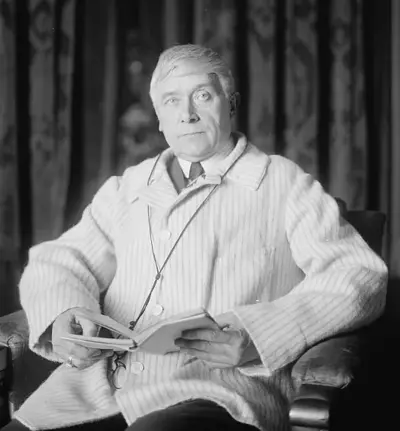
Maurice Polydore Marie Bernard Maeterlinck, also known as Count (or Comte) Maeterlinck from 1932, was a Belgian playwright, poet, and essayist who was Flemish but wrote in French. He was awarded the Nobel Prize in Literature in 1911 "in appreciation of his many-sided literary activities, and especially of his dramatic works, which are distinguished by a wealth of imagination and by a poetic fancy, which reveals, sometimes in the guise of a fairy tale, a deep inspiration, while in a mysterious way they appeal to the readers' own feelings and stimulate their imaginations". The main themes in his work are death and the meaning of life. He was a leading member of La Jeune Belgique group and his plays form an important part of the Symbolist movement.
