Noam Chomsky Quotes
If you look back at the history of the twentieth century, Germany alone had practically destroyed Russia several times.
Chomsky, Noam. Understanding Power: The Indispensable Chomsky. Edited by Peter R. Mitchell and John Schoeffel, The New Press, 2002.

The Russians had lost over 20 million of its people to German WWII hostilities. They wanted a vengeance and were willing to take the casualties that came with the invasion of Berlin and many other key cities that were heavily defended. Eisenhower and Churchill realized that this would give the Russians a very dominant military occupation of Eastern Europe and Eastern Germany. However, they did not want to take the huge casualties of all these battles. Politically, Churchill and American leaders had to explain to their right wings why Russia was involved as an equal partner in making occupation decisions about Germany.

There were a number of world leaders who were not happy about the German Reunification. See Henry Kissinger {610355} for another.


June 1941 was the date that Nazi Germany invaded Russia.


Many people mistakenly believe that this was the first political use of the “iron curtain” phrase—in German, “eiserner vorhang.” However, George Washington Crile used the phrase in 1915 {598870}. It is not known whether Geobbels knew of Crile’s work, or if Winston Churchill in his famous speech {411311} was familiar with either Crille’s or Goebbels use.


Chamberlain’s military assessment of Russia’s military ability was yet another example of his faulty judgment. He was not alone however in that many British military experts and American as well, thought that Stalin and Russia could not hold out against Hitler and any military aid given to Russia would just fall into German hands. It was FDR assistant Harry Hopkins who went to Russia, toured the front, met with Stalin and other Russian leaders and observed the Russian people and then recommended to FDR that we send arms to Russia. It was a critical judgment. In the end, the Germans suffered more casualties on their Russian front than any other part of the war and it was the Russians who took Berlin though they suffered large casualties themselves.

After the breakup of the Soviet Union, NATO expanded to include some fo the former Soviet Nations thus moving NATO territiry to the East--closer to Russia, whose leaders percieved that the expansion was hostile and dangerous for the indpendence of Russia. What made the situation more complex is that the American Secretary of State, when the Soviet Union was very powerful, had made an agreement with the Soviets that in return for Russian aquiessance of NATO being extended to East Germany, NATO would not expand further West. But after the collapse of the Soviet Union, Russia was quite weak and NATO expanded east despite the earleir comittment. The US and th eother NATO counties took the pozition the previous comitmnts were not binidng as they were never formally signed. The Russians then decided to take a hard line position and flaunt and use military force to which would stop the Western expansion closer to the Russian border.
One of the predictions of the oncoming war with Germany.


The only soldier ever so honored. Marshall was then Chief of Staff of the Army. This quotation is historically very important in that it refutes the accusation made by some FDR and New Deal enemies that Roosevelt was very naïve about the importance of capturing Berlin and ceded control over the invasion and capture of Berlin to Stalin and the Soviet Union. Marshall, one of the most upright of politicians in American history, was not a FDR apologist and few doubted his word or judgment. (Senator Joseph McCarthy and other right wingers however falsely accused him of harboring communists in the Army and working against America’s interest against Russia.

FDR was right about Russia being a major factor in stopping Hitler, but partially wrong about the danger of Russia. The Soviets never did dominate Europe although the tried, but they did dominate Eastern Europe.


The then Attorney General had established a back channel to the Russian agent. There was genuine fear by the Russians and some in America that there were still many Nazis and German nationalists who would try and influence, if not take over, German politics to produce another aggressive German fascist state. The Russians had lost 22 million citizens to the Germans in the war and had faced a defeated Germany where virtually every German over the age of 30 had been cheering for and supporting Hitler a decade ago. Neither the Russians nor we and the other allies had not yet seen the remarkable turn-around that the German nation would make and the intense anti-fascist, non-military ethos that would be brought by the younger German generations. The direction of Germany was then very unpredictable.


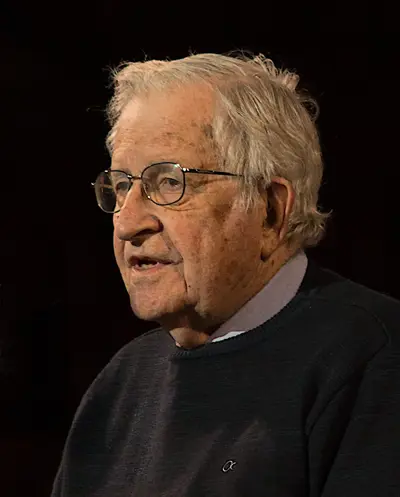
Avram Noam Chomsky is an American linguist, philosopher, cognitive scientist, historian, social critic, and political activist. Sometimes called "the father of modern linguistics", Chomsky is also a major figure in analytic philosophy and one of the founders of the field of cognitive science. He is Laureate Professor of Linguistics at the University of Arizona and Institute Professor Emeritus at the Massachusetts Institute of Technology (MIT), and is the author of more than 150 books on topics such as linguistics, war, politics, and mass media. Ideologically, he aligns with anarcho-syndicalism and libertarian socialism.
