George W. Bush Quotes
I didn’t e-mail during my Presidency because I was afraid of the Freedom of Information Requests.
George W. Bush, 43rd President of the United States, Son of President George W. Bush, Interview with Charlie Rose, PBS The Charlie Rose Show, May 10, 2013
Sourced by: Eigen's Political and Historical Quotations

The main reason that the English or American Freedom of Information Act is not used so much by individuals is that the executive agencies make the process of obtaining documents very difficult and then when the government stonewalls, the requestor has to spend a great deal of time and often engage an attorney. The result is that few individuals can spend the time or money and the field consists mostly of media and non profit organizations which have staff and resources.

He was criticizing the George W. Bush Administration of his own party.

See Louis D. Brandeis for an earlier phraseology.

While many people hold that view today, in the 17th century this was truly a radical notion. There were NO democracies at the time and this philosopher argued that the citizens had a need to know that might supersede the need for the state to maintain secrets from enemies. Spinoza was one of the most feared intellectuals in human history-feared that is by the established power structures. He is the only known person who was excommunicated by the Catholics, the Jews and the Muslims-all were forbidden to read his works. He was the enemy of authority and advocated personal reason as the guide for men.


And the New York press is probably the most difficult and cynical in the world.
At the time Holland was a republic and a confederation of different states. There was an assembly of delegations from each of the States but most important decisions tended to be made by the Prince and a few of the representatives in his sway. Mathenesse was the delegate of the largest and wealthiest state but even others in his state delegation were out of the loop. Others claimed that the necessity of secrecy was just a pretext for a small group to dominate the republic. See {620069}. This battle goes on in almost every country including the United States where there are many matters in which only a few members of Congress and the President make decisions with national security given as the reason. In many cases there has been such a reason, but it is very easily corrupted into a pretext as only the people on the inside who get to make the decision know what the secret material was.

The executive order to which this statement referred was the then new President’s first—Executive Order 13489. It was enthusiastically received by the public, historians, researchers and the media. However at the end of Obama’s two administrations, the system was a little better than when George W. Bush, blocked much of the Freedom of Information Act from being implemented. However, the agencies who want to operate in secrecy without having to deal with public criticism, had developed even more sophisticated techniques of avoiding transparency and when they must disclose, they have developed techniques to delay the process, sometimes even for years, while they study whether the material should be disclosed. The president personally declassified a few CIA files from decades ago that the agency maintained should be secret, but he did nothing else systemic so solve the problem of declassifying and material and nothing to control the over classification which virtually everyone agrees is a major problem. More material is being classified than ever.

The George W. Bush White House which had tried to keep secret things that no other administration in history had attempted found itself in the position where it was leaking secret classified information. A Key staff member of the administration was indicted for covering up their leaking activities of secret material.


At the time there was no Secrecy & Classification System nor any laws enforcing secrecy or confidentiality. However there was no freedom of information laws of expectations even on the part of journalists. This was the first Freedom of Information policy of the American government. Some politicians were more open than others but there was no national, governmental before this. There were however leakers and whistleblowers though the terms were not in use. Note that Roosevelt herein created the first whistle blower protection—himself.

He was the Chairman of the Senate Judiciary Committee.

_0_thumbnail_47x47.jpg "Statue of Robert Hall in Leicester.")
For many people the implication of this quotation is that there should be no government secrets withheld from the citizens who have the right to examine. Others argue that government may have temporary secrets to protect against foreign enemies for example, but that these must be declassified very promptly so that the citizens can examine the actions of their government in time to replace the government if they are not satisfied. Almost all government officials tend to reject the first implication out of hand, and grudgingly accept the second with their discretion controlling when declassification should take place. The problem of America is twofold. There is much over-classification (material kept secret that should not be at all), and the time till declassification is long in general and truly absurd in many cases. For example, there are documents from WWII that by 2013 had still not been declassified. See {591444}, {641317}, and {589105} for exemplar views. William Jennings Bryan introduced this principle into the American political dialogue. See {641027}.


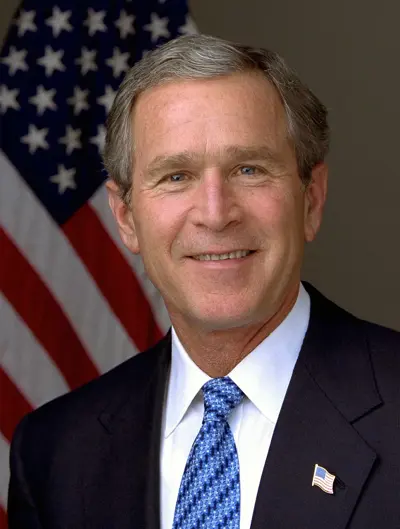
George Walker Bush is an American politician and businessman who served as the 43rd president of the United States from 2001 to 2009. A member of the Republican Party, Bush previously served as the 46th governor of Texas from 1995 to 2000. He was born into the Bush family; his father, George H. W. Bush, was the 41st president of the United States from 1989 to 1993.
