Richard Nixon Quotes
I can go into my office and pick up the telephone, and in 23 minutes 70 million people will be dead.
He had been asked if the impeachment proceedings weakened him as the President.
Richard M. Nixon, 1913-1994, 37th President of the United States (Republican, CA), Statement to Reporters during his impeachment hearings, 1974
Sourced by: Eigen's Political and Historical Quotations

This is a very important quotation. It is often cited by preventive war hawks to show that deterrence might not be a sufficient inhibitor against an extreme ideological enemy. In this case it was political philosophy that would make the enemy willing to have the majority of its population die to reach the ideological objective. More fearful is the prospect of the Theocracy of Iran where the leaders may believe that nuclear jihad is a commandment of God. More critical is the Islamic theology which says that if most of the Iranian Muslim population die in a nuclear war that they start all those people will be martyrs and immediately go to God’s Paradise. Thus, even the dead Muslims are not victims and the nonbelievers should be killed. For extremely fanatical Muslims nuclear war can be a logical and holy course of action.


The Scientific Project that developed the Atomic Bomb. Oppenheimer was the great physicist who directed the successful development of the atomic bomb so as to build the weapon before Hitler did in World War II. However, as the technology evolved, he had doubts as to the wisdom of creating even more powerful hydrogen weapons. His viewpoint was hurting the administration’s policy of rapid unlimited nuclear weapons development, and he was the victim of a character assassination whereby his security clearance was withdrawn. The “father” of the atomic bomb was the first American casualty of atomic weapons development.


The Booklet told people that even under an atomic attack there would be many survivors and it was everyone’s job to increase the number of survivors by taking precautions like building fallout shelters and maintaining a supply of food and water at home and ducking under desks and tables if there was an atomic attack. The implication was that despite the great firepower of the then Hydrogen Bombs there would be great survivability. The suggestions for protection ranged from minimal likely effect to absurd. The Publication also bore the imprimatur of the Executive Office of the President for credibility and many people believed it.


See {624449} for the essence of the letter.


This is one of the earliest uses of the phrase “weapons of mass destruction.” Panneloek quoted it in 1948, so it was used by Urey before then.


1st Earl Mountbatten of Burma
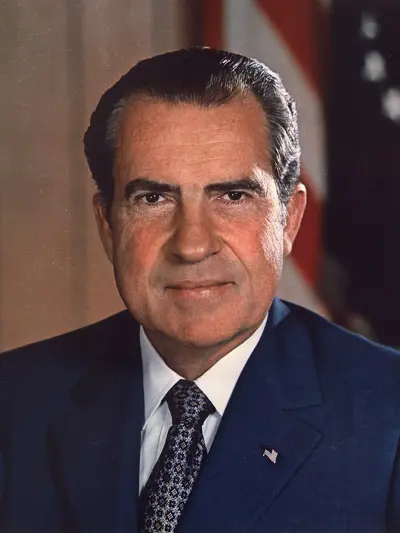
Richard Milhous Nixon was the 37th president of the United States, serving from 1969 to 1974. A member of the Republican Party, Nixon previously served as the 36th vice president from 1953 to 1961, having risen to national prominence as a representative and senator from California. After five years in the White House that saw the conclusion to the U.S. involvement in the Vietnam War, détente with the Soviet Union and China, and the establishment of the Environmental Protection Agency, he became the only president to resign from the office, following the Watergate scandal.
