Milton Friedman Quotes
Hell hath no fury like a bureaucrat scorned.
Milton Friedman, 1912-2006, 1912-2006, Nobel Laureate in Economics, Frequent Statement
Sourced by: Eigen's Political and Historical Quotations


3rd Earl Russell of Kingston


Political conservatives have generally been very verbal in their attacks upon and criticisms of bureaucracy. And yet, bureaucrats are the epitome of conservatism in their outlook and mode of operation as is made clear by this quotation.


The National Park Service had traditionally estimated the crowd sizes of Washington DC events and protests and mad them public, After the Donald Tump Inaguration, they followed the usual procedure using the Internet and tweeting the size of the crowd. Howevert, the resultrs showed that the crowd for the Trump inaguaration crowd size was smaller than that of Barak Obama and even George W. Bush. Trump, very sinsitive to any thing that he believed diminished him, then as one of his early adminsiotrative acts as Chief Executive, ordered the the Park Service to stop doing any indpendent tweeting or other public statemetns about crowd size, He was particualry worried that the Women's March the Next Day would show the protesting women outdrawing his inaguaration. Baltz was specualting with other political journalists and pundits on how the Park Service bureaucracy would react to the heavy censorship over relative trivia imposed by the new president.


Actually, Kerry was incorrect, but he had a point, There are about 110,000 employees of the U. S. Department of Agriculture and every state has their own department of Agriculture with employees. There are about 2 million farms in America. So there is a government agriculture employee for about every 15 farms—a ratio that no other occupation shares.
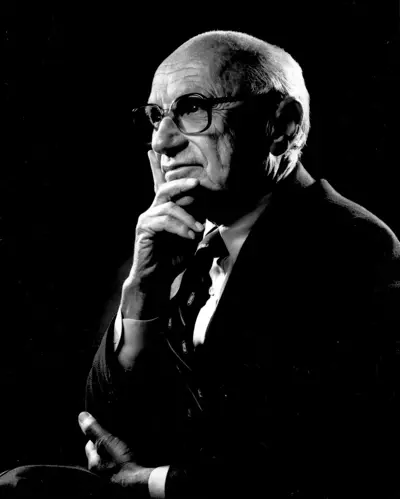
Milton Friedman was an American economist and statistician who received the 1976 Nobel Memorial Prize in Economic Sciences for his research on consumption analysis, monetary history and theory and the complexity of stabilization policy. With George Stigler and others, Friedman was among the intellectual leaders of the Chicago school of economics, a neoclassical school of economic thought associated with the work of the faculty at the University of Chicago that rejected Keynesianism in favor of monetarism until the mid-1970s, when it turned to new classical macroeconomics heavily based on the concept of rational expectations. Several students and young professors who were recruited or mentored by Friedman at Chicago went on to become leading economists, including Gary Becker, Robert Fogel, Thomas Sowell and Robert Lucas Jr.
