Robert M. Gates Quotes
There are so many elements of the Department of Defense that have to sign off to do anything, that any one of them was able to stop something. The only person who could make something happen was the Secretary of Defense.
Robert M. Gates, U. S. Secretary of Defense (Republican), Director of the CIA, Interview, C-SPAN Radio, October 2014
Sourced by: Eigen's Political and Historical Quotations

He was objecting to the current crop of senior military officer who have little experience in fighting and much in academic, strategic and technical training. Many however see him as a dinosaur who does not realized the complex nature of the modern military missions. In general, we have won almost all of our fighting battles but often failed in our maintaining civil society, occupation, nation building, military procurement, preventing sexual assault of our own troops by our own soldiers, assuring mental health of our soldiers. Hackworth, detractors argue, wants to change what already works and ignore what does not.


Generally, the American military is much more optimistic of its ability to accomplish its objectives as that it the way they have been trained. The General warns that the same attitude will make them more optimistic and willing to tackle a very difficult if not impossible problem than most would be. So civilians in America have to question what they are doing. At the same time, there have been a number of highly sophisticated military officers who have both a military and civilian perspective and education. They tend to be more realistic and at times argue against military deployments and missions that are being considered. However, once deployed and committed, it is culturally difficult or impossible for a member of the military to be pessimistic about the eventual


The new director was faced with 2,600 personnel vacancies in this critical office and the jobs were not getting filled quickly. Many people who are appointed to high Federal Office and come from the private sector or state and local government, are appalled at the extensive and cumbersome bureaucracy that makes the hiring of Federal employees so tedious and slow.


In bureaucracy, as in most other aspects of politics, it is not a serious problem if you are wrong as long as most or many others are. However, if your are alone, you had better be right.

June 1941 was the date that Nazi Germany invaded Russia.


He confuses modernity and religion. Muslims who live in a modern world have the same degree of bureaucracy then the Christians, Jews, Hindus, Buddhists and other religions do. The Muslims of America have the same degree of paperwork as other Americans, and the Turkish bureaucracy has as much filing and other paperwork as countries where the majority of people are of different religions. Historically, when England and France and other Christian countries were in the Dark Ages, Islamic bureaucrats kept Western and Eastern knowledge alive, and when the Ottoman Empire ruled most of the known world, they almost collapsed under their very heavy bureaucracy.

Note the egalitarian and democratic nature of the method of selection of military officers. This was typical of frontier thinking—the men who were putting their lives on the line should have a say in who their leaders would be. The Governor and the legislature could only select the top officers like the Adjutant General or the Major General. Congress had retained the power to appoint general officers but allowed them and the civilian secretaries of the armed services to select all other officers. The latter enabled wealthy people to be appointed officers without any necessary competence and many even in the Civil War in effect bought their appointments by paying for the uniforms or bringing weapons. While America became more democratic and egalitarian over its first two centuries, the appointment of military officers is the one area where it became less democratic and egalitarian. The election of officers so popular in many states was gradually and finally abolished.

FDR, Eleanor and lost liberals of the time were advocates of a strong military, and unlike after the 2nd Word War, most of the Republicans were conservative isolationists who were opposed to spending much public money for the armed services or weapons.

Socioeconomic class was a major factor in the Continental Army just as it was in the British Army. New York, unlike New England, did not have the clear-cut majority in favor of independence. Most of the working class at this stage had no opinion on independence as they did not need to and were not of the social class that had been discussing and arguing about the relationship with England. The upper class had been discussing the issue for some time and were polarized into Patriot and Loyalist sympathies. When the Patriots of New York voted to raise its first Regiment, the first people to volunteer were the men of the upper class who had been debating the question for some time. Because of their social class, they had to be officers. The lower classes got into the intellectual and political debate later, and they too were divided. The Patriots among them then volunteered to provide the privates and other enlisted men to the NY regiment. But the early contingents of New Yorkers were very top heavy with officers. While not as rigid as the Continental Army, the modern American Armed Services are still affected by this tradition. While there are many exceptions, there is still a strong correlation between military rank and socioeconomic family status.


Rumsfeld wanted Defense Department people running and controlling the civilian government of Iraq after our invasion. General Garner, who was the American appointee to run the civilian government until the Iraqis could have elections wanted State Department, Justice Department and other non military personnel run Iraq.
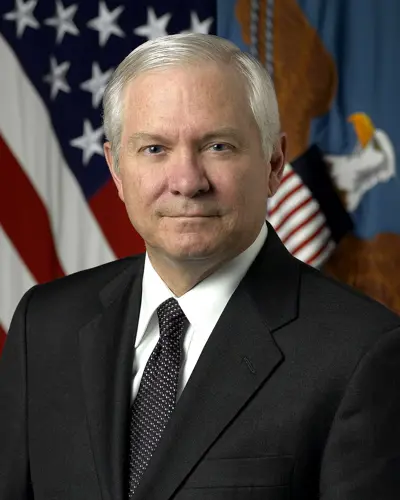
Robert Michael Gates is an American intelligence analyst, and university president who served as the 22nd United States secretary of defense from 2006 to 2011. He was originally appointed by President George W. Bush and was retained for service by President Barack Obama. Gates began his career serving as an officer in the United States Air Force but was quickly recruited by the Central Intelligence Agency (CIA). Gates served for 26 years in the CIA and the National Security Council, and was Director of Central Intelligence under President George H. W. Bush. After leaving the CIA, Gates became president of Texas A&M University and was a member of several corporate boards. Gates served as a member of the Iraq Study Group, the bipartisan commission co-chaired by James A. Baker III and Lee H. Hamilton, that studied the lessons of the Iraq War.
