John Quincy Adams Quotes
Go abroad in search of monsters to destroy.
John Quincy Adams, 1767-1848, 6th President of the United States (Independent, MA), Quoted in New York Times Magazine, September 22, 1996
Sourced by: Eigen's Political and Historical Quotations


Every major Western power and Japan were looking to control parts of China for their own mercantile advantage. The Emperor, her adopted son, had stated that under no circumstances would the Chinese fight, but Cixi issued this decree, in effect, overruling the Emperor—a remarkable occurrence.


There was much political Japanese opposition to attacking the United States. Most military judgments were that Japan could not win such a war. The militarist hawks in the Japanese leadership argued that while Japan might not be able to defeat the U. S., Japan could not be defeated in the Pacific. And the U. S. would not spend the money to rebuild their navy of the Japanese could destroy most of the capital ships with surprise attack. Therefore starting a war might provide the opportunity to negotiate for more favorable terms and less pressure, boycotting, and castigation of Japan by the United States and they could come out with control of a number of lands of the Pacific. However, the Naval Chief of Staff told the Emperor that war ight be inevitable as America or Great Britain might attack one of the Japanese held territories and force Japan into war. Later, the Japanese conservatives and Militarist hawks, were able to purge opponents of war from the Cabinet, and when they had control of the government, convinced the Emperor to flip flop, and started WWII with the Attack on Pearl Harbor.


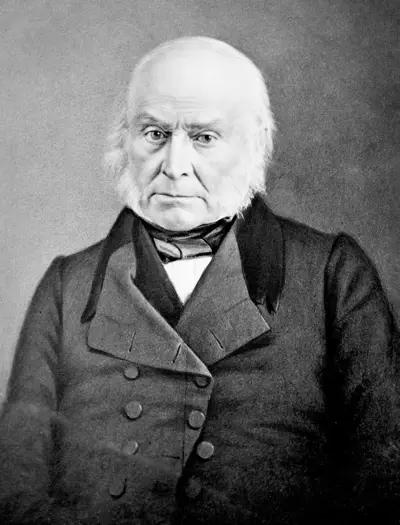
John Quincy Adams was an American statesman, diplomat, lawyer, and diarist who served as the sixth president of the United States, from 1825 to 1829. He previously served as the eighth United States Secretary of State from 1817 to 1825. During his long diplomatic and political career, Adams also served as an ambassador, and as a member of the United States Senate and House of Representatives representing Massachusetts. He was the eldest son of John Adams, who served as the second U.S. president from 1797 to 1801, and First Lady Abigail Adams. Initially a Federalist like his father, he won election to the presidency as a member of the Democratic-Republican Party, and in the mid-1830s became affiliated with the Whig Party.
