Ludwig von Mises Quotes
The root of the evil is not the construction of new, more dreadful weapons. It is the spirit of conquest.
von Mises, Ludwig. Omnipotent Government: The Rise of the Total State and Total War. Yale University Press, 1944.


the new nation of South Sudan The President was under indictment as a war criminal by the international Court in the Hague. He had difficulty understanding any other language that of the gun.


The first Bishop in Britain, sent by Pope Gregory in 597. This was in large part fulfilled in 607 when Ethelfrith led Saxon troops to Wales killing many including 200 priests who had been sent to pray for the Welsh.

Coughlin was a great admirer of Adolf Hitler and Benito Mussolini and the Fascists. He was one of the American “heroes” in Nazi Germany, receiving assistance from the Nazi government. Between his anti-Semitism and support for Hitler, Fascism and radical socialism, the Vatican ordered him off the air and shut down his political demagoguery.


The President was also getting ominous news from England. See {41111}


The atomic bomb had just been used the year before. However, in the next decades, nuclear weapons were not used again as those nations with nuclear capability also had potential enemies with nuclear weapons. The fear of Mutually Assured Destruction prevented nuclear weapons from being used for a long time.


See {613496} for the origin of the “thrashing a cannibal” phrase.

Ironically, when he attacked Athens in 480 BC, the Athenians under Themistocles, abandoned the city—see {612656}—and lured the overly-confident Xerxes into a sea battle at Salamis where the Persians were totally destroyed. A few public buildings of Athens were burned, but before Xerxes could fulfill his vow, he was defeated and had to retreat to Persia.


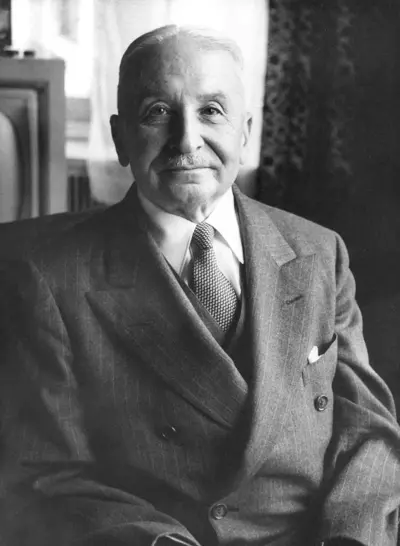
Ludwig Heinrich Edler von Mises was an Austrian School economist, historian, logician and sociologist. Mises wrote and lectured extensively on the societal contributions of classical liberalism. He is best known for his work on praxeology, a study of human choice and action.
