Wilhelm II, German Emperor Quotes
Germany is a young and growing empire. She has a worldwide commerce which is rapidly expanding, and to which the legitimate ambition of patriotic Germans refuses to assign any bounds. Germany must have a powerful fleet to protect that commerce and her manifold interests in even the most distant seas. She expects those interests to go on growing, and she must be able to champion them manfully in any quarter of the globe. Her horizons stretch far away.
Germany had world power aspirations before Adolf Hitler.
Wilhelm II, 1859-1941, Emperor of Germany & King of Prussia, Explanation of the rapid German buildup of warships, Interview, London Daily Telegraph, October 28, 1908
Sourced by: Eigen's Political and Historical Quotations


Germany had a very small and insignificant navy. It was Tirpitz who persuaded the nation to develop sea power.

There were few military thinkers at that time who would agree with Goebbels on this point.


The notion of America flexing its military muscles and intimidating other nations by sending a fleet of 16 battle ships around the world was not greeted enthusiastically by some. However in Japan, the reaction was totally positive. The Russo-Japanese War had been ended thanks to the mediation of Theodore Roosevelt (for which he was awarded the Nobel Peace Prize) and America was a model for much of Japan’s modernization. 25 years later the Japanese would view America as an interfering, intimidating bully, curtailing their national aspirations and rights.


Frederick the Great. He and many other Europeans thought that England had been so preoccupied with the American rebellion that she was ignoring Europe and other traditional foreign policy interests of theirs.
This was not the ravings of a right wing extremist. It was normative for Prussia as a whole. Right wing extremism as we think of it today was the norm of the ruling classes in Prussia and other parts of Germany. This book was a best seller in Germany. This quotation illustrates the mentality of the conservative, militarist, culture that dominated Germany at the time. The German aggression of WWI was not even considered as immoral but a God-given right.


Koxinga had an overwhelmingly superior force, and wanted the Dutch to surrender and avoid bloodshed. The Dutch with their typical European colonial attitude, had great difficulty surrendering to “natives” even if outnumbered. Finally, the Dutch Commander agreed to surrender. Koxinga then established a Chinese Government on the Island and became a great hero of the Ming Dynasty. Note the graphic of the statue to him which is one of the very few Chinese memorial statues to a military hero showing him in action—very similar to European statues. Already Koxinga’s massed wooden junks with small cannon and fire torches had sunk one of the Dutch warships (they were not iron but had some iron plates on the deck to protect the gunners) and there were so many junks that the other Dutch ships sailed out to sea to avoid the Chinese huge number of junks.

The Byzantine emissary had pointed out that Mehmed’s predecessors had signed a treaty agreeing to “consult” with Constantinople before building any fortified structure in the area surrounding Constantinople. Mehmed was only 19 years old at this time. His intention f building a fort was to have a platform from which to attack and capture Constantinople itself which he did 2 years later. Earlier, the Eastern Roman Empire was much stronger and the Ottoman sultans were more cautious in dealing with them. However, the various Christian factions were all feuding with each other, and Mehmed II, despite his youth, was much better organized and was a better leader than his predecessors.

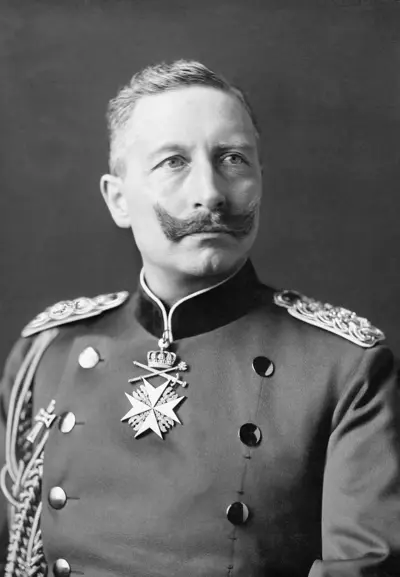
Wilhelm II, anglicised as William II, was the last German Emperor (Kaiser) and King of Prussia, reigning from 15 June 1888 until his abdication on 9 November 1918. Despite strengthening Germany's position as a great power by building a blue-water navy and promoting scientific innovation, his tactless public statements greatly antagonized the international community and his foreign policy was seen by many as one of the causes for the outbreak of World War I. When the German war effort collapsed after a series of crushing defeats on the Western Front in 1918, he was forced to abdicate, thereby bringing an end to the three-hundred-year rule of the House of Hohenzollern.
