Walter Lippmann Quotes
Franklin D. Roosevelt is no crusader. He is no tribune of the people. He is no enemy of entrenched privilege. He is a pleasant man who, without any important qualifications for the office, would very much like to he President.
Walter Lippmann, 1889-1974, Political Columnist, Interpretations, 1931-l932, 1932
Sourced by: Eigen's Political and Historical Quotations

This quotation illustrates an interesting phenomenon in American Presidential Politics. There have been Democratic Presidents (FDR and Obama are the most glaring examples) for whom there was vituperative hatred and derision from the conservative Republicans who would frequently refer to them as Socialists and would believe that they were trying to lead the country on the path to socialism. The Presidents always stated that they were opposed to socialism, but to little avail with their conservative haters. But the socialists of the times and even the left wing of the Democratic Party not only did not see them as socialists, but were not very supportive or complementary of their skills and capabilities. Roosevelt reveled in the situation and “welcomed: their hate. Obama was more of a public centrist who tried to avoid the president getting involved in the extreme partisanship of the day.

Patton always believed that Eisenhower wanted to be President. At the beginning of the war Patton was much senior to Eisenhower, but President Roosevelt promoted Eisenhower above many more senior generals. Eisenhower thought Patton the best fighting general in the army, but a public relations and administrative problem. Several times when he had gone too far, Eisenhower reprimanded him but kept him in his command position. After the fighting was over, Patton became the military governor of part of Germany and was not as successful at peacekeeping and nation building as he was at fighting. Eisenhower was convinced that Patton would destroy himself and get fired by the army command and the President if he continued as governor. Patton confused Eisenhower’s prudent and politic demeanor with the allies as a lack of courage. And Patton could never get over the fact that Eisenhower and never commanded an army fighting in the field. He was jumped to Supreme Allied Commander, in a very bold and brilliant stroke by FDR who passed over many senior generals.


In many recent Presidential elections many have thought a Vice Presidential candidate superior to the Presidential candidate. Such was also the case in 1900.


Ingersoll was considered to be the greatest orator and political thinker of his day, but his overt atheistic views curtailed his elected political career.
Running against FDR for the 1932 Democratic presidential nomination:

One-liner, soundbytes, have been good political oratory long before TV


Lippmann was the leading political pundit of the time. He, like many others, totally underestimated Roosevelt whose easy-going manner, and non ideological style tended to put off ideologues and some intellectuals. See {609696}.
This was written by a French Journalist who had been assigned to America for 7 years when he wrote this in 1939. WWII was just breaking out in Europe. President Franklin Delano Roosevelt was in his 3rd term of office (of 4) and since George Washington was the most popular American President, yet he had strong conservative critics and enemies.

In a large, diverse nation like the United States even then, there was a wide spectrum of opinion and political ideology. It is true that almost all of Roosevelt’s initiatives were not original with him, but he was incredibly effective at bringing those ideas to the large bulk of people who had had no serious view on the subject before. He also was able to change many contrary opinions. What was most remarkable about Roosevelt was that the issues that he did advocate were very unpopular and even anathema to the establishment—the “ruling class” of the day even though most were in his own political party.


After FDR died in his 4th term, Republicans started a movement to limit the Presidential service to eight years. There was little public interest in the issue, but the Republicans who had just obtained control of Congress considered it a priority for them. Despite the lack of public interest, the Republican-controlled Congress passed the amendment, which was later ratified by the States.


Ford was outraged about the President’s administration making rules and regulations to cope with the worst economic crash in American History. Former President Hoover had been voted out of office because philosophically he believed like Ford that the Federal Government should not be actively involved with private business and the economy. Some view regulation as meddling and interference while others see it as fulfilling its responsibility for the majority of citizens. See {642381} for Ford’s view of the Great Depression.

Lindbergh, a great aviator, was a Fascist who was a great admirer and supporter of Hitler and Mussolini. By this time, even Lindbergh had seen much of the German aggression, and his opposition to the war was on the pragmatic ground that we could not win. He thought that democracy was too unsuited to a country being a major power.


Referring to Governor Franklin Delano Roosevelt, then contesting for the Democratic presidential nomination:
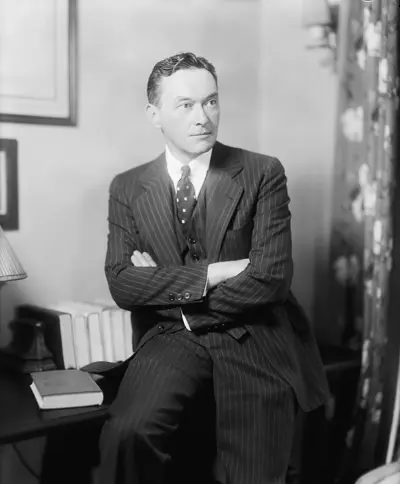
Walter Lippmann was an American writer, reporter and political commentator. With a career spanning 60 years he is famous for being among the first to introduce the concept of Cold War, coining the term "stereotype" in the modern psychological meaning, as well as critiquing media and democracy in his newspaper column and several books, most notably his 1922 book Public Opinion.
