Dewey Jackson Short Quotes
Mr. [Thomas] Jefferson founded the Democratic Party and President Roosevelt has dumfounded it
One-liner, soundbytes, have been good political oratory long before TV
Short, Dewey. Congressional Record. 74th Cong., 1st sess., Government Printing Office, 1935.


This quotation illustrates an interesting phenomenon in American Presidential Politics. There have been Democratic Presidents (FDR and Obama are the most glaring examples) for whom there was vituperative hatred and derision from the conservative Republicans who would frequently refer to them as Socialists and would believe that they were trying to lead the country on the path to socialism. The Presidents always stated that they were opposed to socialism, but to little avail with their conservative haters. But the socialists of the times and even the left wing of the Democratic Party not only did not see them as socialists, but were not very supportive or complementary of their skills and capabilities. Roosevelt reveled in the situation and “welcomed: their hate. Obama was more of a public centrist who tried to avoid the president getting involved in the extreme partisanship of the day.

Kennedy hated Roosevelt who had forced him to resign as the U. S. Ambassador to England. Kennedy was an admirer of Mussolini and Hitler. He had allied himself with the part of the British aristocracy that was pro Fascist and opposed Winston Churchill and the democratic element in Britain. Kennedy had opposed aid to Britain to fight Hitler and advised all who would listen that Britain could and would not stand up to Germany. Roosevelt’s support of Britain with Lend Lease and other means proved Kennedy wrong pragmatically and Kennedy’s own statements had forever proved him wrong morally. Although Kennedy opposed our entry in WWII, his sons did not. His oldest son volunteered for a very dangerous mission and was killed. Kennedy blamed his death on Roosevelt {616651} and forever after slandered FDR whenever he got a chance until his son Jack got into politics when his ambition for his son outweighed his hatred.


Ford was outraged about the President’s administration making rules and regulations to cope with the worst economic crash in American History. Former President Hoover had been voted out of office because philosophically he believed like Ford that the Federal Government should not be actively involved with private business and the economy. Some view regulation as meddling and interference while others see it as fulfilling its responsibility for the majority of citizens. See {642381} for Ford’s view of the Great Depression.


Referring to Governor Franklin Delano Roosevelt, then contesting for the Democratic presidential nomination:


Hoover, a brilliant administrator before his presidency, was so ideological about the role of government that when the Great Depression came, he was unwilling to use government directly to cope with the new problems. He was turned out of office in favor of FDR and the New Deal which the voters ratified 4 times. Hoover was embarrassed by the New Deal successes and lashed out with many insults. In this case, he called the New Deal “fascist”. See {589568} for another quote where he labels the New Deal communistic. Ironically, Hoover is rated by most historians as one of the least effective Presidents in American history while Roosevelt is always rated among the top 3 presidents.

The feeling was mutual. These two men hated each other as much as any two individuals in politics.

When the Trs Psrty snd other extrme conservatives gsined contol of the Republican Party and moved the party far to the right, the Democratic Party, began shifting to the left. The centeriists of both parties began to be ignored as politicians of each party stove to avoid attacks from their extremes. The result were centerists who left their old party loyalties becomming indeprndents or joininng the other party.

President Donald Trump was extremely egocentric

Closest reference to this quote is during remarks at a Fundraiser for Gov. James R. Thompson, Jr., in Rosemont, Illinois August 12, 1986 where he said: “When [Jim O’Grady] was at the White House, Jim said to me, "The great Democratic Party of my father's and grandfather's time just doesn't exist anymore. Mr. President, I didn't leave the Democratic Party, the Democratic Party left me. That's why I switched parties." And I said, "Jim, join the crowd.”” http://www.presidency.ucsb.edu/ws/?pid=37732


After JFK’s assassination, many of his appointees who were liberal Democrats, were concerned that LBJ was a Southern conservative and might not want to serve in a conservative administration. Johnson satisfied Heller and all of the other Kennedy appointees who he asked to stay on. Actually, Johnson was more liberal than JFK, and proved it during his Presidency.
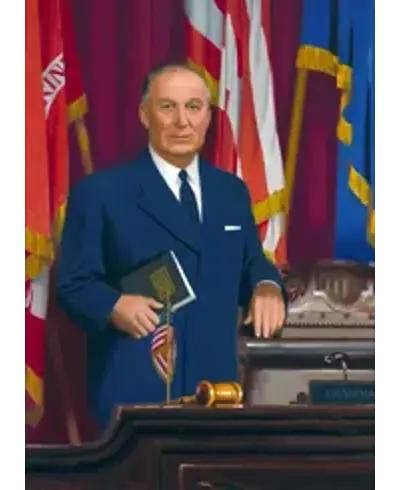
Dewey Jackson Short was a Republican U.S. Representative from Missouri's 7th congressional district for 12 terms and a staunch opponent of President Franklin Delano Roosevelt's New Deal.
