Elizabeth I Quotes
For the better discovering and avoiding of all such traitorous and most dangerous conspiracies and attempts as are daily devised and practiced against our most gracious sovereign lady the queen's majesty and the happy estate of this commonweal, by sundry wicked and seditious persons, who, terming themselves Catholics, and being indeed spies and intelligencers, not only for her majesty's foreign enemies, but also for rebellious and traitorous subjects born within her highness's realms and dominions, and hiding their most detestable and devilish purposes under a false pretext of religion and conscience, do secretly wander and shift from place to place within this realm, to corrupt and seduce her majesty's subjects, and to stir them to sedition and rebellion …
Elizabeth I, 1533-1603, Queen of England, Preamble of The Act Against Recusants, 1593
Sourced by: Eigen's Political and Historical Quotations

He was shot in 1944 for his involvement in an attempt to kill Hitler

Jesuits were leading the “covert action” efforts to destabilize the Elizabethan kingdom.

The names cited were the British police and military forces. Fraternization was considered spying and brought death. That year the IRA executed over 100 of their fellow Irishmen, with no trial or chance to defend themselves. Some were scores and personal grudges being settled and others mistakes.


Ironically, until after the assassination of JFK, the United States did not have a specific crime against killing the President.


motivates him as opposed to a plot He had entered the Catholic cathedral in Lisbon, and in the middle of the mass, wrested the host away from the bishop and trampled it on the ground. The Catholics thought that the Protestant English were about to launch a plot to establish a reformed church in Portugal. They arrested all Englishmen in Portugal. Finally, after much torture, the decision was reached that Gardener acted on his own, and he was roasted alive.
There was no Catholic university in Ireland at the time. Unlike England where Catholic students attended both Catholic and Protestant schools, the Irish Priests were opposed to Catholic young men attending Protestant schools. See {617782} for the view of a leading academic of the era.

In 1956, Democratic presidential candidate, Adlai Stevenson, had suggested a nuclear testing ban. The then Vice President made his extreme accusation. See {619523} for another Nixon smear of Stevenson.


This was his name for the wealthy slaveowners in Tennessee. He was the military governor of Tennessee when he so labeled the secessionists.


He was of course not the President then. But the stands that politicians took with respect to the rebellion of the South often determined their political futures. See {640751} for another future President’s quotation on the subject.
The King had earlier replaced the Pope as the head of the English church. The references to money referred to a then common corruption of the Church whereby people could buy indulgences—religious papal pardons of past or future sins. This was a major revenue source for the Vatican and a major issue for Martin Luther and the Protestant Reformers some of who saw the pope as the Devil incarnate See {623153}. For Martin Luther’s view pf the practice and {626720}, {595195}, and {639436} for other contemporary views.

Historically, most of the revolutionary leaders are the sons (and daughters) of upper class and upper middle class parents. They generally have had a good education and are intimately familiar with the foibles of the ruling class.
After he wrote that there was no such thing as witches he was imprisoned.

Henry of Navarre. This edict made the Huguenots and other Protestants legal in France whereas only 26 years earlier 50,000 of them had been slaughtered in France by the Catholics. It wasn’t a century before the Catholics reneged. See {617765}.
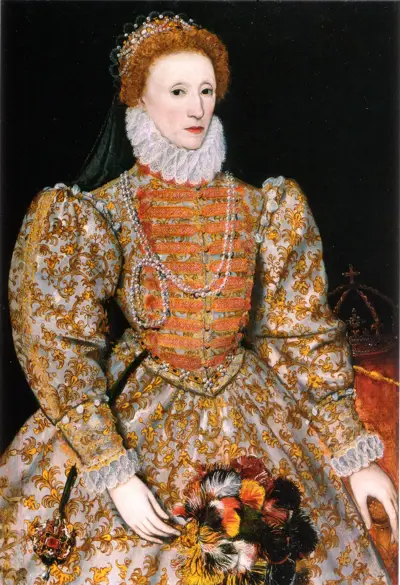
Elizabeth I was Queen of England and Ireland from 17 November 1558 until her death in 1603. Sometimes called the Virgin Queen, Gloriana or Good Queen Bess, Elizabeth was the last of the five monarchs of the House of Tudor.
