Henry IV of France Quotes
And in order to leave no occasion for troubles or differences between our subjects, we have permitted, and herewith permit, those of the said religion pretended Reformed to live and abide in all the cities and places of this our kingdom and countries of our sway, without being annoyed, molested, or compelled to do anything in the matter of religion contrary to their consciences
Henry of Navarre. This edict made the Huguenots and other Protestants legal in France whereas only 26 years earlier 50,000 of them had been slaughtered in France by the Catholics. It wasn’t a century before the Catholics reneged. See {617765}.
Henry IV, 1553-1610, King of France, Edict of Nantes, 1598
Sourced by: Eigen's Political and Historical Quotations

It was uttered in the King’s name by soldiers and officials throughout the land. It is not certain that the exact words of choice were created by Louis but they were uttered in his name. Protestants had been given the right to practice their religion in France by the King’s grandfather (the Edict of Nantes {617664}), but Louis XIV rescinded that {617765} and gave Protestants this choice. Some converted. Some were murdered. Some escaped to other countries.
The Protestants had been given the right to practice their religion free from harm by the King’s grandfather. See {617664}. The inter-religious animosity continued and the Catholics again tried to make France an exclusively Catholic country.


Henry of Navarre

At first this clause appears to be very enlightened and establishing freedom of conscience. This clause allowed Catholics to practice freely whereas in other colonies they could not. However, as one reads on, it becomes clear that the “tolerance” is limited to Christians only. Then if one examines the exception within the parentheses and refer to the rest of the act—see {611994}—, one finds that even Christians who have certain theological beliefs are to be put to death—those for example who deny the holiness of the Trinity such as Unitarians who were a major group in the New England Colonies. It was a significant step at the time however to protect Roman Catholics.


Kennedy was being hurt be fears that as a Catholic, he would be beholden to the Pope and the Catholic Bishops. There were many protestants who believed that the Catholic Church was antithetical to democracy and some who even believed that Catholicism was the religion of Satan. Kennedy decided to confront the issue head on.

It is an error to say that. It is an error to say that He was the last Pope to hold temporal power. Years later, the Vatican rejected this view and adopted the modern concept of freedom of conscience. See {612714}.


Wesley had been to Island several times and was interested in affairs there. He was a strong advocate of freedom of religion but the violence of the earlier religious conflict made him very wary of the Irish Roman Catholics who seemed to him particularly prone to religious violence.


He is a Greek Orthodox Christian, and he correctly observes that the Islamic world was considerably more tolerant than the Christian until the 18th century when Islam had become less tolerant in the Middle East while the Christians were modernizing and going through a cultural and intellectual enlightenment and societal modernization while the Muslims, became less tolerant than they were in earlier years leading to the modern situation.

Anne was a Protestant but her father James II was a Roman Catholic. There was always suspicion about her true religious allegiance by the extremists in the Church of England. The Act of Toleration, despite its name, required the Church of England to be the established church and the sovereign’s to be the heads of the church.

Those who claim that the founding fathers contemplated religion as a critical component of government often point to this article of the South Carolina Constitution. However, they ignore the almost simultaneous passage of the New York constitution as in {612166}. When the framers of the Constitution met in 1787 in Philadelphia the separation of church and state issue was not really resolved and awaited the Bill of Rights where the separatists won out.

Prior to Vatican II, freedom of conscience was not explicit in Catholic Doctrine. The controlling view had been that of Pope Pius IX a hundred years earlier. See {612299}.


This law governed the territories outside of the original 13 colonies. This is the first chance that Congress had to legislate on religious freedom, and they guaranteed that there would be no territory that would be founded by or unilaterally controlled by any particular religion at the expense of the religious freedom of other people.

Abdul Rahman, Afghan citizen, had converted from Islam to Christianity 16 years before. Conversion from Islam is a capital crime under Sharia Law which was the law of Afghanistan even after the Taliban had been overthrown. He was jailed and threatened with death. Statements like this and others made directly to the government persuaded the Afghan politicians to go against their mullahs who demanded the death penalty as is proscribed by Islamic Law—Sharia. The judges tried to get Rahman to recant and he would not (see {589518}). So they finally decided that he must be mentally insane and therefore could not be tried, and the problem was solved that way.

Martin wanted William Howard Taft to answer questions about his religious beliefs. Taft was TR’s selection to be his successor. Ironically, a starting with John F. Kennedy, many presidential candidates have been asked about their religious belief’s and have answered whereas Roosevelt would have them not reply to such inquiries.
- Born:
- Nationality: French
- Profession: Royalty, King of France, Monarch
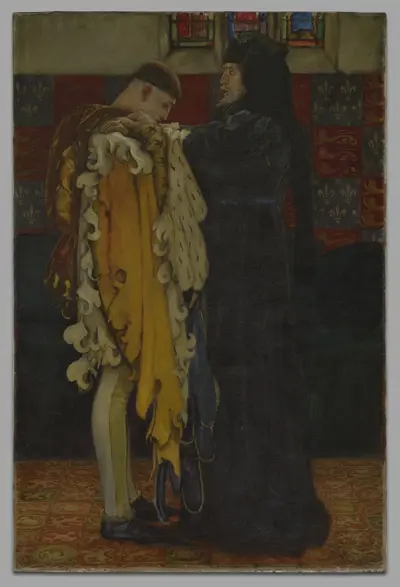
Henry IV (French: Henri IV; 13 December 1553 – 14 May 1610), also known by the epithets Good King Henry or Henry the Great, was King of Navarre (as Henry III) from 1572 and King of France from 1589 to 1610. He was the first monarch of France from the House of Bourbon, a cadet branch of the Capetian dynasty. He was assassinated in 1610 by François Ravaillac, a Catholic zealot, and was succeeded by his son Louis XIII.
