Niall Ferguson Quotes
Disasters don’t always discredit ruling elites.
Much depends on the culture of the people and the power of the rulers. In Pakistan, corruption and one disaster after another occurs and neither the government nor the army—the two ruling elites—does little or nothing to help the people, yet they retain their power and support of the majority of the population. The Palestinians have been led by the PLO, Hamas, and Hezbollah, and with each decision the elite rulers make, the Israeli’s obtain more territory than they were willing to settle for earlier, the standard of living of the Palestinians degrades, their employment prospects deteriorates, and their humiliation becomes greater. Yet, the elites maintain their power.
Niall Ferguson, Historian, Speech, World Affairs Council. September 27, 2006
Sourced by: Eigen's Political and Historical Quotations

See {594396} for his going a step further and advocating lying in the interest of the nation. Note that he does not consider the simple alternative of telling the voters and then fixing the problem.


The incident to which he referred was Islamic extremist terrorists attacking with assault weapons a group of unarmed tourists killing over 30. Tunisia, although it has a large majority Muslim population, became a secular republic after its Arab Spring revolution. Tunisia's economy is dependent on tourism, which is diminished by the fear of more terrorist attacks.


Virtually every scientist and most laymen realized that the air quality of London was getting worse and worse. But the politicians did nothing until in 1952, it became so bad that people dies, traffic came to a standstill, business had to shut down and the city was just about paralyzed. Then they finally acted and improved the air quality immensely.

ONLY DANGER SAN FRANCISCO STRIKE IS THAT MAYOR IS BADLY FRIGHTENED AND HIS FEAR INFECTED ENTIRE CITY
In July of 1934 there was a general strike in San Francisco while the President was on a Pacific vacation cruise. Hiram Johnson and Cordell Hull saw a "revolution" in the making and urged Roosevelt's return. His chief assistant, Howe, urged him not to return, so not to allow people to think it was anything more than a local labor dispute:. The President remained at sea and the labor dispute was resolved through normal channels.


He was of course not the President then. But the stands that politicians took with respect to the rebellion of the South often determined their political futures. See {640752} for another future President’s quotation on the subject.

He was arrested by the Gestapo 2 weeks later and hanged with piano wire. The upper class of Germany had no love for Adolf Hitler. They thought him gross, crude, immoral, and a danger to Germany. But Germany was such ab authoritarian society that the people who would be most independent were as intimidated and in fear as most of the non Nazi population.


In the Meldown of 2008 which caused the Great Recession, he, his Republican Predecessor and Ben Bernanke, the Federal Reserve Chairman, I the opinion of most on ideological economists saved the American economy from a collapse that would have been as bad or worse than the Great Depression. However, to accomplish that they had to in effect bail out the banks, 2 of the 3 American Auto companies, and the largest insurance company with taxpayer money. Worse, they could not do much for the millions of Americans whose homes were “under water” as a result of the banks’ handling of home mortgages and mortgage backed securities. To help them, they would have had to force the banks to admit that their assets were much lower than the banks were claiming and the banking and financial executives had to be appeased. Meanwhile, they had few other resources and did not provide any help to Main Street, small business or even small banks. Worse, they were intimidated into allowing the subsidized and saved banks to pay huge bonuses to their executives whose performance was terrible while millions of normal Americans were unemployed and the others were getting no increase in compensation. See {639655} for Geither’s explanation of the problem.

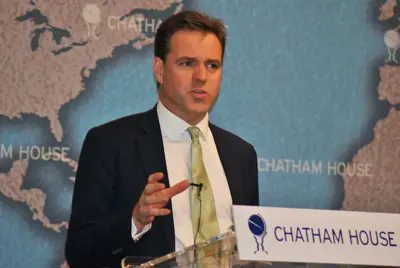
Niall Campbell Ferguson is a Scottish historian and the Milbank Family Senior Fellow at the Hoover Institution at Stanford University. Previously, he was a professor at Harvard University, the London School of Economics and New York University, visiting professor at New College of the Humanities and senior research fellow at Jesus College, Oxford.
