Beji Caid Essebsi Quotes
Tunisia, which is dear to all of us, is going through difficult circumstances, exceptional circumstances, that necessitate exceptional measures to face them and prevent a worse situation Our security forces are in a full alert status, but we do have weaknesses as our prime minister admitted. We are not blaming anyone, but we are calling for everyone to feel and act responsibly. If such incidents happen again, the state will collapse. It is the duty of the president to take a stance.
The incident to which he referred was Islamic extremist terrorists attacking with assault weapons a group of unarmed tourists killing over 30. Tunisia, although it has a large majority Muslim population, became a secular republic after its Arab Spring revolution. Tunisia's economy is dependent on tourism, which is diminished by the fear of more terrorist attacks.
Beji Caid Essebsi, President of Tunisia, Declaration of a State of Emergency, National Television Address, July 2, 2015
Sourced by: Eigen's Political and Historical Quotations


Tunisia, although it has a large majority Muslim population, became a secular republic after its Arab Spring revolution.


Over a century ago, modern Islamists were critical of the Wahhabi sect for their extremism. Unfortunately, the Saudi Arabian royal family whose absolute control of the kingdom could be threatened by an extremist religious movement, cut a deal with the Wahhabi that not only gave them control over all religious and legal interpretations of Sharia in the kingdom, but also gave them large amounts of money with which the Wahhabi expanded and exported their extremist brand of Islam to many other counties—including the United States. A large part of the Islamic terrorism of the end of the 20th century into the 21st was caused by fanatics who had been exposed to Wahhabi schools (madrassas), mosques or materials which are virulently anti-Christian and ant-Semitic. Muslim intellectuals like Muhammad Abduh had warned about extremism in general and Wahhabi extremism in particular.


Bush claimed he did not remember the conversation. His incoming National Security Advisor, Condoleezza Rice, was also briefed about bin Laden by the Clinton anti-terrorism director, Richard Clarke. The Bush Administration ignored the warnings until bin Laden struck on 9-11

Tragically, at the time, reasonable, moderate Muslims who did stand up at that time ran the personal risk of social, religious ostracism to physical attack and killing of them and their families.


Islamic terrorists took over one of the major cities of Mali, a former French colony, and controlled the immediate area imposing Sharia (Islamic Law). The Mali government and military tried to prevent the takeover, but the military was too weak. The French President, with the support of the Mali government, immediately dispatched French special troops to Mali. They quickly defeated and ousted the terrorists before they could attract more Islamic jihadist fighters and before they could incite Muslims in other areas to try and take over to install Sharia.
The Nigerian Government was very slow in making a policy to protect communities against the Boko Haram, fundamentalist Islamic terrorists. The Nigerian army was totally corrupt with no interest in risking their lives, so they would rarely go after the terrorists or interpose themselves between the terrorists and their targets even when they had advance knowledge.


6th Baron Byron. This is one the earliest references to the ultra-fundamentalist Wahhabi Islamic sect which dominated Saudi Arabia Islam in the late 20th and early 21st century and which inspired terrorism against the West and Israel. When Byron wrote this canto the sect was just a decade old and had already taken over Mecca by violence. Byron was prophetic.

Son of Reverend Billy Graham. While parts of the Koran do preach violence, parts of the Old Testament also do, as do parts of the New Testament such as the Book of Revelations.


His views are a mix of modernism and fundamentalism. He favors democracy and elections but also favored the Taliban destroying the great ancient Buddha statues when he was called an idol worshipper for urging the preservation of art.


See {583817} for how France was more assertive in handling this problem.

Fanatic Muslims believe that suicide bombers when they blow themselves up have done so to defend Islam and therefore will not only go directly to heaven but will get 72 Virgins when they get there. Most of the suicide bombers are young men with very little or no sexual experience. At the time that Trainor made this remark, there had been an enormous increase in suicide bombers in the Iraq war.

She had been covering Muslim nations and leaders for a long time and saw the relationship between the contemporary domination of Islamic fundamentalism and terrorism long before most.
See {586916} for a passage from the Koran supporting his point.


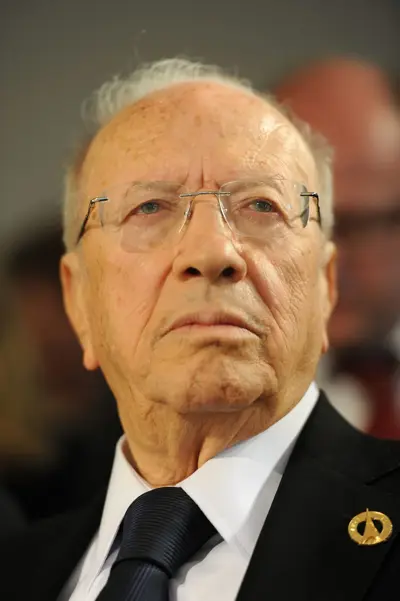
Mohamed Beji Caid Essebsi was a Tunisian politician who was the President of Tunisia from 31 December 2014 until his death on 25 July 2019. Previously, he served as Minister of Foreign Affairs from 1981 to 1986 and as Prime Minister from February 2011 to December 2011.
