Timothy Geithner Quotes
We did save the economy, but we lost the country doing it.
In the Meldown of 2008 which caused the Great Recession, he, his Republican Predecessor and Ben Bernanke, the Federal Reserve Chairman, I the opinion of most on ideological economists saved the American economy from a collapse that would have been as bad or worse than the Great Depression. However, to accomplish that they had to in effect bail out the banks, 2 of the 3 American Auto companies, and the largest insurance company with taxpayer money. Worse, they could not do much for the millions of Americans whose homes were “under water” as a result of the banks’ handling of home mortgages and mortgage backed securities. To help them, they would have had to force the banks to admit that their assets were much lower than the banks were claiming and the banking and financial executives had to be appeased. Meanwhile, they had few other resources and did not provide any help to Main Street, small business or even small banks. Worse, they were intimidated into allowing the subsidized and saved banks to pay huge bonuses to their executives whose performance was terrible while millions of normal Americans were unemployed and the others were getting no increase in compensation. See {639655} for Geither’s explanation of the problem.
Tim Geithner, U.S. Secretary of the Treasury (Democrat), President, New York Federal Reserve Bank, Stress Test: Reflections on Financial Crises, 2014
Sourced by: Eigen's Political and Historical Quotations


Geithner, the Treasury Secretary immediately after the Meltdown of 2008, facing complete collapse of our financial system, among other ameliorations, advocated and implemented many subsidies to bail out the banks most of whom had been greedy, foolish and often dishonest. He even allowed banks to use taxpayer money to pay bonuses to Bank executives who had brought the bank to ruin being a cause of the crisis. However, the banks not only survived but recovered and made huge profits while many of the taxpayers whose funds were used to help the banks were still struggling to make ends meet and it was they who received little, if any, government assistant.


Barry Bonds was a star professional baseball player whose accomplishments were aided by taking illegal drugs. He lied about his use of drugs, and the Department made a very large effort over years to finally prosecute him. However during that time there were almost no prosecutions of the thousands of bankers and financiers who had lied, cheated, forged legal documents and in the process almost permanently ruined the American economy—the Great Recession of 2008. The Justice Department claimed that white collar cases are very complex and take longer to prepare prosecutions. Critics claimed that there are so many law breakers, that the government does not want to prosecute all the felons, but just go after a few, and this is easier if time has gone by and public anger has receded or been forgotten.


Sovereign credit substitution is where the government, one way or another, assumes and guarantees the debts of private corporations. This is an elegant way of saying: “taxpayer bailouts”
The Chairman of the Federal Reserve Board, creatively found alternatives that the Fed had never used before and almost all experts did not even realize that were possible. He and Treasury Secretary Paulson, almost certainly saved the American system of capitalism. But in the process, they in the early stages and Bernanke throughout the crisis took a number of steps to save the system where the very people and companies whose actions had triggered the entire crisis seemed to personally benefit while most Americans were hurt badly and none of them received any immediate personal benefits the way the large bankers did. The amount of money that Bernanke and his Federal Reserve Board associates spend was staggeringly large and that too distressed many Americans. Almost all of the money was actually returned to the taxpayers as a result of the work of the Fed and the Treasury officials, but no one could feel good about the unfair disparity that had so benefitted much of Wall Street particularly and Main Street and the rest of American only generally while so many lost their jobs, their homes, their dignity and their hopes. Only the big banks and bankers also got a personal huge windfall of taxpayer money and took no risk for that. The alternative would have ruined everyone and even have been worse for the average citizen.

Under the Republican George W. Bush administration, the economic meltdown of 2008 triggered the Great Recession where the middle class bore the economic and emotional brunt. In 2012, the Republicans were in the midst of their primary elections for their Presidential nominee. There were 4 candidates in a vicious campaign where they trashed and attacked each other trying to pander to the right wing of the Party who tended to control the primaries. So all of the candidates were opposed to all the laws that Congress had made to prevent another economic disaster and in addition to repealing those, would roll back most of the executive orders and regulations to prevent another Banking debacle.


U. S. Treasury Secretary Larry Summers called Rajan a “Luddite” for this view, but what Rajan observed and predicted was exactly what happened in the Meltdown of 2008 which led to the Great Recession. Rajan was one of the few economists to call this right. Several, invested their own money assuming a crash and made billions. Most, like Summers and the Federal Reserve Chairmen in retrospect admitted that they missed the signs and didn’t connect the dots. See {637168}, {637987}, and {620038}

When the Meltdown hit America, the crisis drew attention to the fiscal solvency and stability of banks in most of the world. The Irish banks were much more overextended than those of most counties and when that came to light there was a bank panic in Ireland. Ahern and the Irish Dail (parliament) decided to bail out the Irish bank at a very great cost to the rest of the Irish economy and people. He believed if Lehman Brothers had been bailed out, as America did with other institutions, the Irish bank bubble would not have burst. It is not known whether he actually meant to use the word “testicles” or he made a gaff intending to use the word “tentacles”. Both have relevant meaning in the situation with a significant shade of difference in meaning between the two.

While Abraham Lincoln set the precedent for independent Presidential action in a national political crises without much reliance on Congress, this was where Roosevelt established the precedent of unilateral action in financial crises.

His predecessors had lied about the status of the Greek Economy and then squandered the money with waste, fraud, and corruption. To avoid total national bankruptcy, Greece needed a large bailout which was given subject to a set of required conditions of reform and transparency. This “austerity” package created a great hardship for many of the average Greek citizens while the wealthy who had benefitted from the previous incompetence and corruption took their money out of the country. The Greek voters elected a new government without much experience but who were committed to lifting the burden of the austerity package. The problem was that the major nations of the Eurozone, whose taxpayers would have to pay for the bailout, had been burned before by Greek government lies and incompetence and did not trust the Greeks, insisting on the austerity measures if any bailout money would be forthcoming. The new Greek government was caught in a great dilemma. Agree to the same kind of Austerity package and continue the great hardships on the people or go into Bankruptcy and leave the Eurozone the consequences of which would probably be worse. The finance minister was hoping for a compromise.
Geithner and Federal Reserve Chairman Bernanke went way “out of the box”, using creative methods of preventing the crash of 2008 from turning into a major Depression. See {639655} for Geithner’s further explanation.


He was referring to the success of the Clinton Administration.


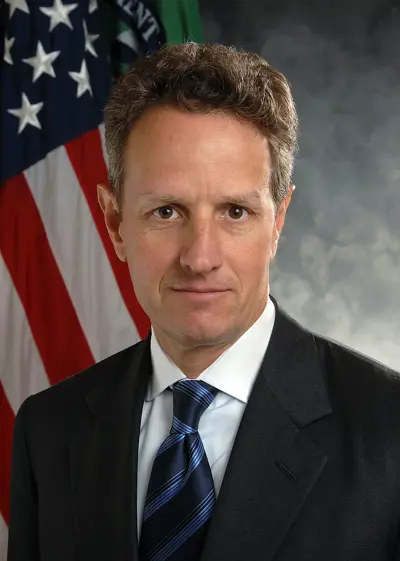
- Born: August 18, 1961
- Nationality: American
- Profession: Public Servant
Timothy Franz Geithner is a former American central banker who served as the 75th United States Secretary of the Treasury under President Barack Obama, from 2009 to 2013. He was the President of the Federal Reserve Bank of New York from 2003 to 2009, following service in the Clinton administration. Since March 2014, he has served as president and managing director of Warburg Pincus, a private equity firm headquartered in New York City.
