Louis McHenry Howe Quotes
ONLY DANGER SAN FRANCISCO STRIKE IS THAT MAYOR IS BADLY FRIGHTENED AND HIS FEAR INFECTED ENTIRE CITY
In July of 1934 there was a general strike in San Francisco while the President was on a Pacific vacation cruise. Hiram Johnson and Cordell Hull saw a "revolution" in the making and urged Roosevelt's return. His chief assistant, Howe, urged him not to return, so not to allow people to think it was anything more than a local labor dispute:. The President remained at sea and the labor dispute was resolved through normal channels.
Louis McHenry Howe, 1871-1935, Presidential Assistant (Democrat), Campaign Manager & Earliest Political Advisor, Radiogram to Franklin Delano Roosevelt, July 1934
Sourced by: Eigen's Political and Historical Quotations

In 1937 there were major automobile and steel strikes. President Roosevelt castigated both sides of the dispute:

While Abraham Lincoln set the precedent for independent Presidential action in a national political crises without much reliance on Congress, this was where Roosevelt established the precedent of unilateral action in financial crises.

This is a wonderful historical picture of FDR on his campaign train. Note that the President liked to listen to ideas of many people. Unlike most Presidents he did not have any particular political programs that he advocated in his campaigning. He had no immediate answers to the Great Depression that he had inherited from the Hoover administration. But unlike Hoover, and most Presidents, he was willing to try ideas for which there was no advance evidence of success. If that did not help, he would try something else. He sought ideas from anyone and everyone. His enemies called him a weak leader who had no ideology—no principles but just trying unproven solutions to solve the nation’s critical problems. But it worked and he was elected 4 times—the only President who had served even 3 terms.

At the beginning of World War II the President called business and union leaders to the White House for a conference on labor management relations for the war effort. There was agreement on some issues but acrimony on others—especially the concept of a union shop. President Roosevelt congratulated the conferees on their agreements, ignored their disagreements, and told the press things had been settled:


She was at the time the European Commissioner for Competition


The only soldier ever so honored. At the beginning of WWII, President Roosevelt and Churchill wanted the U. S. Army to invade German and Italian North Africa. Marshall, General Eisenhower, and all the other military men, advised that while it was possible, it would be a diversion from the strategic objective of invading Europe. None the less FDR ordered the invasion. The effect on the American people was wonderful, It showed that the Germans were not invincible, increased enlistment and morale at home, and developed more popular support for the war. Later, Marshall learned much about Democratic leadership and he, himself became a very effective government leader, and began to appreciate FDR’s approach but with a little cynicism about democracy.
The only soldier ever so honored. Marshall was then the Deputy Chief of Staff of the Army. The President was meeting with the Army leadership to plan the nation’s preparedness to come with the Nazi menace. Army brass had wanted to build up large ground forces. However, conservatives (in those days opposed to military spending) accused the Roosevelt administration of fomenting war. FDR wanted to be less visible and opted for a program that would build 7 aircraft factories first and later build ground forces. He asked if all agreed and the army heads all bobbed except for Marshall, then a relatively junior general. FDR never forgot the one general who told him, No, and when War was eminent, he selected Marshall lead the military and promoted him over 34 more senior generals. Great leaders appreciate people who have the courage and integrity to say No to power and FDR had the confidence in himself that he could handle people who disagreed or were difficult. This was one of FDR’s many great appointments.


This was praise indeed as Wellman was generally very conservative.

Van Cleave was rabidly opposed to any anti-trust government “interference” with business and he was also virulently opposed to labor unions. See {638616}, {638612}, {638614}, and {638613}.
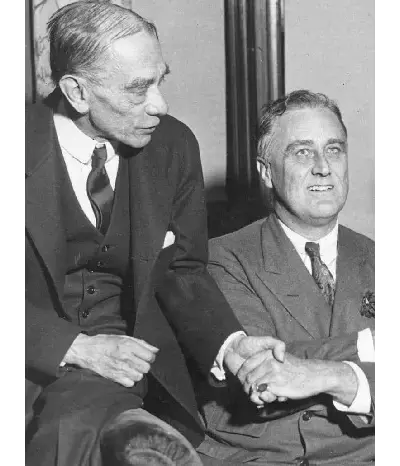
Louis McHenry Howe was an American reporter for the New York Herald best known for acting as an early political advisor to President Franklin D. Roosevelt.
