Andrew Johnson Quotes
Congress, factious, domineering, tyrannical Congress has undertaken to poison the minds of the American people, and create a feeling against me in consequence of the manner in which I have distributed the public patronage.
Andrew Johnson, 1808-1875, 17th President of the United States (War Democrat), Speech, Cleveland, September 3, 1866
Sourced by: Eigen's Political and Historical Quotations


Congress at that time had about a 12 percent public approval rating. Other emergency disaster appropriations had been made in previous years in days or weeks, but the aid for New Jersey, New York and Connecticut had been voted by the Democratic-controlled Senate but not in the Republican controlled House. The Republican House leadership had planned a vote after the Fiscal Cliff vote the previous evening before the end of the Congressional term. Then the speaker cancelled the vote infuriating Christie and many of the members of Congress. His reason was that there was opposition from the Tea Party Conservative wing of his own party who had just been badly beaten on the fiscal cliff legislation, and the Speaker was up for reelection by his own party caucus the following day. If the vote had proceeded, it would have passed with Democratic and some Republican support but with the opposition of the conservative wing some of whom noted that the states seeking the emergency aid had just recently voted for President Obama and they were opposed to more federal spending despite the fact that emergency aid had never before been subjected to such partisan criteria. After much pressure, the Speaker then committed to an up or down vote in the following Congress to the chagrin of some of the Tea Party members. Governor Christie, much admired for his commitment to his state and not politicking was his candid self but he did not even go as far as Republican Congressman Peter King {630995}.

He was expelled from Parliament for such.


In 2015, a group of hyper-partisan Republicans initiated yet another investigation of the attack on an American Consulate in Libya where the U. S Ambassador was killed. The incident had occurred when Hilary Clinton had been Secretary of State some time earlier. However, she was then the leading Democratic Candidate for President, and some Republicans wanted to question her under oath in the hopes that they could find something to embarrass her and derail her surging campaign. Hanna and a few other Republicans admitted the truth as they were opposed to the abuse of the Congressional power to investigate for partisan purposes. However, the reaction against Hanna by some members of his own party was extremely harsh. The theory of the Hanna critics was that telling the truth was in this case highly embarrassing to the Party and damaged the credibility of many accusations made against Mrs. Clinton who turned the tables on the investigators in when they questioned her for over 11 hours straight, and despite the total absurdity of the hearing and the questions—all of which had been asked before, she comported herself with Presidential dignity and pretended to take the hearings very seriously and answered the same loaded questions repeatedly. See {582957} for his earlier statements.


Samuel Langhorne Clemens, 1835-1910

The United States had just ousted the popularly elected leader Patrice Lumumba {640611}, and backed Mobuto. Lumumba was an idealist who was not corrupt at all, but were not so sure about our new protégé. Sadly he turned out to be one of the worst kleptocrats of all time, and he stole with more United States money than we gave to many nations in toto. Many believe that one of the reasons, corruption of our “allied” leaders was so bad lies in the wording of this cable. Note that to the State Department writers there was “normal” corruption as opposed to excessive corruption. Once that view is taken there is a constant battle to determine whether each new act of corruption is “normal “ or not, and corruption is simply lessened by pushing back against the most abnormal schemes. These critics advocate a zero tolerance for corruption especially with United States AID money. The State Department has been ambivalent and have often used the corruption system to bribe leaders to obtain national objectives.


President Andrew Johnson had been impeached by the House of Representatives and was being tried in by the Senate. A majority of the Senators voted for conviction but the vote was 1 short of the two-thirds that were needed. Johnson remained in office. These were two of the charges against Johnson. A Century later Presidents commonly did both of these. George W. Bush made reappointment of Senate rejected nominees into an art form but after the Johnson trial, these were never to be considered reasons for impeachment again.


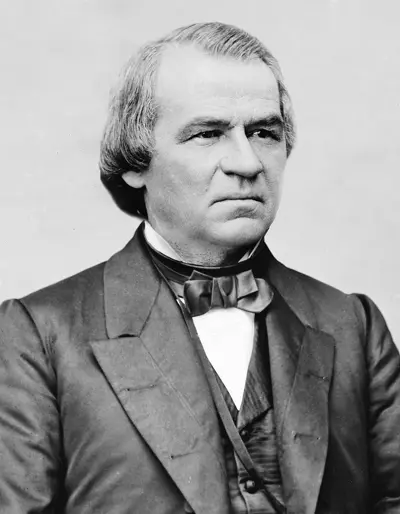
Andrew Johnson was the 17th president of the United States, serving from 1865 to 1869. He assumed the presidency as he was vice president at the time of the assassination of Abraham Lincoln. Johnson was a Democrat who ran with Lincoln on the National Union ticket, coming to office as the Civil War concluded. He favored quick restoration of the seceded states to the Union without protection for the former slaves. This led to conflict with the Republican-dominated Congress, culminating in his impeachment by the House of Representatives in 1868. He was acquitted in the Senate by one vote.
