Leo XIII Quotes
Books of apostates, heretics, schismatics, and all other writers defending heresy or schism or in any attacking the foundations of religion, are altogether prohibited.
Leo XIII, Pope. Officiorum ac Munerum: Apostolic Constitution of Pope Leo XIII. Vatican Polyglot Press, 25 Jan. 1897.


In his preface he lists the objections that the religious authorities had made to allowing common people to read the Bible. The priests were in danger of losing their monopoly in telling people how God required them to behave. Note that one of the objections was that it was impossible to render an accurate translation of the scriptures. Although some of the scholars realized that the Latin version of the Bible was itself a translation from Aramaic, Greek and Hebrew, most men of the era thought that the Latin version was the only version of the Bible. Tyndale wanted to bring the Gospels and the Old Testament to every Englishman, and he did just that. He was however burned at the stake for his “heresy.”

At the time Islam was quite conflicted about the role of innovation, science and reform. Innovators were to many theologians as dangerous to society as heretics and had to be refuted. Al-Ashari’s school of thought has prevailed in much of the Muslim world to this day.


Giovanni Battista Cibo. This was quoted in the Malleus Maleficarum, the man legal handbook used for centuries for the discovery and punishment of witches.

Lotario de' Conti

The King, a religious fanatic, was a great supporter of the Inquisition whose excesses were even more horrible during his reign than others.

The Christian Roman Empire was split in two—a Western (Latin) Empire led by the Roman Catholic Church in Rome, and the Eastern (Greek) Roman Empire led by the Orthodox Church headquartered in Constantinople (Byzantium). The two churches were not only in a theological conflict but violence broke out and the armies of the two religious empires attacked each other now and then. In 1439, leaders of the two versions of Christianity met in Florence, and they agreed to reunuion in which the Eastern Orthodox would again acknowledge the authority of the Pope. This was not a popular agreement with the majority of the Eastern Orthodox people and some of the clerical leadership. Constantine, realizing that he did not have pubic support at home for the end to the schism and the acceptance of the authority of the Pope, kept stalling on officially announcing and implementing the unity treaty. The Pope’s patience was wearing thin. Constantine did not adhere to ther treaty and the two churches have been apart ever since.
The Church exercised the law enforcement and censorship authority in all Catholic countries. Note the offense of saying anything which is “offensive to pious ears”. The particular example that “offended” the pious was that a heretic should not be executed. These were the cultural values of the day.

While Aquinas brought much wisdom and good to the Church, this statement and others laid a foundation for murdering non-believers and organizing the Inquisition.
In this speech, and in {634756}, he argued against unification to a public that was mostly opposed. The leadership was interested because they were facing the Muslim Ottoman Turks who were getting more powerful each day. The Eastern Emperor, Constantine XI, more of a soldier and politician than a cleric, wanted the military strength of the Franks and other Western European Christian armies to help protect the Eastern Empire and Byzantium and were willing to reunite under the Pope to get it. Gennadios and his faction were not. They prevailed and the next year, the Muslims conquered Byzantium which had little help from the armies of the Western Roman Empire.
The Christian Roman Empire was split in two—a Western (Latin) Empire led by the Roman Catholic Church in Rome, and the Eastern (Greek) Roman Empire led by the Orthodox Church headquartered in Constantinople (Byzantium). The two churches were not only in a theological conflict but violence broke out and the armies of the two religious empires attacked each other now and then. In 1439, leader of the two versions of Christianity met in Florence, and they agreed to reunuion in which the Eastern Orthodox would again acknowledge the authority of the Pope. This was not a popular agreement with the majority of the Eastern Orthodox people and some of the clerical leadership including Gennadios who had dissented in 1439 and voted against unification. In this speech, and in {634755}, he argued against unification to a public that was mostly opposed. The leadership was interested because they were facing the Muslim Ottoman Turks who were getting more powerful each day. The Eastern Emperor, Constantine XI, more of a soldier and politician than a cleric, wanted the military strength of the Franks and other Western European Christian armies to help protect the Eastern Empire and Byzantium and were willing to reunite under the Pope to get it. Gennadios and his faction were not. They prevailed and the next year, the Muslims conquered Byzantium which had little help from the armies of the Western Roman Empire.


He had whipped the crowd up into a feverish pitch until someone rushed the bound and tied blacksmith and stabbed him to death. He had only criticized Mathias for being too harsh and stern a leader.
As a result of Henry VIII establishing himself as the head of the Church in England and Ireland in place of the Pope, Henry’s heirs also became head of the Church. And that was the role that Queen Elisabeth had inherited in addition to the Crown. Many of those loyal to the Pope found most offensive the fact that a woman was making decisions for men and women on matters of faith. A Papal representative travelled with FitzGerald and probably helped him compose this document of which this is but 2 sentences. He may have drafted it completely. The Pope was a factor in many of the Irish rebellions against the English, and this caused great suspicion of all English Catholics whose loyalty to the Queen was in conflict with their loyalty to the Pope who was plotting for a Catholic takeover of England and Ireland.


Actually, many religions have had relatively sudden flip flops or changes in doctrine. Most of these make it easier for the religion to function in the then modern world. The abandonment of plural marriages by the Mormons, and the abandonment of the requirement of circumcision by the early Christians are but two examples. Being religions they do not ascribe the reason for change as refutation of scientific evidence, but in both of these cases, the new doctrine solved very real existing problems the religion was facing.

In the terrorists perverted logic, infidels are to be killed therefore all Iraqis who would vote would be targeted. Numerous Iraqi election officials were murdered by the terrorists as well as Iraqis who registered to vote.
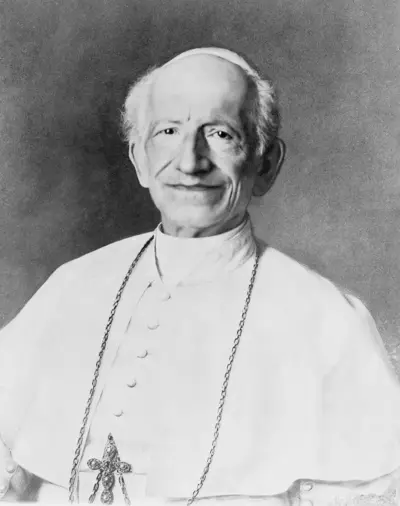
Pope Leo XIII was the head of the Catholic Church from 20 February 1878 to his death in 1903. He was the oldest pope (reigning until the age of 93), with the exception of Pope Benedict XVI as emeritus pope, and had the third-longest confirmed pontificate, behind those of Pius IX (his immediate predecessor) and John Paul II.
