John Quincy Adams Quotes
At the establishment of the Federal Government under the present Constitution of the United States the principle was adopted of considering them (Native Americans) foreign and independent powers and also as proprietors of lands. They were … considered as savages, whom it was our policy and our duty to use our influence in converting to Christianity and in bringing within the pale of civilization. As independent powers, we negotiated with them by treaties; as proprietors, we purchased of them all the lands which we could prevail upon them to sell; as brethren of the human race, rude and ignorant, we endeavored to bring them to the knowledge of religion and letters. The ultimate design was to incorporate in our own institutions that portion of them which could be converted to the state of civilization. Before our Revolution, they had been considered as children to be governed; as tenants at discretion, to be dispossessed as occasion might require; as hunters to be indemnified by trifling concessions for removal from the grounds from which their game was extirpated. In changing the system it would seem as if a full contemplation of the consequences of the change had not been taken. We have been far more successful in the acquisition of their lands than in imparting to them the principles or inspiring them with the spirit of civilization… when we have had the rare good fortune of teaching them the arts of civilization and the doctrines of Christianity we have unexpectedly found them forming in the midst of ourselves communities claiming to be independent of ours and rivals of sovereignty within the territories of the members of our Union. This state of things requires that a remedy should be provided -- a remedy which, while it shall do justice to those unfortunate children of nature, may secure to the members of our confederation their rights of sovereignty and of soil.
This is a particularly good historical quotation describing the state of the Native Americans and the different policies that had been adopted before and after the American Revolution. The President candidly admits there were unexpected consequences to American efforts after the Revolution and that some of the original objectives for the Indians had not been successful. He states some of the problems and notes the challenge ahead to resolve them equitably. After Adams was succeeded by Andrew Jackson, the new President and the forces he represented decided that the land and sovereignty over the land for America was more important than the other objectives which had not been successfully met very often. The age of rank discrimination and Indian removal began.
John Quincy Adams1767-1848, 6th President of the United States (Independent, MA), State of the Union Address, Washington, DC, December 2, 1828
Sourced by: Eigen's Political and Historical Quotations

“Cleaned out” meant destroyed. He had been a strong advocate of peace with whites. See {610679} .


The central Indian policy problem for Jefferson’s Administration was the fact that most Indians hunted for subsistence and the amount of land needed to support a hunting society was per capita much greater than an agricultural and especially an industrial one. Jefferson had no personal animosity against the Indians as many in his day did. But he perceived the need to obtain Indian lands for white agricultural use.
While Jefferson was clear on this point, there were other forces and points of view that did not recognize Indian rights and were prepared to use force to obtain Indian lands. These, together with some Indians who made bad and sometimes corrupt bargains and treaties ceding land, produced the loss of most of the Indian land in America.


The Iroquois were among the most sophisticated of the North American Indian Tribes. They also were highly assimilated into the American society. In the next decades, they would switch their political position when New York State provided better legal guarantees for Iroquois land than the Federal Government. By the end of the 20th Century, led by the Iroquois, the Indian residents of New York State had the same level of earnings as the white man—and that was with NO INDIAN GAMING.

This is one of the first Policy Statements of the new Republic about the Indians. Essentially, although the government policy was reasonable and fair, public opinion was totally different and the leadership could not persuade the people on this point. One complicating factor was the fact that most of the Indian tribes had overtly or covertly sided with the British in the Civil War. Many Indians were exiled to Canada. Even the Indians who were American allies, had their lands encroached upon however.
Jackson’s policies regarding Indians set back all the work of the earlier Presidents and created facts on the ground and attitudes that vex us to this day. In this occasion he said very forthrightly that it was his intention to deny Indians title to ANY land in the then United States. His idea was to send all the Indians to the Oklahoma Indian Territory and establish reservations for them there. Of course, as the Western states joined the Union, the Whites wanted those Indian Lands as well. See {643150} for other Jackson views on Indian policy.

Note that there was still a serious attempt to coexist with the Indians and to pay for lands that whites moved into. This would change radically in the administration of Andrew Jackson who would replace Adams.
More and more whites had been encroaching on land of the Chickasaw Reservation which the United States was bound to protect. However, soldiers fighting whites was politically unpalatable and the Government came up with the idea of providing land West of the Mississippi as a new reservation in exchange for the existing reservation. The Indians expenses of moving would be paid and they would be given generous provisions in the new lands. The U. S. negotiators were surprised when the translator for the Chickasaw negotiators made this speech which was then reported to the President and Congress. Andrew Jackson was strongly in favor of Indian Removal and he had forced other tribes out of their lands. Eventually the Government upped the ante and agreed to pay the Chickasaw the large sum of $3 million to move and they Chickasaw realized that if they did not accept, they would be removed as other tribes had been, The promised payment was delayed over Congressional arguments over appropriations but eventually the Chickasaw were paid.
Published 100 years after it was written. This is the first known written statement of what became a de facto policy regarding the American Indian.

This law governed the territories outside of the original 13 colonies. The intentions of the founding fathers and the first Congress to the Indians was fair and honorable. However, there was no practical way that the new Federal Government could enforce this principle in the territories. A single greedy land speculator or trader could abuse a group of Indians and start a small war. The vast cultural differences between Indians and whites tended to polarize all violent conflicts regardless of who was at fault. The different perceptions of cruelty and atrocities further pushed the government to defend whites violating national policy and there was sufficient corruption and money to be made on Indian land and trading and things went downhill fast.

There were a few members of Congress who were distressed at the deception that was very often used in negotiations with Indians. They never were a sufficient majority to pass serious, meaningful legislation.

First Published American Indian Author
When the first Southern States seceded, each appointed a whose job it was to persuade the other Southern States to also secede. In this case Hale was marketing secession to Kentucky which with Maryland were the only two Southern States to reject what they regarded as treason and rebellion. The importance of the quotation however is in his argument which was all based on enmity to racial equality and abolition. Later Southern apologists would argue that the Civil War was fought, not about slavery and racism butt about different philosophies of government. See {623715} .
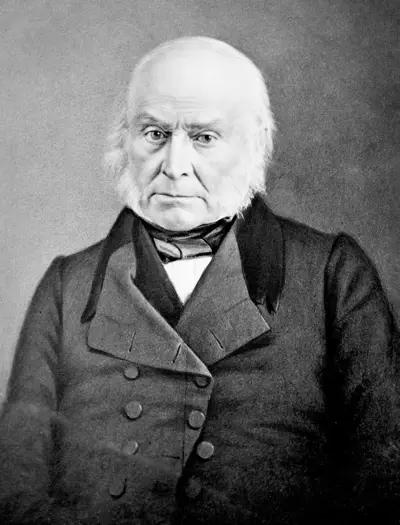
John Quincy Adams was an American statesman, diplomat, lawyer, and diarist who served as the sixth president of the United States, from 1825 to 1829. He previously served as the eighth United States Secretary of State from 1817 to 1825. During his long diplomatic and political career, Adams also served as an ambassador, and as a member of the United States Senate and House of Representatives representing Massachusetts. He was the eldest son of John Adams, who served as the second U.S. president from 1797 to 1801, and First Lady Abigail Adams. Initially a Federalist like his father, he won election to the presidency as a member of the Democratic-Republican Party, and in the mid-1830s became affiliated with the Whig Party.
