House of Commons Quotes
Alex. Nowell, being Prebendary in Westminster, and thereby having voice in the Convocation House, cannot be a member of this House... .
i.e., a clergyman representing a congregation The theory of this particular expulsion applied not to clergy in general, but to clergy who represented a Congregation. In the absence of strict separation of church and state, clergy representing congregations had representative and legal roles in other aspects of the government and therefore represented a problem of separation of powers within the government. The same logic, for example prohibited Sheriffs and Tax Officials from the House of Commons as well as Judges sitting in the Lords. With strict separation of church and state however, the separation of powers argument does not hold, and hence there is no such current prohibition. However, at the end of the 20th century, the Roman Catholic and some other religious institutions had reached the conclusion that clerics serving as elected representatives to various civil legislative bodies potentially had an inherent conflict of interest and divided loyalty and banned the practice from the religious end although the civil laws did not preclude it.
House of Commons, First Elected Member Expelled from the House, 1553
Sourced by: Eigen's Political and Historical Quotations


Carroll was writing to Troy during the time of the question of Catholic emancipation in England. Here he is clearly alluding to the British form of government. Carroll never missed the opportunity to champion religious freedom as manifested in the U.S. Constitution. For an earlier example of his praise for religious freedom, see {596933}.


This was before the state had officially sanctioned and accepted the church. Most of the institutions were pagan and the kings had subjects of both religions with Christianity not yet dominant. Yet among Christians, the Church had government temporal power, even before the church was allied with the state.

For those who doubt that there was intended a rigid separation between church and state, they have but to contemplate this passage. However, at about the same time, the State of South Carolina moved in its constitution in an opposite direction. See {612573}. When the framers of the Constitution met in 1787 in Philadelphia the separation of church and state issue was not really resolved and awaited the Bill of Rights where the separatists won out.

This concept is not terribly different from the concept of the theocracy of the Islamic government of Iran in the 21st century. There is a civil government but it serves and is “under the direction of the spiritual power.”


This was often referred to as “The Golden Bull.” The Church clerics formed the judiciary for civil as well as religious matters. In time Catholic Europe would separate the judicial authority between religious and civil courts, the final step was to bring clerics and the church under the civil control and authority which was fought vehemently by the church which for years tried to retain at least the right to try priests and other church officials even for civil crimes.


This quotation illustrates how the power and mechanism of an established church operated to control ideas and maintain theological monopoly. In this case, no one could sell or rent any facility in the city to a cleric or church of any kind or persuasion without first having the approval of the Bishop who had theological control of that territory. Even Catholic scholars could not rent a room in the city unless their scholarship met with the Bishop’s approval. This was history with which the American Founding were very familiar, and wanted to avoid by adopting the 1st Amendment.


_0_thumbnail_47x47.jpg "Statue of Robert Hall in Leicester.")
Many of the founding fathers were aware of such views in England as the same issues were being debated in America in the debates on Ratification of the Constitution and the required inclusion of the Bill or Rights—specifically the First Amendment.


The clergy of the colonies were split on the American Revolution, but those clergy who supported the revolution made a huge contribution to the individual American’s intellectual view of the legitimacy of Parliament’s making laws governing the American Colonies. The anti-British clerics called for action while other forces of colonial America urged caution.

This was his perception of the change in Parliament in the 64 years he was in that body. Bribery, for example, was then commonplace for American and British legislators. By the 21st century the money spent by the rich and corporations to by legislative outcomes was many times as great but had been covered over by the fig leaf of campaign and party contributions.


New York State was so concerned about the separation of church and state that they would not allow any religious cleric or official, to serve in any position of the state militia or government. Delaware had earlier placed the same prohibition against clerics serving in any branch of the government. See {621428} The Bill of Rights did not go that far, but there are a few religions that also support this notion. Perhaps the most dramatic example was Pope John Paul’s prohibition of Priests running for elective office.
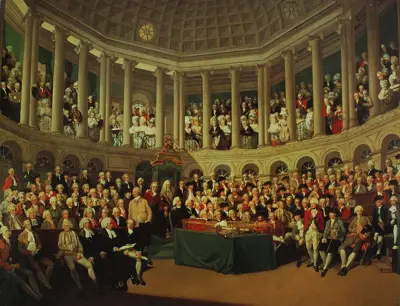
The House of Commons is the name for the elected lower house of the bicameral parliaments of the United Kingdom and Canada. In the UK and Canada, the Commons holds much more legislative power than the nominally upper house of parliament. The leader of the majority party in the House of Commons by convention becomes the prime minister. Other parliaments have also had a lower house called a "House of Commons".
