John Stuart Mill Quotes
A man who has nothing which he is willing to fight for, nothing which he cares more about than he does about his personal safety, is a miserable creature who has no chance of being free, unless made and kept so by the exertions of better men than himself.
John Stuart Mill, 1806-1873, Member of Parliament, British Political Economist, “The Contest in America,” Fraser’s Magazine, February 1862
Sourced by: Eigen's Political and Historical Quotations


Thompson’s son was serving with U. S. forces in the Iraq War at the time.


The Prime Minister, Neville Chamberlain, preceded him with the announcement of declaration of war against Germany, but it was left up to the Foreign Minister to explain the implications. This was the first time in history that a nation had used radio to communicate such momentous events to its population.


Referring to the British war dead:


He drove the British into the sea when no one expected that outcome.


Ataturk was a young major at the time commanding troops of a weak and corrupt Ottoman regime. However a combined English and French (the strongest military powers in Europe) invasion of the Gallipoli Peninsula threatened to capture the Turkish capital, Constantinople. Ataturk alone rallied the Turkish defenders and fought the invaders to a standoff in long drawn out battle with huge casualties on both sides. Ataturk became a national hero. Although Ataturk thereafter was very reluctant to use military force or endanger troops, the thing he always thought worth the supreme sacrifice (including his own) was the independence and sovereignty of the nation. See {584502} for his continuing belief in this type of sacrifice.
Some apologists for the Muslim Brotherhood claim that the organization is social and political and not violent or advocates of terrorism. However, quotations like this one calls clearly for the sacrifice of lives. Hamas, a recognized terrorist organization is the Palestinian Branch and Offshoot of the Muslim Brotherhood which has never repudiated any of their terrorist murders and actively raises money for Hamas. See the original founding principle of the Muslim Brotherhood—{621776}

The American Army had just liberated Bellau Wood, but had lost almost 8,000 men.
It was then customary to return with the head of a killed Samurai which would be made up as if in life so the dead man could be recognized. That way, the victor received more recognition with the importance of the Samurai who he defeated.

This statement is perhaps the greatest and most eloquent description of the United States exceptionalism and its behavior in WWII. Such a statement could only come from a non-American.

Drumbo was morally opposed to war. He also refused to name Hollywood communists to Congressional Committees during the Red Scare. He was then blacklisted from his occupation, screen writing.

This line was used in the WPA Federal Theater Project. The play was closed down, because the State Department was distressed that the Federal Theater quoting heads of State might be insulting to the world leaders. Mussolini was another character in the play and he was depicted as the boorish thug that he turned out to be. It was that which offended the government officials who closed the show before it could open. FDR used a similar line 6 years later. See {32529} . Dolores Ibarruri in the Spanish Civil War is quoted with a similar phrase at about the same time. See {604321}


An example of this was the landing in the beaches of Normandy in WWII. Once on the beaches the allied troops had to win or die. Some of the most heroic fighting in American and English military history occurred on those beaches. Another was the Spanish Explorer Hernando Cortez who after landing in the New World, had his ships burned so that he and his soldiers had to conquer or they would die.
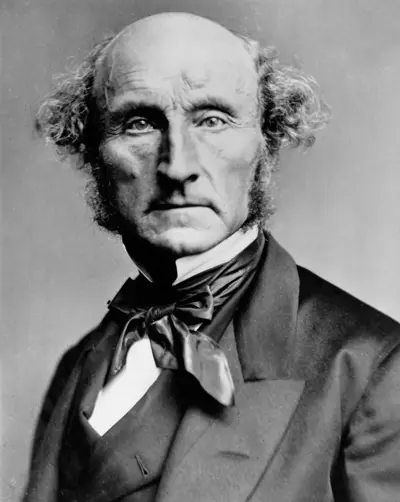
John Stuart Mill, usually cited as J. S. Mill, was an English philosopher, political economist, Member of Parliament, and civil servant. One of the most influential thinkers in the history of classical liberalism, he contributed widely to social theory, political theory, and political economy. Dubbed "the most influential English-speaking philosopher of the nineteenth century", he conceived of liberty as justifying the freedom of the individual in opposition to unlimited state and social control.
