NGO DINH DIEM
(Ngô Đình Diệm)

During the Vietnam War there was much American disaffection with South Vietnam President Ngo Dinh Diem. The then Vice President was cautious about supporting a coup against Diem despite his shortcomings:

Hunt was being questioned about his forgery of a State Department cable linking the Kennedy administration to the assassination of President Ngo Dinh Diem of South Vietnam:

He had just assumed his post 6 days earlier. At this point he did not have enough knowledge to favor or oppose the regime change, but he did realize that the decision was a serious one and there would be no turning back. Diem was a creature of the Central Intelligence Agency. An anti-Communist Christian in a Buddhist county, the CIA engineered his rise to power, created his political party, provided him with cash to bribe other Vietnamese politicians, and paid for all the propaganda so he would “win” the Presidential elections. However, he abused the Buddhists, was thoroughly corrupt and ran a corrupt administration, but worst of all from the American point of view, he was unable to motivate the South Vietnamese population to fight the Communists. He reached the point where he was more of a liability, and the Central Intelligence Agency engineered a coup d’etat to remove him from power and replace him with a President more to our liking. (See {634540}.)

President Ngo Dinh Diem of South Vietnam Diem was a creature of the Central Intelligence Agency. An anti-Communist Christian in a Buddhist county, the CIA engineered his rise to power, created his political party, provided him with cash to bribe other Vietnamese politicians, and paid for all the propaganda so he would “win” the Presidential elections. However, he abused the Buddhists, was thoroughly corrupt and ran a corrupt administration, but worst of all from the American point of view, he was unable to motivate the South Vietnamese population to fight the Communists. He reached the point where he was more of a liability, and the Central Intelligence Agency engineered a coup d’etat to remove him from power and replace him with a President more to our liking. (See {634540}.) Another reason this quotation is important is that it demonstrates the involvement that the Attorney General had with foreign and defense policy. Normally the Attorney General has nothing to do in these areas and is not even in the loop. But Robert F. Kennedy was also the President’s brother, and his advice was sought by President Kennedy on almost all matters. He was probably the most influential attorney general in American history.

Diem was a creature of the Central Intelligence Agency. An anti-Communist Christian in a Buddhist county, the CIA engineered his rise to power, created his political party, provided him with cash to bribe other Vietnamese politicians, and paid for all the propaganda so he would “win” the Presidential elections. However, he abused the Buddhists, was thoroughly corrupt and ran a corrupt administration, but worst of all from the American point of view, he was unable to motivate the South Vietnamese population to fight the Communists. He reached the point where he was more of a liability, and the Central Intelligence Agency engineered a coup d’etat to remove him from power and replace him with a President more to our liking. (See {634540}.) Though not planned that way, the South Vietnam military officers who we backed in the coup, then murdered Diem, who although ineffective and unsuccessful, he had been a friend and ally of the United States.

To depose President Ngo Dinh Diem of South Vietnam Conein was one of the first American intelligence operatives in Vietnam. Diem was a creature of the Central Intelligence Agency. An anti-Communist Christian in a Buddhist county, the CIA engineered his rise to power, created his political party, provided him with cash to bribe other Vietnamese politicians, and paid for all the propaganda so he would “win” the Presidential elections. However, he abused the Buddhists, was thoroughly corrupt and ran a corrupt administration, but worst of all from the American point of view, he was unable to motivate the South Vietnamese population to fight the Communists. He reached the point where he was more of a liability, and the CIA, through Conein, engineered a coup d’etat to remove him from power and replace him with a President more to our liking. Though not planned that way, the South Vietnam military officers who we backed in the coup, then murdered Diem, who although ineffective and unsuccessful, had been a friend and ally of the United States. Even President Kennedy felt badly about the outcome. See {634539}.

even though in this case the objective The State Department, the Defense Department and most important President Kennedy had decided to get rid of Diem. Most of the Central Intelligence Agency thought that this was a very unwise policy, because Diem was a known risk, and the people who would replace him and their talents and policies were unknown. The negatives of Diem—the facts that he, a Christian, was persecuting the majority Buddhists, was totally corrupt, and not a very good leader was less distressful to the CIA than to the President and the other agencies as the intelligence agency frequently not only tolerated “offensive” allies, but actually employed them including war criminals. Another importance of this quotation is that it shows that it was by no means certain that the CIA would always follow the orders of the President and the government policy makers. Colby, who was not the agency director at that time but was the head of the South East Bureau, was one high level official who argued that the policies should always be followed even if they were unwise or foolish. Another importance of this quotation is that it illustrate a common error that administrations are frequently forced to make: making a policy decision to eliminate a problem while not having much of an idea of what the alternative or consequence would be when the policy is implemented. The Syrian Civil War in 2013 was a good example. The Government side appeared to have used Chemical Warfare on Civilians and public opinion demanded that we do something. However, having a no-fly zone or any of the alternatives to prevent (punish) the government for the Chemical Warfare would strengthen the rebel side which was made up of numerous factions—some of which were known Islamic fundamentalist terrorists and jihadists. If the balance of power were tipped toward the rebels, the consequence for the American national interests were unknown—just as the consequence of ousting Diem was unknown and turned out to also be bad and was probably worse.

Most Americans had not then realized that American troops had gotten involved in the Vietnamese Civil War. For some this was shocking. Kennedy helped his brother, President Kennedy, arrange for a coup to replace President Ngo Dinh Diem in which the man we pledged to “stand by” was murdered. He turned out to be thoroughly corrupt, and had little if any more respect for democracy and human rights than the North Vietnamese leadership did. Nonetheless we broke a pledge to an ally. This and similar promises that are not kept complicates American diplomacy as there is rarely complete trust in the pledges of American officials.

South Vietnamese President Diem was thoroughly corrupt, and had little if any more respect for democracy and human rights than the North Vietnamese leadership did. Worse we scorned the intellectuals in his own country.
Diem appointed his relatives and cronies to his cabinet and other key political positions, and allowed the legislature to meet infrequently thereby having his family control the country.
Diem appointed his relatives and cronies to his cabinet and other key political positions, and allowed the legislature to meet infrequently thereby having his family control the country.
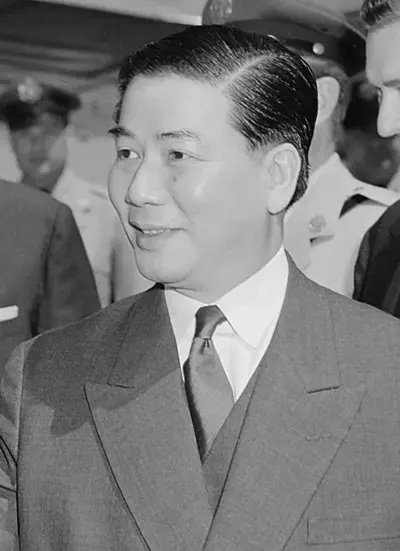
- Born: January 3, 1901
- Died: November 2, 1963
- Nationality: Vietnamese
- Profession: Statesman
Ngô Đình Diệm was a Vietnamese politician. He was the final prime minister of the State of Vietnam (1954–55), and then served as President of South Vietnam (Republic of Vietnam) from 1955 until he was deposed and assassinated during the 1963 military coup.
