Bertolt Brecht Quotes
Would it not be easier...for the government to dissolve the people and elect another?
Bertolt Brecht, 1898-1956, German Dramatist, ~ 1953
Sourced by: Eigen's Political and Historical Quotations


This is an interesting historical quotation. In 1917, Joseph Stalin, was for democracy and elections with rule by the majority. Once he and his party gained control, the democratic idea of free elections with competition evaporated.


This constitution, 13 years later, became the basis for the national Batavian Constitution.

His faction won on the House and lost with respect to the Senate.


the Electoral College system that we have

Helen Keller was a remarkable woman who was blind and deaf, and yet she became a great orator and social reformer.


Bartolo was the most famous legal expert of his day and for many years thereafter as he died at the age of 44—the height of his career. In Italy, Spain and other nations of Europe there were statutes passed that said if there was no precedent in Roman Law, the writings of Bartolo should dictate the law.


Jefferson and a number of other Founding Fathers were so against aristocracy and monarchy that the assumed that the only way to prevent it was to have all government officials subjected to annual elections. Jefferson was not at the constitutional convention, while annual elections were considered, the compromise that became the Constitution required 2 year elections for the House and 6 years for the Senate with 4 years for the Presidency.


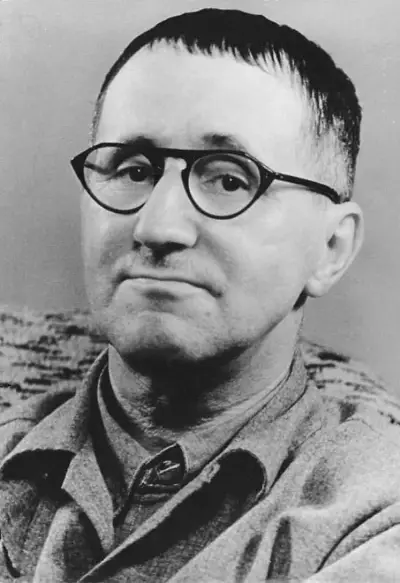
Eugen Berthold Friedrich Brecht, known professionally as Bertolt Brecht, was a German theatre practitioner, playwright, and poet. Coming of age during the Weimar Republic, he had his first successes as a playwright in Munich and moved to Berlin in 1924, where he wrote The Threepenny Opera with Kurt Weill and began a lifelong collaboration with the composer Hanns Eisler. Immersed in Marxist thought during this period, he wrote didactic Lehrstücke and became a leading theoretician of epic theatre (which he later preferred to call "dialectical theatre") and the so-called V-effect.
