John Marshall Quotes
The government of the Union, then, ... is, emphatically, and truly, a government of the people. In form and in substance it emanates from them. Its powers are granted by them, and are to be exercised directly on them, and for their benefit.
John Marshall, 1755-1835, Chief Justice of the U. S. Supreme Court, U. S. Congressman (Federalist, VA), U. S. Secretary of War, U. S. Secretary of State, McCulloch v. Maryland, 1819
Sourced by: Eigen's Political and Historical Quotations

This quotation had a close proximity to Lincoln’s Gettysburg Address (see linked quote). Although this was probably Lincoln's most famous line, it was not totally original. John Adams came close in a 1774 proclamation (see linked quote). As did John Marshall in his McCulloch v. Maryland decision (see linked quote). There was also Thomas Cooper in 1795 (see linked quote). But the earliest close phrase use appears to be the English cleric, John Wycliffe, in 1382 (see linked quote). It is not known with which of these Lincoln was familiar.

This quotation had a close proximity to Lincoln’s Gettysburg Address {458852}. Although this was probably Lincoln's most famous, was not totally original. John Adams came close in a 1774 proclamation {598723}. As did John Marshall in his McCulloch v. Maryland decision. Daniel Webster's Speech on Foot's Resolution was very close {606471}. There was also Thomas Cooper in 1795 {598723} . But the earliest close phrase use appears to be John Wycliffe in 1382 {567292}. It is not known with which of these Lincoln was familiar,


_0_thumbnail_47x47.jpg "Statue of Robert Hall in Leicester.")
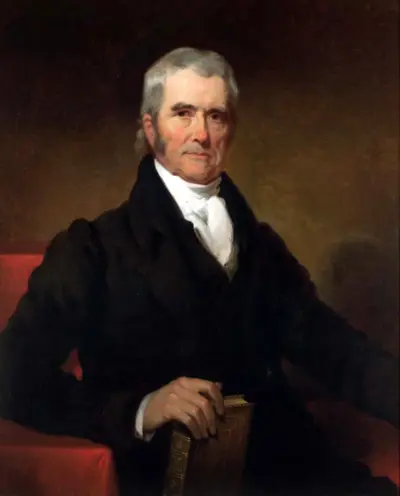
John Marshall was an American politician and lawyer who served as the fourth Chief Justice of the United States from 1801 to 1835. Marshall remains the longest-serving chief justice and fourth-longest serving justice in Supreme Court history, and he is widely regarded as one of the most influential justices to ever sit on the Supreme Court. Prior to joining the Supreme Court (and for one month simultaneous to his tenure as Chief Justice), Marshall served as the United States Secretary of State under President John Adams.
