Black Elk Quotes
White men come in like a river. They told us that they only wanted a little land. But we knew better.
Black Elk, 1863-1950, Oglala Sioux Holy Man, Quoted on The History Channel, America: The Story, May 28, 2011
Sourced by: Eigen's Political and Historical Quotations


Wayne played so many parts depicting whites in the process of expanding Westward that many people saw him as an expert on the history of the Westward Expansion. He did not comment on the whites who then kept huge ranches “selfishly” for themselves or those who selfishly would not share the mineral rich land that they had taken with anyone including the original Indian owners. So in this view, the Indians should have not been capitalists but they should have been socialists and shared their resources.


this is a joke Tutu has used, but variants of it exist which are not original to him.


When the British first colonized South Africa, the area they used was akmost uninhabited or very sparcely so. However, some Black tribes (including the Zulus) were moving from the north and themselves were colonizing or annexing the areas to their kingdom. The British were most interested in Trading so did not have large land asperations. The Dutch white Boer Africanners, in contrast, wanted to farm the lands and use the range for their cattle. They wanted the land. The English policy was that there would be friendly relations with the Black tribes surrounding their Cape Colony and no one should take their land. However the Boers started attacking the Black areas and seizing their farms and villages. At first, the English assumed that the Blacks would easily be able to ward off the invasion as the Afrikanners had no professional troops like the British. However, the neighboring tribes were not very warlike or good fighters. They were being overrun by the Zulus coming from the North and the Boers from the South. The British Government had a real problem in that they would have to have British soldiers fight the white Afrikanners if they wanted to stop the illegal white invasions. This was the root of the Boer War where the British would be fully at war with the Africanners.


First Published American Indian Author


This quotation is often used as the greatest evidence the white usurpation of Indian land and the dubious value of all the treaties that had been made with the Indians guaranteeing them specific lands. Jackson, however, was not completely accurate. The Iroquois who fought on the American side in the Revolution were still on their lands in New York State. However, the Iriquois had their dealings with the State and local governments, and fared better than those tribes that depended in the Federal Government—especially with racists like Jackson in the Presidency.

The highway was planned to go through a poor neighborhood which had a high percentage of Black residents—all of whom would have to find other housing and move to make room for the highway. If the government plans a highway through a wealthy area, the cost to condemn and pay for the land will be much greater than if a poor neighborhood is acquired. For urban highways, the poor almost always bear a disproportionate share of the inconvenience while the major benefit inures to the wealthy and middle class. Abbot had been a labor organizer and a professional artist before he entered politics. The graphic is of his famous poster which by itself stopped the plans to build the highway very quickly.

See {633119} for the basic provision of the Dawes Act.


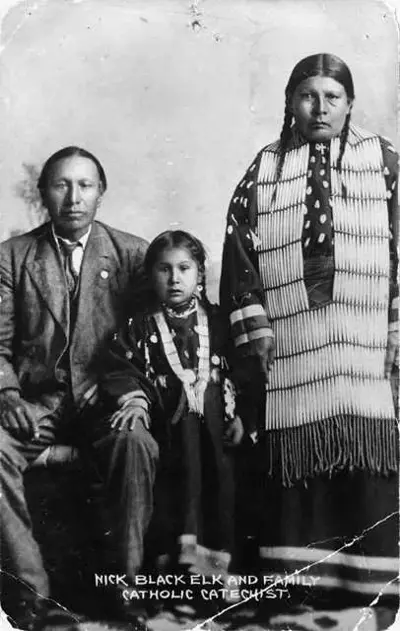
Heȟáka Sápa, commonly known as Black Elk, was a wičháša wakȟáŋ ("medicine man, holy man"), heyoka of the Oglala Lakota people and educator about his culture. He was a second cousin of the war leader Crazy Horse and fought with him in the Battle of Little Bighorn. He survived the Wounded Knee Massacre and traveled in Europe as part of Buffalo Bill's Wild West Show. He converted to Catholicism, becoming a catechist and the Roman Catholic Diocese of Rapid City opened an official cause for his beatification within the Roman Catholic Church in 2016. His grandson, George Looks Twice said, "He was comfortable praying with this pipe and his rosary, and participated in Mass and Lakota ceremonies on a regular basis".
