Sophia Louisa Jex-Blake Quotes
While women in Britain are prevented from studying for medical degrees… other European nations have taken a very different position. We have already seen the Italian Universities were in fact never closed to women, and that at Bologna no less than three women held Professors’ chairs in the Medical faculty. We have several instances of degrees granted to women in the Middle Ages by the Universities of Bologna, Padua, Milan, Pavia and others…
She was one of the first female physicians in England. However, she could not study there or sit for her examinations. She trained in the Scotland, Ireland and Swizerland where she earned her medical degree.
Sophia Louisa Jex-Blake, 1840–1912, English Physician & Feminist, Medicine as a Profession
Sourced by: Eigen's Political and Historical Quotations


This was one of the first higher educational opportunities for women in England. Note how they felt they had to justify higher education for women.


He gave a litany of ills that have occurred when women had been educated. He did not provide any of the counter examples.

This was her last public speech.


A Polymath is a genius in a number of different subjects. She learned her mathematics initially by listening in on her brother’s tutoring sessions. She published in mathematics, geography, physics, astronomy, and biology. Although her first husband was totally unsupportive as indicated in the quotation, after his death, her second husband was a great asset to her and assisted her in many ways.


The CAA was the Civil Aeronautics Administration, the forerunner to the Federal Aviation Administration (FAA).

Samuel Langhorne Clemens, 1835-1910. This is an excellent example of political sarcasm. Read literally, this quotation indicates that he was opposed to women’s suffrage, and was a fairly extreme sexist. What he was doing however, is stating publicly the argument that many men made at the time—especially those who were not highly literate or well-educated. By stating the argument of the opposition, he allows fair minded people to be exposed to views that they might otherwise not be exposed to. Many sexist men at the time read the quotation and, not appreciating Twain’s sarcasm, concluded that Twain, unlike most of the “egghead intellectuals” of the day was an opponent of the increasingly militant feminists. In actuality, Mark Twain was a strong feminist. See {630191}, {630192}, & {630193}.
At the time and for the next decade she was one of the few world leaders who made women’s equality and rights a major priority. But slowly American and European women and many men began to give higher priority to using foreign policy and foreign aid. Then women from Asia and Africa began to take up the issue and in the early 21st century even some women in the Islamic nations began to fight for women’s rights. Mrs. Roosevelt. However, was the first modern major and high visibility politician to make women’s rights a major international and national issue.

In English law, the second a woman married, she ceased to exist and an entity independent from her husband who had total control in the family. This doctrine was carried over to American law. See {629246}.

See {628477} for the Dean’s answer. Professor Brooks was about to be married and under the mores of the day and Barnard’s rules, married women were not allowed to work. They should be at home taking care of husband and children. Ironically, there are still a few conservatives who advocate a return to the old policy.

She was referring to Malala, a young Pakistani girl who was shot and badly wounded in an assassination attempt. She had publicly advocated girls attendance at school—a practice banned by the ultra-fundamentalist Taliban.


The concept of taxpayers being entitled to vote to avoid taxation without representation was fundamental to the Founding Fathers. However, the only people who paid taxes were those who owned property as there was no income tax at the time. Since the male controlled the family property, not allowing women to vote did no injury to the basic principle. However, the sexist attitude of the times ran up against this basic principles in the case of widows and unmarried women who owned property. Faced with this contradiction, some of the Founding Fathers like Lee actually favored the voting franchise for women who were widows and property owners or even unmarried female property owners. There were not enough people who saw this contradiction so that all women were originally prohibited from voting, but this quotation shows that it was a political issue at the time.

This observation has never been really taken seriously until the women’s movement stimulated historical and sociological studies to test such a hypothesis. More and more people are finding that Tocqueville may have been right on this point albeit still not a majority of scholarly opinion.
She was instrumental in outlawing slavery and two years after this speech she and her daughters appeared in public without the traditional Burka or veils. The conservative fundamentalists were outraged and they deposed her husband and her modern influence ended.
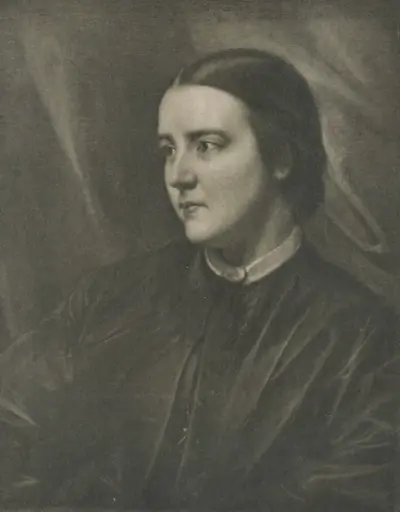
Sophia Louisa Jex-Blake was an English physician, teacher and feminist. She led the campaign to secure women access to a University education when she and six other women, collectively known as the Edinburgh Seven, began studying medicine at the University of Edinburgh in 1869. She was the first practising female doctor in Scotland, and one of the first in the wider United Kingdom of Great Britain and Ireland; a leading campaigner for medical education for women and was involved in founding two medical schools for women, in London and Edinburgh at a time when no other medical schools were training women.
