Damon Tweedy Quotes
Universities—and medical schools in particular—should go out of their way to recruit good students of every race from … less affluent backgrounds. Over time, such efforts could produce a greater cohort of doctors who are better prepared to relate to the patients who need them the most.
Damon Tweedy, Physician, “The Case for Black Doctors”, Op Ed, New York Times, May 17, 2015
Sourced by: Eigen's Political and Historical Quotations


Gates, a Black man, was one of the leading intellectuals in America. Until relatively recently, most schools had quotas of how many Blacks they would take. Many also had quotas for Jews, Asians and other minorities. It was affirmative action that started the change in racial discrimination in colleges and universities.


The recent FBI directors have had a difficult legacy to cope with. In the 1930s throughs the 1960s, the FBI (under J. Edgar Hoover), worked very closely with Southern, Racist, Law enforcement agencies who were constantly covering up and often participating in assaults and lynching of Blacks. Hoover, despite the fact that he was a closet gay, projected a very masculine FBI image and would not have female agents. Even in the Civil Rights movement local FBI offices were working closely with Southern law enforcement to suppress the Civil Rights demonstrations. Nationally, the FBI was not only illegally surveilling Martin Luther King, but Hoover who despised King actually had agents try and blackmail him and pressure him into committing suicide. So the legacy was not good for hiring women of Blacks and Jews, Hispanics, Asians and other minorities as well. Even when Comey made this statement, he was dealing with a group of highly conservative and racist FBI agents who were illegally leaking information that would help to swing the Presidential election to Donald Trump, who was opposed by most women and almost all blacks. So Comey had to persuade new recruits to enter the Bureau despite the legacy and existing component that would not be very comfortable for them. At the same time, the educational qualifications for the FBI were very high (unlike most local and stat law enforcement agencies). Most people who could meet them, could easily qualify for other jobs that paid more than the FBI so it took a good bit of desire and commitment to get anyone to join.


The returning GIs were entitled to have their tuition paid under the GI Bill of Rights. American educators were faced with a different population than what they were used to. These students were older and much more mature than the 17-19 year old regular students entering college. And they had been fighting a war since their high school education and their academic skills were rusty. With the Federal payment of tuition, the veteran students had a much more diverse socioeconomic background, and many did not have a very strong high school education to begin with. For a school like Brown, most of the veterans could not meet the usual entrance requirements. Brown and a few other schools created a special program where the veterans could refresh their high school work and take preparatory courses so that they could meet the school’s regular program requirements. It was called the “Veterans’ College”, and was designed for 2 years of study and then the veterans would enter regular college. The program and the others like it were very successful. The veterans worked much harder than the regular younger students. At Brown, of the 486 students attending Veterans’ College, 142 were admitted to the regular college after only 1 semester rather than the 2 years.

He was the first FHA administrator to make statements saying that non-discriminatory housing services should be available to the American people. At the time the Southern states had laws allowing and protecting legal segregation especially in housing. The Southern field staff interpreted his instruction to be sure that both blacks and whites had access to FHA services, but they used the “separate but equal” doctrine: Provide services to both races but always in segregated housing projects. This was typical of the kinds of problems that motivated the Civil Rights Acts offered by President Kennedy in 1963 and passed by President Johnson in 1964. See {637272} for a similar Mason statement.


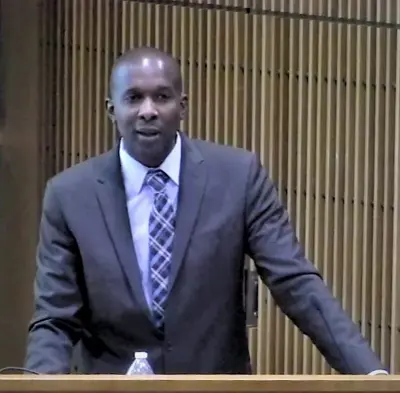
Damon Scott Tweedy is an American physician who is an associate professor of psychiatry and behavioral sciences at the Duke University School of Medicine. In 2015 Tweedy published his memoir, Black Man in a White Coat: A Doctor's Reflections on Race and Medicine.
