John Bright Quotes
Well, will anybody deny now that the government at Washington [America], as regards its own people, is the strongest government in the world at this hour? And for this simple reason, that it is based on the will, and the good will, of an instructed people.
John Bright, 1811-1889, British Member of Parliament (Liberal), Speech at Rochdale, November 24, 1863
Sourced by: Eigen's Political and Historical Quotations


The University Presidents had written to the American Public arguing that the German aggression was the result of the militarists in the German society dominating the people and pushing them to war. They argued that most German people were not really responsible. Lamprecht took exception and argued that the German policy was the democratic will of the majority of the German people. He claimed that Germany at the time was more of a de facto democracy than America—as the Untied States did not have a Voting Rights Act or any way of de facto ensuring that all citizens could vote—particularly Negroes in the South. While he was accurate about the voting aspects of a democracy, Germany neither had the Constitution nor a judiciary that was independent and co-equal to the executive and legislature, but Germany did not have the institutions with democratic traditions. The greatest embarrassment to modern Germans is that Adolf Hitler was actually elected by a majority of Germans and was very popular until things in Germany started to go poorly. This quotation is very important in that it shows the importance of a Constitution to limit the powers of even a popularly elected government.


Chief legal officer of a Dutch town. He wanted to have a plebiscite in each town on major issues before the assembly so as to instruct the representative as to how to vote. The graphic is a painting of Adriaan van Zeebergh and his board of the Teylers Stichting.


_0_thumbnail_47x47.jpg "Statue of Robert Hall in Leicester.")
For many people the implication of this quotation is that there should be no government secrets withheld from the citizens who have the right to examine. Others argue that government may have temporary secrets to protect against foreign enemies for example, but that these must be declassified very promptly so that the citizens can examine the actions of their government in time to replace the government if they are not satisfied. Almost all government officials tend to reject the first implication out of hand, and grudgingly accept the second with their discretion controlling when declassification should take place. The problem of America is twofold. There is much over-classification (material kept secret that should not be at all), and the time till declassification is long in general and truly absurd in many cases. For example, there are documents from WWII that by 2013 had still not been declassified. See {591444}, {641317}, and {589105} for exemplar views. William Jennings Bryan introduced this principle into the American political dialogue. See {641027}.


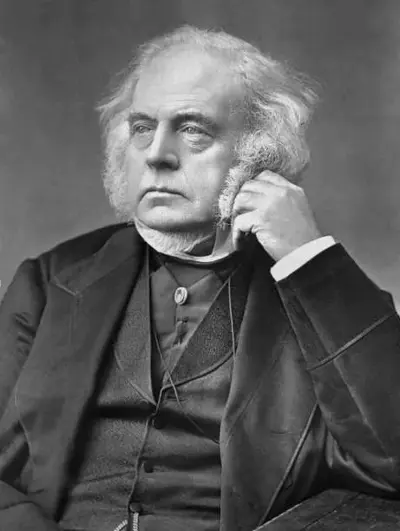
John Bright was a British Radical and Liberal statesman, one of the greatest orators of his generation and a promoter of free trade policies.
