Paul Robeson Quotes
We in America do not forget that it was the backs of white workers from Europe and on the backs of millions of Blacks that the wealth of America was built. And we are resolved to share it equally. We reject any hysterical raving that urges us to make war on anyone. Our will to fight for peace is strong...We shall support peace and friendship among all nations, with Soviet Russia and the People's Republics.
This very important historical quotations did not derive its importance for its content or the eloquence of the language. It is famous for what it triggered the examination of the role of the press that followed. His speech was at a Russian Sponsored "Peace Conference" and the Associated Press (AP) reported extensively on the role of the most prominent American participating in the conference. Exactly how it happened of why is still a mystery, but AP immediately sent back a wire story from Paris that quoted Robeson of having said, "We colonial peoples have contributed to the building of the United States and are determined to share its wealth. We denounce the policy of the United States government which is similar to Hitler and Goebbels.... It is unthinkable that American Negros would go to war on behalf of those who have oppressed us for generations against the Soviet Union which in one generation has lifted our people to full human dignity." This version was reprinted all over the United States and when a few weeks later, Robeson was to have given a concert for a civil right cause, at the instigation of a local newspaper in Peekskill NY motivated by the erroneous AP story triggered a riot where thugs beat concert goers and prevented Robson from singing that evening. See {583346} for the editorial and background. Bad reporting and irresponsible editorializing had triggered a terrible incident that at least luckily did not kill anyone.
Paul Robeson, 1898-1976, Entertainer, Pacifist and Civil Rights Leader, Speech, Paris, 1949
Sourced by: Eigen's Political and Historical Quotations

The benefit concert had been organized by a musical group called The People's Artists and it featured baritone Paul Robeson and folk singer Pete Seeger both great musicians with leftist political views. The beneficiary organization was The Civil Rights Congress which was fighting for a stay of execution for six African-American youths sentenced to death in New Jersey. Peekskill, only 25 miles from New York City had 3 major demographic groups: Lower and middle class white workers, middle class blacks who vacationed in the area, and liberal white intellectuals many of whom were Jewish who also vacationed in the area. Robeson had given a speech on Paris a few weeks earlier that was misquoted and the American Legion and others who had been fired up by this editorial and other anti-Communist, anti-Black and anti-Semitic rhetoric. The Concert was attacked by an organized white group who beat ticket holders and staff. The local police did not intervene, and in the aftermath of what had turned into an assault over 700 whites from the Peekskill area applied for membership in the KKK (Klu Klux Klan). See {72167} for Robeson's misquoted statement which was one of the triggers for this assault. The attack galvanized many groups of the area who were not going to let the thugs deny free speech and the following month the concert was performed. The concert itself was free from violence, though marred by the presence of a police helicopter overhead and the flushing out of at least one sniper's nest. An incredible Twenty thousand people showed up. Security, organized by labor unions, was tight with union men standing in a protective circle around the entire concert grounds and sitting with Robeson on the stage. The Musicians performed without incident.


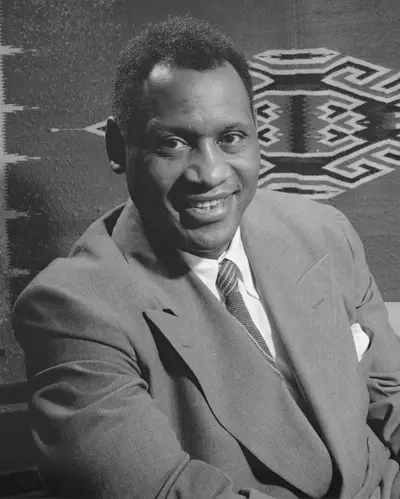
Paul Leroy Robeson was an American bass baritone concert artist and stage and film actor who became famous both for his cultural accomplishments and for his political activism. Educated at Rutgers College and Columbia University, he was a star athlete in his youth. He also studied Swahili and phonetics at the School of Oriental and African Studies in London in 1934. His political activities began with his involvement with unemployed workers and anti-imperialist students whom he met in Britain and continued with support for the Republican cause in the Spanish Civil War and his opposition to fascism. In the United States he became active in the Civil Rights Movement and other social justice campaigns. His sympathies for the Soviet Union and for communism, and his criticism of the United States government and its foreign policies, caused him to be blacklisted during the McCarthy era.
