Marwan al-Muasher Quotes
We cannot claim that we [Arabs] cannot reform unless the Arab Israeli conflict is solved. Rights for women have nothing to do with the conflict with Israel.
Marwan Jamil Muasher, Jordanian Foreign Minister, Lecture, “Challenges Facing the Arab World,” The Woodrow Wilson International Center, March 11, 2004
Sourced by: Eigen's Political and Historical Quotations

Al-Ahram is the semi-official newspaper of the Egyptian Government.

The Arab nations have not reformed their autocratic, dictatorial, rule; have not developed their economies, and are amongst the most corrupt nations on earth. Khalef and others believe that the leadership of the Arab nations have perpetuated the Arab Israeli conflict so that their populations would focus on that and not on the lack of any reasonable progress despite much international aid.


First woman elected to Congress. She voted against the declaration of war in WWI and was the only member of Congress to vote against war in WWII.

The importance of women in the Hamas, fundamentalist vision is to function as a brood mare to “manufacture” men and then to bring them up which at least requires something more than their bodies. The role of women in producing other women however is never mentioned as important.

While it is true that there is a powerful minority of Palestinians and Palestinian organizations—Hamas & Hezbollah, for example whose official position is that there must be no compromise with Israel and Jews must be killed unless they convert to Islam, there are ultra-orthodox, religious, Jewish groups who believe that all the land in dispute was given to the Jews by God and there can be no compromise. The majority of Israelis believe that there is no Palestinian leadership who can stand up to the powerful minorities. The majority of Palestinians believe that the Israeli governments will never stand up to thieir powerful minorities. The Israeli Prime Minister was trying to signal the Palestinians, that if they compromise, the Israelis will also, but neither side has a lot of credibility when it comes to land, borders, and religious identity and that is especially true of this Israeli Prime Minister, who many Israelis (and many Americans) doubt that he will compromise on the land and borders with all the Israeli settlers already inhabiting enclaves of what is, by every law (International, Israeli, and traditional Arab—with the exception of God’s law of the Old Testament—which agrees that the Israelis or the Jewish People do not have title to or control over the lands outside of Israel proper.


The Palestinians were split between supporters of Hamas and Fatah. The former was a terrorist organization which refused to recognize the right of Israel to exist and whose charter called for the killing of all Jews. The latter, accepted the right of Israel to exist and was committed to peace and coexistence with the Jewish state. They had fought a civil war and Hamas controlled Gaza with well over 1 million people which they seized for force and killed of forced out Fatah Representatives. Fatah was the elected ruling party of the West Bank, the larger and more populous of the Palestinian territories. There was little chance of any peace given that split. However, Israel which had undergone over 7000 rockets fired upon them by Hamas, stated that they refused to negotiate with the Palestinians as long as the Hamas terrorists were a part of the control of the potential Palestinian state. They would only discuss a 2 state solution if Hamas agreed that they accepted the right of Israel to exist in their general territory as a Jewish State, Hamas would accept and follow previous agreements made with the Palestinians, and Hamas would give up terrorism and the objective of killing Jews. So either Hamas would have to change its policies or Israel would negotiate with an organization that claimed it would never accept the existence of that country as a Jewish state. Al-Masri thought that the agreement he had mediated, was a necessary first step and was constructive for all the parties.


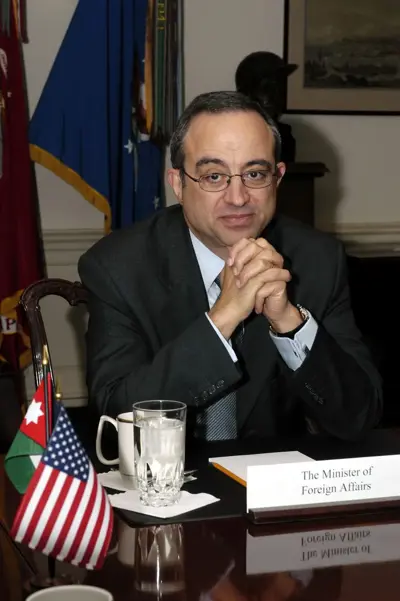
Marwan al-Muasher (Arabic: مروان المعشر) (born 1956) is a Jordanian diplomat and politician who was Jordan's foreign minister from 2002 to 2004 and its deputy prime minister during 2004 and 2005. He currently serves as vice president for studies at the Carnegie Endowment for International Peace, where he oversees research on the Middle East. He was Jordan's first ambassador to Israel and former ambassador to the United States.
