David Lloyd George Quotes
We are witnessing the collapse of Bolshevism.
1st Earl Lloyd-George of Dwyfor. This turned out to be one of the worst predictions in political history.
David Lloyd George, 1863-1945, British Prime Minister (Liberal), Statement when Lenin’s forces failed to gain control of Georgia, Armenia, Azerbaijan and other states and negotiated a treaty with Germany, 1918
Sourced by: Eigen's Political and Historical Quotations


This was one of the first of the world communist leaders who had concluded that the Russian communist state and its revolution had failed. Russia of 1923 was perceived as too dictatorial and not democratic enough. At the same time they thought Russia had not only sold out the democratic nature of communism but also the economic as well by having too much private property and making economic deals with Western capitalists giving concessions of all kinds to Krupp and other major Multinational companies to try and develop international trade and investment. Politically the communist critics thought Russian communism too left wing and undemocratic and economically too right wing and capitalistic.

After the Russian Revolution in 1917, there was a vicious civil war and the Communists governed ruthlessly not even pretending to follow the democratic principles that they had espoused before they can to power. This was a typical intellectual rationalization of a dictatorial behavior that lasted until the fall of Communist Russia. However, at this time most supporters thought that things would soon change. They only got worse culminating in Stalin’s atrocities. The Bolsheviks were the ruling communist party in Russia.

After the 1917 Russian Revolution many of the Western Countries sent troops to Russia where they aided the Whites against the Reds. When the Red Bolsheviks prevailed, there were many attempts to diplomatically and economically undermine the Communist government. This caused a unity among different Russian factions. Sforza urged leaving them alone and letting the Bolsheviks fail by their own ideology. Most Western nations and the United States did not agree with him.

Harriman at that time was the United States Ambassador to Russia and one of President Roosevelt’s closest advisers. There were those who claimed that the Roosevelt administration was very naïve about the potential danger of Stalin. This statement as well as others like it, show that the administration was not so naïve and ignorant.


The speech writer, Anthony R. Dolan, had written, “Now and forever, Russia is an Evil Empire. Reagan crossed out “Now and forever” as he had the optimism that the Soviet Union would fall and Russia would reform at a time when only Senator Pat Moynahan had ever suggested the idea.

In 1921 an Paul E. De Mott, an American Quaker famine relief worker in Germany was arrested as a "Bolshevik" and murdered without trial. American correspondents heard about the crime and asked for a statement from the chief American diplomat in Germany.

This was an incredible prediction with no other world leader thinking it possible for decades until that is exactly what happened.

FDR was right about Russia being a major factor in stopping Hitler, but partially wrong about the danger of Russia. The Soviets never did dominate Europe although the tried, but they did dominate Eastern Europe.

The "iron curtain" phrase was used here a few months before Winston Churchill's famous speech using it {411311}. Also, it appears to have been used earlier than that by Nazi Propaganda Minister Joseph Goebbels in Das Reich. And Viscountess Snowden used the phrase in her memoirs of a Past WWI trip to Russia {616546}. It is not known whether Troubridge or Churchill were familiar with those works.


He served as a liaison with the Russian military officers after WWII. As a result he developed friendships with some who told him much about Stalin and the Communist party of the Soviet Union.
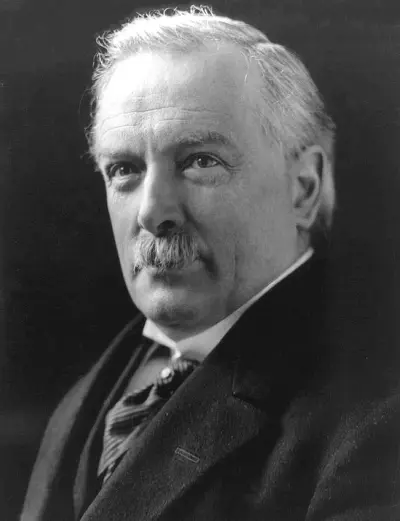
David Lloyd George, 1st Earl Lloyd-George of Dwyfor, OM, PC was a Welsh statesman who served as Prime Minister of the United Kingdom from 1916 to 1922. He was the final Liberal to hold the post of prime minister, but his support increasingly came from the Conservatives who finally dropped him.
