Semyon Timoshenko Quotes
We are harassing them and will go on harassing them until they are totally exhausted. This is not merely tactics of a definite kind—it is a strategy with a broad perspective, directed at definitive and total victory. The Russian defense always had preparation for the counter-offensive as its aim. The Russian war plan here follows the commandment of Clausewitz.
Although most of the American Military Experts thought the strategy a loser, Presidential Assistant Harry Hopkins made an inspection trip to Russia and recommended to President Roosevelt that we support Russia. The Russian strategy defeated the Germans but the Russian losses were horrendous—over 20 million killed. See {626597} for the Clausewitz commandment he refers to.
Semyon Timoshenko, 1895–1970, Soviet Russian Military Commander, Statement of Russian Strategy Against the German Invasion of Russia, Autumn, 1941, Quoted in The Great Offensive: The Strategy of Coalition Warfare
Sourced by: Eigen's Political and Historical Quotations

An irony is that Timosheko used German Prussian traditional military strategy to successfully defend against the German invasion of Russia.


At Hamburg Harris organized a massive fire bombing of the German industrial city and the fire storm was so great that it sucked the oxygen out from huge sections of the city and thousands of people were roasted alive. Even with 100,000 Germans killed, Harris was convinced that it was a relatively humane way of waging a necessary war when compared to the classic artillery barrage followed by invading soldiers and street to street fighting.

This was an incredible order not allowing any Russian Army unit to retreat or surrender. However, it worked. The Russians, with American help of arms, held off the mighty German invading Army. However the German invasion cost the Russians a staggering 22 million lives, mostly civillian.

Ivan Khrfistoforovich Bagramyan. Most militaries including ours have generally been trained and equipped for the last war and not the next war.

The only soldier ever so honored. Marshall was then Chief of Staff of the Army. This quotation is historically very important in that it refutes the accusation made by some FDR and New Deal enemies that Roosevelt was very naïve about the importance of capturing Berlin and ceded control over the invasion and capture of Berlin to Stalin and the Soviet Union. Marshall, one of the most upright of politicians in American history, was not a FDR apologist and few doubted his word or judgment. (Senator Joseph McCarthy and other right wingers however falsely accused him of harboring communists in the Army and working against America’s interest against Russia.

Stalingrad was the bloodiest battle in human history with over 2 million casualties, many produced by Hitler’s order. The Germans were bogged down, could not take Stalingrad, the Russian Winter was closing in on them, the Germans were not equipped or dressed for the winter, and the Luftwaffe had not been able to resupply the armies who were out of food and ammunition. Paulus requested permission to surrender the army and received this response. Shortly thereafter, he disobeyed orders and surrendered what remained of the German forces who by that time were in terrible shape. Professional military men have criticized the Field Marshall for not having surrendered much earlier and saved so many of his men.
This was the classic German method of invading a neutral country. First they claim that they have good information that their enemy, in this case France, is going to March through Belgium to attack Germany. Then they state that the Belgians are too weak to prevent this breach of their neutrality. Therefore, Germany as an act of “self defense” must send troops into Belgium to repel the French. The Belgians of course objected and stated that they would maintain their neutrality (see {613959} ) but the Germans then invaded the next day and could not understand why the world considered it aggression.

This was 5 months before Pearl Harbor & U. S. entry in WWII. However, FDR was not allowing Germany to invade critical territory. Germany had invaded and occupied Denmark. Iceland then was a part of Denmark. In the month previous to this message, Iceland declared independence from Denmark and hence from Germany. The British had naval bases in Iceland. As part of the Lend Lease agreement providing war material to England, repayment included giving the U. S. title to the Icelandic bases. With Britain at war, Iceland was a legitimate target for the Germans who could say they were acting against the bases of an enemy and at the behest of Denmark who did not recognize the Independence. However Danish King Christian would not stand in the way of Icelandic Independence, & when the U. S. Navy occupied the bases, there was no way Germany could attack without bringing America actively into the war. In this way & many others, the U. S. was a military force even before we were in the war.
The allies had differences in desirable strategy alternatives. Russia was facing the German Army on its Eastern front and causing huge German casualties but were paying for them in large loss of Russian life—civilian and military (The Russians suffered 22 million deaths as a result of WWII.) Stalin wanted to open a second front in France which would force the Germans to move some divisions from the Russian front, thereby relieving some of the pressure.

War between England and Germany had just commenced. The last sentence refers to the fact that Hitler had recently signed a peace pact with Stalin to everyone’s surprise as Hitler told the German people over and over that Russia was Germany’s biggest enemy. The pact was only a ruse on Hitler’s part to delay Russia’s entry into the war. Hitler broke the treaty and invaded Russia a little later.

Both Hitler and Stalin were gross egomaniacs who each thought that they had gotten the better of things. The result was that 22 million Russians were killed and the industrial base if Russia Was destroyed. On the German side, the German military was virtually destroyed, many civilians were killed, the nation reduced to rubble and starvation, German leaders were killed, jailed or committed suicide including Hitler, and the country was occupied for years. Neither leader appeared very smart if one judges by the results.

He signaled his subordinates that it was OK to commit war crimes against the Italian Partisans.

This speech was given in the early days of WWII when it was far from clear that we would win.


Conant, a great scientist in his own right, had the confidence of the political, academic, and industrial establishment and was appointed to the Committee that was to set policy for the Manhattan Project representing President Roosevelt. Germany had been the world leader in Physics before the war. American leaders and scientists were certain that we were in a scientific race with the Germans. Even after Germany had been defeated, President Truman was told that we had beaten the Germans in the race for the bomb. Actually, although almost no one in the US government realized it then, the Germans had NO PROGRAM of nuclear weapons development at all. Hitler did not trust the Theoretical Physics and Theory of Relativity because Einstein and other Jewish scientists had been instrumental in its development. He derogatorily referred to it as “Jewish Science”. Germany bet its scientific efforts on the V2 Rockets and the Jet Airplane, both of which they were successful with but too late to have any material effect on the war. Ironically, even after most of the great German physicists were run out of Germany, there were still two of the greatest who may well have been capable of nuclear weapons development. But neither Werner Heisenberg or Otto Hahn were inclined to engage in that kind of research, and neither of them were even asked whether or not they thought it was possible. The anti-Semitic Nazis just assumed that it could not be. Truman and his associates did not find out for another year or more that there was no race. There was one OSS spy, Moe Berg, who had actually talked to Heisenberg in the midst of the war, and concluded that he not only was not working on an atomic bomb, but was not up on the latest pre-war critical research needed to develop a bomb. Hahn knew and had created the first chain reaction for which he later won the Nobel prize but he was a chemist and didn’t really understand the Physics and mathematics involved in making a weapon and was a confirmed pacifist. Ironically, his colleague, Lise Meitner who had done the physics and mathematics on that experiment was Jewish and had to flee Germany. In Denmark she gave the results to Niels Bohr, who shared them with Leo Slizard and Einstein when Bohr came to the United State and that initiated the famous letter that was sent to FDR which triggered the Manhattan Project. The German first nuclear reaction was used by the Americans because the politicians listened to the scientists, while in Germany, the politicians gave no credence to their scientists and their experiments in nuclear fission.
While the President had total faith in American scientists, at the time the state of American physics was not world class in several key areas. Oppenheimer, was for example, the ONLY senior American theoretical physicist at the outbreak of the war, and he had been trained in Germany. What the President did not quite realize was how many of the key scientific positions on the Manhattan Project were foreign refugees who had fled the Nazis in Europe. Many American scientists and engineers did not want to go to Los Alamos where they could not leave for the duration of the war, had to give up their own personal research, and whose relatives who did not accompany them would never know where they were or what they were doing. But there were enough great American scientists who Oppenheimer recruited that combined with the Europeans formed the greatest and most effective concentration of scientific manpower working in history.

The Russians had lost over 20 million of its people to German WWII hostilities. They wanted a vengeance and were willing to take the casualties that came with the invasion of Berlin and many other key cities that were heavily defended. Eisenhower and Churchill realized that this would give the Russians a very dominant military occupation of Eastern Europe and Eastern Germany. However, they did not want to take the huge casualties of all these battles. Politically, Churchill and American leaders had to explain to their right wings why Russia was involved as an equal partner in making occupation decisions about Germany.

Germany had tried to invade Russia but it was too large for the resources that Germany devoted to it. The Russians took huge civilian and military casualties (22 million) but with U. S. material supplies, they bogged the Germans down and eventually Hitler under pressure from his generals, gave up the Russian invasion.
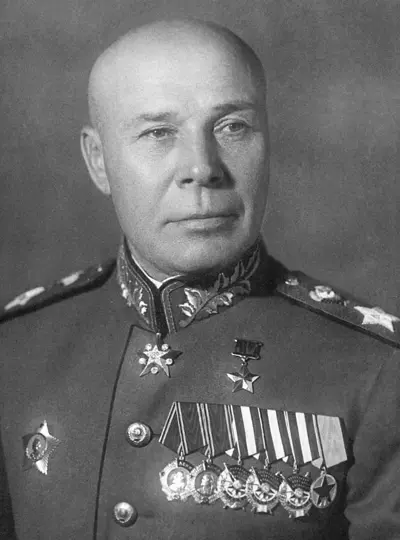
- Born: February 18, 1895
- Died: March 31, 1970
- Nationality: Russian
- Profession:
Semyon Konstantinovich Timoshenko (Russian: Семён Константи́нович Тимоше́нко, Semën Konstantinovič Timošenko; Ukrainian: Семе́н Костянти́нович Тимоше́нко, Semen Kostiantynovych Tymoshenko) was a Soviet military commander and Marshal of the Soviet Union.
