Joseph Stalin Quotes
… it is time to finish retreating. Not one step back! Such should now be our main slogan. ... Henceforth the solid law of discipline for each commander, Red Army soldier, and commissar should be the requirement — not a single step back without order from higher command.
This was an incredible order not allowing any Russian Army unit to retreat or surrender. However, it worked. The Russians, with American help of arms, held off the mighty German invading Army. However the German invasion cost the Russians a staggering 22 million lives, mostly civillian.
Joseph Stalin, 1879-1953, Russian Premier, "The Order of the National Commissar for the Defense of the Soviet Union" July 28
Sourced by: Eigen's Political and Historical Quotations

An irony is that Timosheko used German Prussian traditional military strategy to successfully defend against the German invasion of Russia.


Some southerners had gotten out of the Confederate chain of command and were attacking civilian steamboats killing Southerners as well as “Yankees”. See {633900} . While Sherman had trouble with some of his own men on parts of his March Through Georgia, at this time, it was Southerners who were acting independently and improperly. Legally, the Confederates were responsible for any people committing terror. Sherman tried to persuade the Confederate commanders with letters like this, but was very quick to retaliate for every violation. He also complained to some Union officers that they were not moving quickly enough to retaliate and prevent future behavior--{584048}

Ivan Khrfistoforovich Bagramyan. Most militaries including ours have generally been trained and equipped for the last war and not the next war.


Stalingrad was the bloodiest battle in human history with over 2 million casualties, many produced by Hitler’s order. The Germans were bogged down, could not take Stalingrad, the Russian Winter was closing in on them, the Germans were not equipped or dressed for the winter, and the Luftwaffe had not been able to resupply the armies who were out of food and ammunition. Paulus requested permission to surrender the army and received this response. Shortly thereafter, he disobeyed orders and surrendered what remained of the German forces who by that time were in terrible shape. Professional military men have criticized the Field Marshall for not having surrendered much earlier and saved so many of his men.

This practice credited to the Americans in WWII while the German’s waited for instructions, was not an American invention. It appears to have originated with one of the greatest of the Russian military leaders.

These tactics were revolutionary in China and the rest of the world. They were unexpected and were very effective. The non communists however were corrupt, exploitative, and divided. The communist revolution in China might well have not succeeded had the capitalist forces not been so corrupt and badly led.

At Hamburg Harris organized a massive fire bombing of the German industrial city and the fire storm was so great that it sucked the oxygen out from huge sections of the city and thousands of people were roasted alive. Even with 100,000 Germans killed, Harris was convinced that it was a relatively humane way of waging a necessary war when compared to the classic artillery barrage followed by invading soldiers and street to street fighting.

The allies had differences in desirable strategy alternatives. Russia was facing the German Army on its Eastern front and causing huge German casualties but were paying for them in large loss of Russian life—civilian and military (The Russians suffered 22 million deaths as a result of WWII.) Stalin wanted to open a second front in France which would force the Germans to move some divisions from the Russian front, thereby relieving some of the pressure.

Kleinst, one of the guilty war criminals, is here quoted with the defense that most Nazi war criminals uses—namely that they were obeying orders. But international law makes no distinction between military and political orders, and it is the obligation of a soldier to refuse to obey an illegal military order and the orders he obeyed were illegal and contrary to International law—an order to kill babies and young children can never be legal for example.

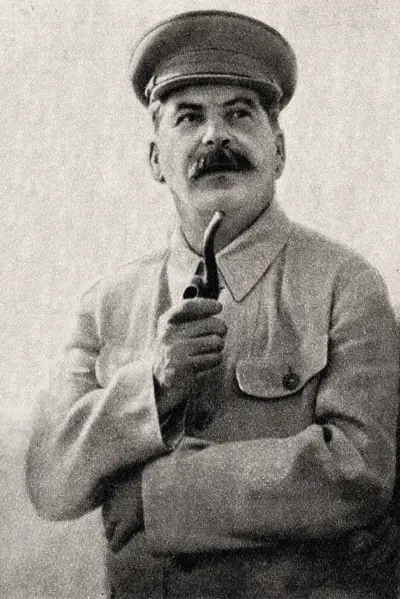
Joseph Vissarionovich Stalin was a Georgian revolutionary and the ruler of the Soviet Union from 1927 until 1953. He served as both General Secretary of the Communist Party of the Soviet Union (1922–1952) and Chairman of the Council of Ministers of the Soviet Union (1941–1953). Despite initially governing the country as part of a collective leadership, he ultimately consolidated power to become the Soviet Union's de facto dictator by the 1930s. A communist ideologically committed to the Leninist interpretation of Marxism, Stalin formalized these ideas as Marxism–Leninism while his own policies are known as Stalinism.
