Mao Zedong Quotes
Divide our forces to arouse the masses, concentrate our forces to deal with the enemy. The enemy advances, we retreat; the enemy camps, we harass; the enemy tires, we attack; the enemy retreats, we pursue. To extend stable base areas, employ the policy of advancing in waves; when pursued by a powerful enemy, employ the policy of circling around. Arouse the largest numbers of the masses in the shortest possible time and by the best possible methods.
These tactics were revolutionary in China and the rest of the world. They were unexpected and were very effective. The non communists however were corrupt, exploitative, and divided. The communist revolution in China might well have not succeeded had the capitalist forces not been so corrupt and badly led.
Mao Tse-Tung, 1893-1976, Chairman, Communist Party, China, Basic Tactics of the Communist Party at the time, A Single Spark Can Start A Prairie Fire, January 5, 1930
Sourced by: Eigen's Political and Historical Quotations

During his revolutionary battles in Kaingsi, Mao reduced his theory of guerrilla tactics to a poem:

The Kuomintang was the anti-Communist political party controlled by Chaing Kai Chek and the major opponent of the Communists. It took more than another decade but Mau and the Communists with the vast support of the majority of the masses, did indeed take over all of China. At the time few thought that they would ever do it.
Many Communist Party officials saw the red army as only a fighting unit. Mao had a larger vision and that vision contributed greatly to the success of the communist revolution. However, long after the revolution the Red Army, even into the 21st century, was so involved with affairs at all levels it was an economic, intellectual and political force of its own.


of the German tactics of Blitzkrieg Goering, Hitler and the other leading Nazis were quite open about their military aggression. Terrorism was admittedly used to persuade the next nation Germany would attack to capitulate rapidly.


The commander complained of the brutal behavior of Bolivar and the revolutionaries, but the atrocities committed by the Spanish forces were even worse and both sides fought with techniques that had no civilized restraints.

Many foreign armies, including troops of the United States, had surrounded Russia. Most had no specific instructions or purpose but they all wanted to protect their interests from the chaotic Russian situation as well as from each other who might use the Russian weakness to establish their foothold.


The Emperor was writing to his son to explain the defeat of Japan. In what was a bit of revisionist history, the Emperor neglected to mention that with the exception of some of the incursions in China, Hirohito had personally approved every Japanese invasion including Pearl Harbor. Further, it was he who had approved the orders that Japanese troops should fight to the death rather than retreat or surrender.

The non-communist forces of China were always struggling with each other for power. Attempts by non-communist reformers were defeated by autocrats, warlords, major landlords, and various religions organizations and denominations which were all fighting each other.

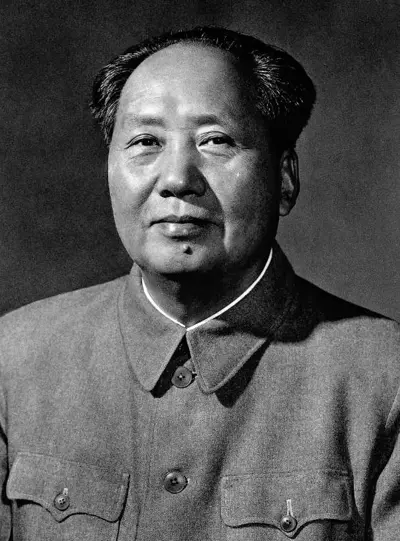
Mao Zedong, also known as Chairman Mao, was a Chinese communist revolutionary who was the founder of the People's Republic of China (PRC), which he ruled as the chairman of the Chinese Communist Party from its establishment in 1949 until his death in 1976. Ideologically a Marxist–Leninist, his theories, military strategies, and political policies are collectively known as Maoism.
