Hamad bin Isa Al Khalifa Quotes
We are a constitutional monarchy. I don't order laws, I propose them. Article 35 of our constitution states that the king can only refuse a law of parliament once, then he has to sign it - if the same law is then supported by a two-thirds majority in both houses of parliament.
Al Khalifa, Hamad bin Isa. "Interview with Bahrain's King Hamad: 'I Don't Order Laws, I Propose Them'." Der Spiegel, 15 Feb. 2012.


This Cahier was the consensus of the Clergy of Blois in 1789. There were cahiers of several provinces of France—some by the clergy, some by the nobles. What is fascinating is the emergence of many of the pre-revolutionary French concepts. The example of the American revolution and its principles was known throughout the educated classes of France.

At the time there was no concept of serious separation of powers. For all practical purposes, the King ruled and he shared some of his powers with the Parliament. The next centuries in England would see the great battle for governmental power between the monarch and the Parliament. Today, the British monarch has no power but still retains a great deal of influence in England but largely because Queen Elisabeth is so well loved and respected.


At that time the king not only called Parliament into session but terminated the session and set the agenda. In this case, Charles I didn't want royal activities regarding taxation to be debated much less legislated upon. As the speaker rose to leave the chair, he was forcibly held in place by two members as the house voted by acclamation to condemn the taxes and even the merchants who paid them. This was perhaps the first legislative tax revolt in history.


In 1628 Parliament, in response to abuses by King Charles I, was about to pass The Petition of Rights–-a type of Bill of Rights. The King gave assurances that the practices—such as forcing nobles to lend him money—would not continue and didn't want to be embarrassed by passage of a law which he claimed would indicate that the Parliament did not trust him and weaken the dignity of the monarchy. The Petition of Rights passed with Cole’s leadership.

President Abraham Lincoln had pocket vetoed his own party's reconstruction bill in the midst of an election year.
Two years later with bipartisan support Speaker Joseph Cannon was stripped of his party and the Rules Committee was created.

1st Earl of Beaconsfield

This was written shortly before he assumed the crown.


In the early 18th century, the succession to the Scottish and English Crowns was unclear. As a safety valve and check, this clause was adopted by the Scottish Parliament. This was one of the most radical and anti monarchy laws ever passed. It took the unilateral power of making war and peace from the king & established the principle of ratification of ALL treaties. The law did not last long. It was nullified by the Union between England & Scotland (1707), and the English Parliament specifically repealed the clause in the “Repeal of Certain Scotch Acts of 1707”. This clause, which only remained in force for 3 years, had a profound effect on the modern democracies. The American founding fathers were totally familiar with the recent English history & this law. So the American’s at the Constitutional Convention of 1787, built the principle into the new Constitution giving the Congress the power to Declare War and the Senate to ratify treaties as a check against Presidential power.


This was the President’s original role regarding legislation. However, in the 20th century, Presidents have become more active and suggest laws and often initiate the process and then end it by signing the law that he suggested and shepherded through the Congress. But this was never the vision of the Founding Fathers, but since it is not addressed in the Constitution is not an unconstitutional process.
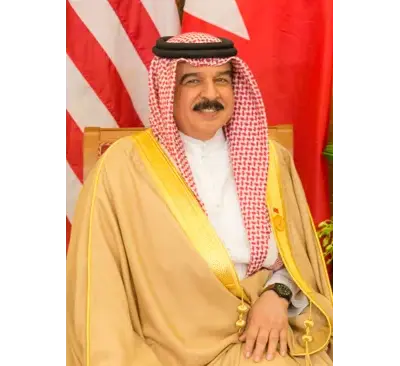
Hamad bin Isa bin Salman Al Khalifa (Arabic: حمد بن عيسى بن سلمان آل خليفة Ḥamad bin ʿĪsā bin Salmān ʾĀl Ḫalīfah; is King of Bahrain since 14 February 2002, after ruling as Emir of Bahrain from 6 March 1999. He is the son of Isa bin Salman Al Khalifa, the previous and first emir. The country has been ruled by the Al Khalifa dynasty since 1783.
