Vladimir Lenin Quotes
Until we apply terror to speculators --- shooting on the spot --- we won’t get anywhere.
Vladimir Lenin. Terrorism has been an instrument of dictatorial states in general and most revolutions. Speculators as used by Lenin at this time were not just businessmen or capitalists. They were people who bought up and hoarded scarce resources and food, waiting for worse shortage, and then selling their food or other goods at very high prices. Or they would take advantage of the fact that farmers did not have enough to eat and only give them food if why would sign over their land rights. Soon honest businessmen were treated like speculators because they made people less dependent on the party and the government. Stalin, who followed Lenin was even more extreme and had speculators, businessmen and landowners executed.
Nikolai Lenin, 1870-1924, Russian Communist Premier, Quoted in George Leggett, The Cheka: Lenin’s Political
Sourced by: Eigen's Political and Historical Quotations

He argues that even if the concession to terrorists is seemingly small, there is much greater damage in that the minimal concession will also stimulate more attempts to gain other victories. See {629723} for his complementary statement on dealing with terrorists.

If there would be free competition in banking as opposed to monopolies in each area, This is the first major history of banks written in the United States. At the time, there was hardly any competition amongst banks. Each bank had a do facto or official monopoly in its area. In many communities of America, this is still true, but competition in banking has reached almost all high density areas of the country.

The terror to which he referred was to the French Revolution’s executing former aristocrats and then including anyone suspected of monarchist sympathies. This quotation shows how fanatics can rationalize evil as justice.

This quotation was extremely damaging to Russian Communism at the time. Goldman had been extremely supportive of the initial Russian Revolution and was an enthusiastic Marxist. She was not the typical conservative who would attack the revolution no matter what the outcome.


This is one of the quotations from the Koran which many Islamic terrorists point to in order to morally justify terrorism. For an example, see {586965}.


There was a financial crisis in the country and the world when highly risky home mortgage loans defaulted leaving investors and speculators in mortgage-backed securities in a poor position. The investors had been reaping very high interest rates for their risky investments, but this was the first time that this form of risky investment had failed. The investors, of course were looking for a bailout from government. When the Bush administration failed to bail out investment bank, Lehman, there was a panic and the banking system of the country and much of the world froze up. Bush and his Secretary reversed their bailout of speculators policy and provided various assistants and bailouts to the very bankers and other investors who had caused the economic meltdown. The policy was continued by the Obama administration although the bailouts were just as distasteful to Obama as they were to Bush, but most economists agree that the two presidents very distasteful and unpopular bailout actions probably saved the nation from a massive depression. After being bailed out by the taxpayers, the Bankers then paid themselves exorbitant bonuses while the results of their management put 10 percent of the country out of work.

The States sold bonds to finance the their efforts in the Revolutionary War. Some states had better prospects for redeeming their bonds than others. Georgia, South Carolina and North Carolina in particular had poorer prospects than most and their bonds were selling at about 25 cents on the dollar. Alexander Hamilton, then the Secretary of the Treasury, wanted the new Federal government to assume the state’s war debt and pay off the bonds. He made his proposal for how he would accomplish this on January 14, 1790. He delivered his report and proposal to Congress “Report on the Public Credit”. As soon as Hamilton’s proposal was read in Congress, sophisticated speculators set off for the Southern States to buy up as many bonds as they could before the owners found out that a Federal bail-out was under serious consideration. They could easily double, triple or even quadruple their money. Many congressmen wanted to outlaw the speculation. See {619929} & {619939}. The pro-speculation forces got their way. Some speculators made fortunes. Most bondholders lost money.

The result was regulation of the banks and the creation of the SEC to regulate the stock market, However, over the years, the regulations were not able to keep up with the sophisticated development of new forms of investments and financial instruments and the financial industry were able to speculate with other people’s money in ways that FDR and his reformers never imagined. Finally, even the regulation that did exist was weakened by the policies of the George W. Bush administration and the combination brought about the Great Recession of 2008 where the profits from excess speculation were privatized and the losses, socialized with the taxpayer and the American worker bearing the brunt while most of the speculators were bailed out and made more money than ever. The Obama administration tried to reform the situation, but was unable to put an end to the legal speculation with other people’s money or of having institutions that were “too big to fail.”

Terror conceptually in France and some other countries was the tool the government used to inhibit criminals.


The atomic bomb had just been used the year before. However, in the next decades, nuclear weapons were not used again as those nations with nuclear capability also had potential enemies with nuclear weapons. The fear of Mutually Assured Destruction prevented nuclear weapons from being used for a long time.


Vladimir Lenin. While Lenin was of this view, Stalin and other hard liners disagreed. They not only imposed their brand of communism on their own people via force with terrible consequences for any dissidents, but the Soviet Army imposed Communism on most of the states of Eastern Europe, and those states in turn used their Armies and secret police to impose it on their own citizens.
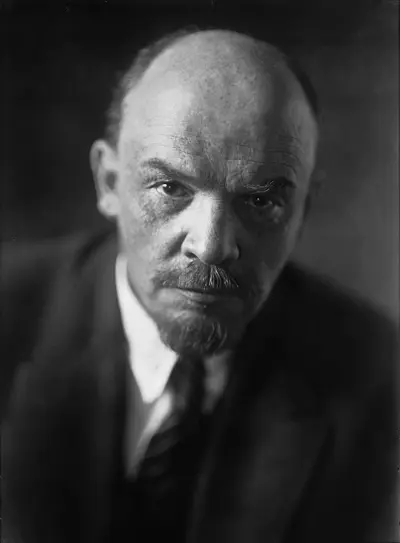
Vladimir Ilyich Ulyanov, better known by his alias Lenin, was a Russian revolutionary, politician, and political theorist. He served as the first and founding head of government of Soviet Russia from 1917 to 1924 and of the Soviet Union from 1922 to 1924. Under his administration, Russia, and later the Soviet Union, became a one-party socialist state governed by the Soviet Communist Party. A Marxist, he developed a variant of this communist ideology known as Leninism.
