Voltaire Quotes
To hold a pen is to be at war.
Voltaire, 1694-1778, [Francois-Marie Arouet], French Historian & Dramatist, Letter to Jeanne-Grâce Bosc du Bouchet, comtesse d'Argental, October 4, 1748
Sourced by: Eigen's Political and Historical Quotations

Alluding to Ecclesiastes 3:1 ff, "For everything there is a season, and a time for every matter under heaven: a time to be born, and a time to die;.." The exact wording of his sermon has been lost, but the sentiment was reported by many.


Though the pen is mightier than the sword, the sword speaks louder and stronger at any given moment.
This was a take off on the famous line of the British Colonial Secretary, Edward G. Bulwer-Lytton {584317}.


The highest court in New York.


He was responding to criticism that the media was bashing the President.


This would be like an American President firing the congressional chaplains. However this is only one small, but telling, example of Atatuk’s secularization of the nation which had a great deal to do with Turkey becoming a modern great power—by far the strongest and most developed of the Islamic world.


While the racial incidents of Jena became a national cause célèbre, the quotation is memorable because it illustrated the huge de facto power that even a small town district attorney has. Though most do not abuse it, some do, and few Das threaten the way that Walters did. The reality is that simply by determining the charge, the DA is capable of incredible consequences on people’s lives. In the Jena situation, Walters had charged Black juveniles with “Attempted Second Degree Murder” for engaging in a fight with white juveniles. The penalty was from 50 to 100 years without any possibility of parole. A white student who had assaulted a Black was only charged with “Battery” a minor crime. Jena became the location of national civil rights protests.


See {613496} for the origin of the “thrashing a cannibal” phrase.
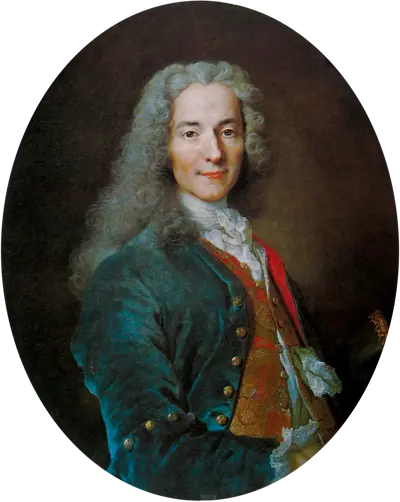
François-Marie Arouet, known by his nom de plume Voltaire (/vɒlˈtɛər, voʊl-/; also US: /vɔːl-/; French: [vɔltɛːʁ]), was a French Enlightenment writer, historian, and philosopher famous for his wit, his criticism of Christianity—especially the Roman Catholic Church—as well as his advocacy of freedom of speech, freedom of religion, and separation of church and state.
