Jose de San Martin Quotes
this battle is going to decide the fate of all America and it is preferable to die on the field of honour than at the hands of our executioners.
Jose de San Martin 1778-1850, President of Peru, Orders to his soldiers before the battle of Maipo against the Spanish, 1819
Sourced by: Eigen's Political and Historical Quotations


Chile with help from San Martin had ejected the Spanish. O’Higgins, the Chilean leader had joined up with San Martin and served under his command. The sectional rivalry bothered men like Carrera. Instead of seeing all the South Americans fighting the Spanish as allies as O’Higgins did, Carrera and his brothers refused to join a government of unity and they and their troops were just as dictatorial and cruel as the Spanish had been. O’Higgins gave Indians and Blacks equal rights with whites which distressed the aristocratic Carrera’s. Finally the Carrera’s tried to set up their own government, and the new Chilean government disarmed their militia and executed two of the three Carrera brothers who were leading the militia troops who were little more than thieves and brigands.
In one of the most unusual revolutions in world history, Brazil became independent from Portugal via a revolution led by the son of the Portuguese King and heir to the throne, Pedro I. The crown prince of Portugal, led Brazil in her breakaway from Portugal and by popular acclaim became Pedro I, Emperor of Brazil. He is probably the only monarch in history who was the heredity monarch of one kingdom and selected by popular acclaim to the throne of another.


In one of the most unusual revolutions in world history, Brazil became independent from Portugal via a revolution led by the son of the Portuguese King and heir to the throne, Pedro I. The crown prince of Portugal, led Brazil in her breakaway from Portugal and by popular acclaim became Pedro I, Emperor of Brazil. He is probably the only monarch in history who was the heredity monarch of one kingdom and selected by popular acclaim to the throne of another.

This line was used in the WPA Federal Theater Project. The play was closed down, because the State Department was distressed that the Federal Theater quoting heads of State might be insulting to the world leaders. Mussolini was another character in the play and he was depicted as the boorish thug that he turned out to be. It was that which offended the government officials who closed the show before it could open. FDR used a similar line 6 years later. See {32529} . Dolores Ibarruri in the Spanish Civil War is quoted with a similar phrase at about the same time. See {604321}

South America, invaded and colonized by Spain was a brutal combination of slavery and repression. Even the European colonists suffered under the terrible combination of exploitation, militarism and religious dictatorship. Independence from Spain was equally bloody as unlike in North America where the fight was against British rule, in South America the black slaves, the indigenous Indians and the white colonists all had scores to settle with the Spanish rulers. And the Spanish in turn realized that and brutally repressed all rebellion attempts. Atrocities were common, and committed by almost all, including even idealists like Bolivar.


Ataturk was a young major at the time commanding troops of a weak and corrupt Ottoman regime. However a combined English and French (the strongest military powers in Europe) invasion of the Gallipoli Peninsula threatened to capture the Turkish capital, Constantinople. Ataturk alone rallied the Turkish defenders and fought the invaders to a standoff in long drawn out battle with huge casualties on both sides. Ataturk became a national hero. Although Ataturk thereafter was very reluctant to use military force or endanger troops, the thing he always thought worth the supreme sacrifice (including his own) was the independence and sovereignty of the nation. See {584502} for his continuing belief in this type of sacrifice.
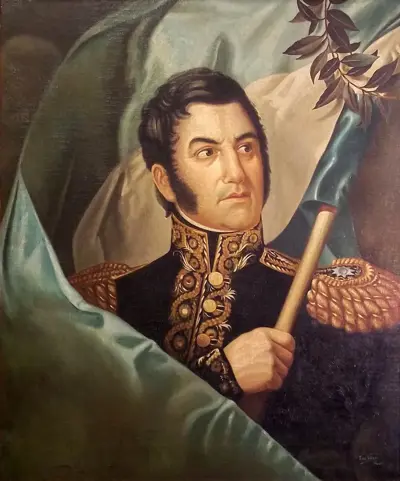
José Francisco de San Martín y Matorras, known simply as José de San Martín (Spanish pronunciation: [xoˈse ðe san maɾˈtin] (listen)) or El Libertador of Argentina, Chile and Peru, was an Argentine general and the prime leader of the southern and central parts of South America's successful struggle for independence from the Spanish Empire who served as the Protector of Peru. Born in Yapeyú, Corrientes, in modern-day Argentina, he left the Viceroyalty of the Río de la Plata at the early age of seven to study in Málaga, Spain.
