Uriah Phillips Levy Quotes
Think not, if you once enter on this career, that it can be limited to the Jew. What is my cast today, if you yield to this injustice, may tomorrow be that of the Roman Catholic or the Unitarian; the Presbyterian or the Methodist; the Episcopalian or the Baptist. There is but one safeguard; that is to be found in an honest, whole hearted, inflexible support of the wise, the just, the impartial guarantee of the Constitution.
Levy was the first Jewish naval captain of the United States Navy. He was acknowledged by the Secretary of the Navy to be qualified for promotion to Commodore, but there was much anti-Semitic opposition among the other senior officers. Levy was finally promoted to Commodore. He was so grateful for the freedom of America that he had purchased Thomas Jefferson's home Monticello and maintained it as a shrine to the author of the Declaration of Independence. See George Bancroft
Uriah Phillips Levy, 1792-1862, Navy Commodore, Testimony at his promotion hearing, 1857
Sourced by: Eigen's Political and Historical Quotations


This book is endorsed by major religious organizations of all faiths as well as National School Boards Association, National Education Association, National PTA, National Association of Secondary School Principals, National Association of Elementary School Principals, American Association of School Administrators and others. It is used as a guideline by most schools systems in the United States.

Pen name: Jack Nipps

There was freedom of religion for Protestants in early New Jersey. Note that Catholics and Jews were not allowed to hold office. This constitution was in force until 1844 when the prohibition was repealed by new constitution. Under the original constitution, men were convicted for blasphemy. See {621063} .


JFK was running for the Presidency and was Roman Catholic. There was a great deal of anti-Catholic prejudice in the country with many people fearing that a Catholic President would mean Papal control of the United States. Peale was the most influential American clergyman of the day, and while he did not overtly oppose the Kennedy candidacy, he did state that he thought the election of a Catholic would profoundly change America. Kennedy won by a thin margin, but none of the events that the anti-Catholics feared, came to pass.


It took only 10 days after the First Continental Congress met for religious bigotry to arise. After hundreds of years of Catholic/Protestant strife, each sect looked upon the other, not only as theologically wrong, but dangerous to the liberty of the other. Unfortunately, the organied religions had acted so badly towards other religions, that everyone was justified in fearing the other religions. This quotation illustrates a then typical attitude of many American Protestants that the Catholic Church was a threat to national security. Ironically, in modern times, anti-Catholic bigots use this quotation to demonstrate that the United States was founded as a Christian Protestant nation—not a general Christian nation. A small, vicious anti-Catholic sentiment still exists, usually by a minority of right wing Protestant religious fundamentalists. Protestant England had just repealed the laws making Catholicism illegal, but this was regarded at that time as intolerable for the new America. This was one of the disputes which that the Founding Fathers were faced with later and one of the reasons that they were so absolute in the need for the 1st Amendment.

Kennedy was being hurt be fears that as a Catholic, he would be beholden to the Pope and the Catholic Bishops. There were many protestants who believed that the Catholic Church was antithetical to democracy and some who even believed that Catholicism was the religion of Satan. Kennedy decided to confront the issue head on.

It was drafted by John Adams. Note that there was freedom of religion for Christians and not others. Of all the colonies, Massachusetts had the worst record of religious intolerance with Puritans controlling everything. Rhode Island and Connecticut were created by religious dissenters from Massachusetts. Adams had all he could do to get the Christian sects on an equal footing ratified. The other colonies however, insisted to a total freedom of religion clause which became the First Amendment to the national Constitution. Adams himself was a kind of secular, cultural Christian who did not believe in the divinity of Christ and other Christian doctrine. See {592695} to illustrate this.


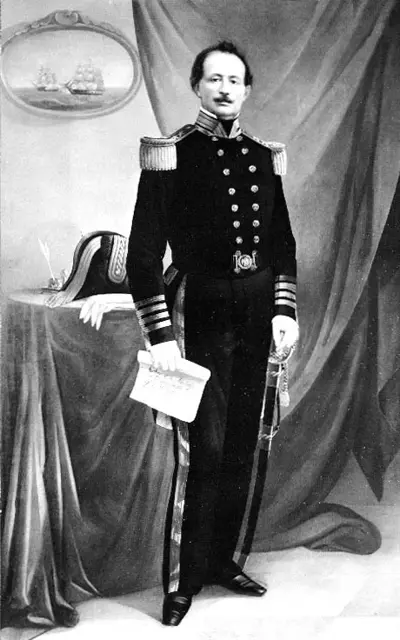
Uriah Phillips Levy was a naval officer, real estate investor, and philanthropist. He was a veteran of the War of 1812 and the first Jewish Commodore of the United States Navy. He was instrumental in helping to end the Navy's practice of flogging, and during his half-century-long service prevailed against the antisemitism he faced among some of his fellow naval officers.
