Arun Shourie Quotes
They [Moslem historians] have made present-day India, and Hinduism even more so, out to be a zoo - an agglomeration of assorted, disparate specimens. No such thing as "India", just a geographical expression, just a construct of the British; no such thing as Hinduism, just a word used by Arabs to describe the assortment they encountered, just an invention of th, e communalists to impose a uniformity - that has been their stance. For this they have blackened the Hindu period of our history, and, as we shall see, strained to whitewash the Islamic period.
This is an example of the politicization of history. Late in the first millinium Islamic warriors invaded and conquered much of Hindu India. The Muguls controlled much of India for hundreds of years. When the English conquered India, the Muslims rejected Western education and legal systems while the Hindus did not. After several generations the Hindus, better educated, and more sophisticated in Western ways took advantage of the numerical majority and regained control under the British. With Independence, Islamic nationalists insisted upon partition of the country creating a Muslim country, Pakistan. Millions of Indians were murdered in internecine attacks during the partition. Subsequently, Muslim historians have written one version of the history of India, while Hindu historians have written another. They appear to come from different planets or parallel universes. British historians have a third universe.
Arun Shourie, Indian journalist, author and politician, Indian Minister of Disinvestment, Communication and Information Technology, General Secretary of the People's Union for Civil Liberties, Eminent Historians: Their Technology, Their Line, Their Fraud
Sourced by: Eigen's Political and Historical Quotations

At the time almost everyone thought him overly pessimistic. Despite huge efforts to bridge the differences including the partition of India and creating a separate Muslim state, the Muslims have become even more discontented in modern times. The Muslim antagonism however has expanded beyond the Hindus, to include the Christians, Jews, Bhais, Buddhists and any other religion in control of land where there are Muslims or they feel should have Muslims. Today, as in 1925 however, the difficult was caused be a very vocal and often violent extremist minority of the Islamic population.

A 'kirpan' is a type of knife—a weapon—which all male Sikhs are religiously obligated to have in his possession and on his body at all times. Singh was a Sikh Maharaja (King) of an area that had about an equal number of Muslims and Sikhs. The Sikh's had a long history of living under Muslim domination and wanted no part of any more. Patiala was within the Punjab and Jinnah was insisting that the Punjab should be a Province of the new Pakistan because the Punjab was majority Muslim. However, there were many Sikhs, as well as some Hindus, Buddhists, and Christians and virtually none of these wanted to be a part of Pakistan. Further, a significant portion of the Muslim Punjab population also preferred to join India for many reasons, not the least of which was that they had become used to a democracy where they had complete freedom of religion and civil rights as well, and with the exception of Turkey none of the Muslim countries were democratic. Based on the history, actions, inactions, and statements of the Muslim League which did not democratically elect its leaders, Pakistan would not likely be a democracy that guaranteed civil rights—especially religious rights—to their citizens (and they were right). So the majority of the people of the Punjab were opposed to becoming a part of Pakistan. The Sikhs were passionate opponents of being a part of Pakistan as they knew their Muslim neighbors one of whose major reasons for wanting a Muslim state was that everyone could then be forced to be Muslim or be expelled or ethnically cleansed.

Even into the 21st century, the problem was not solved and Muslims from Pakistan continue their futile but tragic terrorist tactics to try and acquire more territory from India." 1st Earl Mountbatten of Burma

The Western style of education was extremely effective for the Hindus, but was much less successful for the Muslims. The result was that over time, the Hundus achieved success in the professions, civil service, arts and sciences while the Muslims did not, thus changing the then existing parity of the two groups. For more on the difficulty that the Muslims had with British public education, see {616919} & {616925}.

“Mahomedans” was a term at the time that was used to describe Muslims. This is one of the first serious analyses of why there was very differential achievement levels between Hindus and Muslims in Colonial India which have led to schisms that exist even now.

Arguments against the Partition of India at the time centered around the poor economic viability of a separate Muslim state. However Iqbal and others placed the cultural issues in the forefront. They eventually prevailed.
There are a small body of historians who believe that the Ancient Egyptians were dark skinned Africans and that American and European archeologists and historians, together with their Arab counterparts and Arab workers, have either unwittingly or deliberately ignored or erased the evidence that Ancient Egyptians were Black. The majority of historians and archeologists believe that ancient Egypt was a multi-racial society with extensive intermarriage. The Nubians to the South (Sudan) were and are very dark-skinned, the Lybians in North Africa were much like the Arabs of toady, and there were Greeks and other Caucasians who were in Egypt which was one of the centers of world civilization that attracted people from all over. The Pharoh of Egypt, Ptolemy was a white Greek—one of the Generals of Alexander the Great, and Cleopatra was descended from him and more traditional Egyptians. The Black Egyptian notion seems to have emanated from a statement made by Black leader, Marcus Garvey {618973} .


Countess of Blessington
Magh Bahul Ekadashi. To this day Golwalker is one of the most revered of the Hindu nationalists. This is the kind of intolerance that Indian Muslims faced amongst the most extreme Hindu’s. The possibility that this would become a reality was one of the great motivators for partition of India on the part of the Muslims. The irony is that the Muslim nation that was created—Pakistan—follows this doctrine exactly, only they substitute Islam for the Hindu culture. With the exception of a few Muslim nations, most of Islam follows the intolerance that the Hindu extremists would have followed. Ironically, “Hindu” India still has many millions of Muslims and they are given full citizenship and more democratic freedom and rights than Muslims have in almost all Islamic countries with the exception of Turkey.

Ataturk wrote this manual personally. Religious Turks took violent offense to Ataturk’s proclamation that Turks were great without Islam.
The Partition was accompanied by over 2 million murdered Indians as India was divided into a smaller India with almost all the Hindus and Sikhs and a slight majority of the Muslims and Pakistan with all Muslims who made that choice. Pakistan has been trying to de stabilize the area ever since to gain control of more land and became a theocracy and military dictatorship—sometimes de facto and sometimes de juro.

The Somnauth Temple was one of the holiest of Hindu shrines in India. It had been attacked, looted, and destroyed several times since its erection before the birth of Christ. A Northern Warlord Ruler had raided the temple and stolen the spectacular gates at the tomb. When the British Indian Army of Indians led by British officers and NCOs, conquered the Warlord area, Lord Ellenborough had the huge gates removed and returned to the Somnauth Temple issuing this proclamation which he arranged to have approved by Queen Victoria and have Parliament vote to return the gates. It was a brilliant historical instance of symbols having enormous political effect. Hindus throughout India, most of whom had forgotten about the stolen temple gates, had the British to thank for righting one of the great wrongs of Hindu history.
As early as 1933, 14 years before Indian independence, there was a movement for a separate Muslim nation within India. Ironically, Hindu India was never a nation in any sense of the word, but was a series of independent principalities much like Italy before its unification. However, with the Muslim conquest of the various Indian states, there was a central authority, ruler, and nation for the first time. Later the Muslims had to argue that India was not a country when it was they who had made it such. When the Muslim Emperors were in power, they argued that India was one country under their authority. But when they lost power, the Muslims argued the other side of the issue.
Jinnah himself preached non-violence. At the time there was vicious sectarian violence throughout India but especially in The Frontier Province. However, the Muslims of the day did not heed him or Nehru or Gandhi for that matter and the violence continued. Jinnah however was a particularly shrewd politician who successfully used the threat of Muslim violence to obtain a separate Islamic state with Indian independence. He pointed to the threatening resolution issued earlier {627153}. The man who publicly preached peace, privately threatened violence.
“Mussalman” was another name for a Muslim. Jinnah was arguing for a separate Muslim state within India. 7 years later he got is wish and Pakistan was born. However many Muslims chose to remain in India even though it was a majority Hindu state. Jinnah was right for many Muslims and wrong for many others who have integrated into Indian society and there is some intermarriage in India, which has 120 million Muslims, almost as many as Pakistan with 160 million.
Many were critical then, and in retrospect, of this speech claiming that it incited Muslim separatism and set the stage for the tragic partition of India a half century later in which 2 million people were killed.


This seemingly academic quotation became extremely important over 200 years after it was written because it documents the historical presence of the Rohingya Muslim people in the Arakan province of Burma (Myanmar) which is mostly very orthodox Buddhist. In 1982, the Burmese government revoked the citizenship of the Rohingya on the grounds that they were illegal immigrants from bordering Bangladesh and had no historical roots in Burma. This quotation shows that this claim was untrue.

He was echoing proposals that he made in the Delhi Emergency Committee that had been called to cope with the butchery and murder when the Hindus and Sikhs were trying to leave the areas that were to be part of Pakistan under the Partition and the retaliations against the Delhi Muslims who were trying to flee to the new Pakistan. Unfortunately, the Muslim leadership did not want such a truce as while the land had been partitioned, Indian Money, military equipment, and other resources were yet to be divided and the Muslim leaders who had been so successful playing the violence card to gain and independent Pakistan, did not want to give up that option in the remainder of the division of India. Also, it was not at all clear that the Muslim political leaders could even then control the mobs who they had already whipped up to violence.
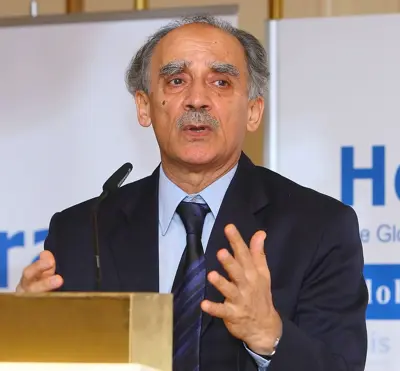
Arun Shourie is an Indian economist, journalist, author and politician. He has worked as an economist with the World Bank, a consultant to the Planning Commission of India, editor of the Indian Express and The Times of India and a Minister of Communications and Information Technology in the Vajpayee Ministry (1998–2004). He was awarded the Ramon Magsaysay Award in 1982 and the Padma Bhushan in 1990.
