Ohio Quotes
There shall be neither slavery nor involuntary servitude in this State,…. Nor shall any indenture of any negro or mulatto, hereafter made and executed out of the State, or if made in the State, where the term of service exceeds one year, be of the least validity, except those given in the case of apprenticeships.
This quotation illustrates the strong abolitionist tendency in the Ohio Territory. Under this clause, escaped slaves from Southern states would not be returned by the state authorities. Even more insulting to the slave enthusiasts of the South, if a Southerner brought any slaves into Ohio with them as was common for Southerners traveling with their personal slaves or horse team drivers, those slaves would be free. An interesting aspect of this clause of the Ohio Constitution was that the beginning was, word for word, copied from the Northwest Ordinance of 1787. See {618100}.
Ohio Constitution, November 29, 1802, Article VIII, Section 2
Sourced by: Eigen's Political and Historical Quotations

See the Vermont Constitution for another variant of how slavery was abolished: {616994}

This law required the treatment of Blacks as whites were then treated with respect to indentured servitude—a limit of 10 years after which the person would be free. However, this law was poorly enforced. The “General Court” was the name for the legislature of the Rhode Island colony.

In the early days of the Civil War slaves who escaped and reached the Northern lines were routinely returned to their Southern owners as the Fugitive Slave Act required. The first actual emancipation of the Civil war was not the President’s proclamation but was Butler who as a Union General ordered that the slaves escaping from Virginia no longer be returned. He was accused of violating the then existing law, however he had a legal rationale which hoisted Virginia on its own petard.


The Act was passed by the Pennsylvania General Assembly whose clerk interestingly enough was Tom Paine.

Lincoln had promised amnesty to Southerners who would pledge loyalty to the Union. What many feared was that this would include slave owners re-enslaving their former "property," or that the government would allow them to do so in order to stop the rebellion.

The general issued a military order emancipating slaves in Florida, Georgia and South Carolina. President Abraham Lincoln rescinded the order feeling it was too premature and it would cause the slave states that stayed in the Union--Delaware, Maryland, and Kentucky--to go over to the Confederates.
In early New England the General Court served as both a legislature and a judiciary before separation of powers was introduced. 5 years later the Court banned importing African slaves at all. While slavery was not common in Rhode Island, the laws was not seriously enforced on those who would defy them. It does represent a public anti-slavery sentiment that existed in Early America. It would take 200 years for Rhode Island to finally eliminate all forms of slavery.

One of the many complaints that many people made at the time about Smith and his Mormons was that they opposed slavery. In fact, Smith not only opposed it be had a plan for compensating the slave owner and a method for paying for it. Smith was not advocating the kinds of personal lifestyle issues of his church the way modern religious leaders do, but was concerned with the much larger issues of expansionism, corruption of the courts and judiciary, and land distribution. He was a classic reform candidate in that sense. Smith had written to most of the then likely Presidential candidates of both major parties asking for their position on the Mormons who were facing persecution wherever they went. None of the politicians would make any satisfactory commitments. Smith took Direct Action and became the only major religious official to have run for the Presidency of the United States until Pat Robertson tried and failed in 2000. Smith’s assassination shortly thereafter cut his run for the Presidency short before it made much headway and politically he had no chance to affect the race.

In this case, the Pope was obeyed on the issue of slavery. However, Papal injunctions against slavery have not always had the desired effect. See {617632}


Jefferson’s views, actions and inactions regarding slavery are very complex and contradictory. This quotation is one example of the many statements and activities to end slavery. Yet he never freed his own slaves (as did George Washington) and he fathered a child by one of his slaves with no attempt at freeing even her and the child. The Andrew Dickson White article is one of the first serious studies of the Jefferson contradictions regarding slavery.

Washington was from Virginia, the largest of the slave states, and he himself owned slaves. In his will he emancipated all his slaves. Most of his fellow Southern Slave owners however not only disagreed about the abolition of slavery but were adamant that slavery spread so that the abolitionists never attain a majority.

There was little thought of emancipating slaves or their value to the South by the senior officers of the Union Army at the beginning of the war. The Secretary of War however changed that. See {629184}.

He was the Russian Reformer who ended serfdom and gave land to the peasants and then was assassinated. Ironically, both Alexander II and Lincoln were assassinated—because of their reform efforts—Lincoln for going too far; the Czar for not going far enough. See the Nickname that was given to the Czar: {622809}.


In April, 1784, the Continental Congress passed a series of laws that Jefferson had drafted for the NorthWest territory—Ohio then being the west and the states that would develop there. However, the quotation is the clause that the Southern States blocked and hence did not become law, as the Soothers states cared little about the status of the area regarding slavery, but feared that the new states wold become a sanctuary for runaway slaves. It was another case where Jefferson attempted to end slavery. It also was yet another example of the unwieldiness of the Continental Congress to manage the new nation which led up to the Constitutional Convention of 1787. Ironically, as a price for union, the Southern States demanded and obtained a disproportionate representation in the New House of Representatives by having 60 percent of their slaves counted inzallocating congressional seats. The senate also worked in their favor as there were enough Southern states to block any attack on slavery in the Senate. There was no democratic way to eliminate slavery and the Civil War resulted. However, Jefferson’s proposed law was passed by the last Continental Congress in June, 1787. The difference was that there was also added a proviso that required the return of all runaway slaves from the new territory and states which was lacking in the earlier attempt.

This Civil War recruiting poster was described by the Free Library of Philadelphia as “Civil War recruitment print targeting African Americans by evoking the freedoms granted by the Emancipation Proclamation. Depicts a montage of symbolic scenes centered around an African American Union soldier triumphantly holding up a sword and an American flag with the banner "Freedom to the Slave." He stands near broken shackles upon a tri-color flag adorned with a coiled snake. The flag is tugged upon by one of three joyous slaves freed by an African American soldier. Other scenes depict an African American man reading a newspaper on a rocking chair near a plow and child, African American children entering a "Public School" near a church, and a regiment of "U.S. Colored Troops" marching across a battlefield strewn with dead bodies.”

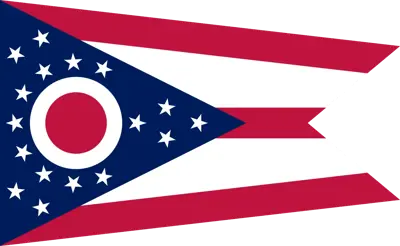
Ohio /oʊˈhaɪoʊ/ (listen) is a state in the Midwestern region of the United States. Of the fifty states, it is the 34th-largest by area, and with a population of nearly 11.7 million, is the seventh-most populous and tenth-most densely populated. The state's capital and largest city is Columbus, with the Columbus metro area, Greater Cincinnati, and Greater Cleveland being the largest metropolitan areas. Ohio is bordered by Lake Erie to the north, Pennsylvania to the east, West Virginia to the southeast, Kentucky to the southwest, Indiana to the west, and Michigan to the northwest. Ohio is historically known as the "Buckeye State" after its Ohio buckeye trees, and Ohioans are also known as "Buckeyes".
