Harlan F. Stone Quotes
There is grim irony in speaking of the freedom of contract of those who, because of their economic necessities, give their service for less than is needful to keep body and soul together.
Harlan Fiske Stone, 1872-1946, Chief Justice of the U. S. Supreme Court, U. S. Attorney General (Republican), Morehead v. N.Y. ex rel. Tipaldo, 298 U.S. 587, 632, 1936
Sourced by: Eigen's Political and Historical Quotations

Jefferson was one of the first political and economic thinkers to express concern over the “wage slave” concept of the industrial revolution. This was one of the major reasons that he was not in consonance with Alexander Hamilton in his economic vision for America. While we followed the Hamilton direction, there are still issues of maintaining freedom and independence for an employee in modern nations and economies.


Ten cents a day was a very low wage—it was about the equivalent of a meal at a tavern at the time. Workers throughout the country were outraged and give him a derogatory nickname—see Quotation 643585.


The argument here is that since the poor working class wages are so low, that they cannot save for an emergency, therefore the society must provide for welfare for those who might otherwise starve.


This is not a common quotation from Thoreau. The great man for whom the establishment had so much respect had a very anti-capitalist streak. His view is that the employer will generally never pay his laborers a fair wage. Instead he will pay the laborer the lowest rate for which he can obtain the laborers services. If the laborer generates added value for his wage, the employer is in a zero sum game with the laborer. If part of the added value—the profit is paid to the laborer, the employer does not have it for himself (or his stockholders). In most cases, the laborer is forced to work for his and his family’s subsistence. This theory argues that they only way the laborer will get a fair wage is if there is a labor shortage (assuming no government laws or union pressure is in the picture. Many capitalists argue that a “fair” wage is what a free man is willing to work for and a free employer is willing to pay. So economics is like politics in general with respect to fairness—there is no universally accepted definition of what is fair.


She was writing about the textile mills of Manchester, England in the Industrial Revolution. Workers’ wages were so low that many of them could not feed themselves and their family decently


the minimum wage in 1996 Delay was known for “factual statements” that just were not true. There were actually tens of thousands of such families at the time. Later, DeLay was convicted and sentenced to jail for money laundering and illegally spending and raising campaign funds. He was also reprimanded by the House Ethics Committee for unethical methods of fund raising for other earlier actions.


While it was true that wages did not increase beyond inflation, the enormous increase in productivity—about a doubling—was not only due to the workers but was also due to the capital investment that the companies made in computers, robots, job restructuring, advanced training, and other management initiatives. Historically, when there are substantial productivity increases, the benefit is shared between the workers and the company as both were necessary to produce the increase in productivity. But since 1980, the workers have not obtained any significant share of the productivity increase.

This fascinating quotation is very frequently quoted out of context. For example even in modern times some Southern slavery apologists quote this passage stating that Adams saw no moral difference between slavery and employment of the lower classes. And anti-capitalists have claimed that this was an attack on capitalism as no better than slavery for many workers. Neither is true. The debate was on the head taxes that states should pay to the central government. Southerners were claiming that they should not have to pay per person taxes on slaves. Adams position was that they should pay in that there is no practical difference in the work and working conditions very often. If slaves should be exempted from the head tax, so should the poor, lower class workers like the fisherman in New England. He always maintained at huge moral difference between a poor free worker and a slave even thought their working conditions might be similar.

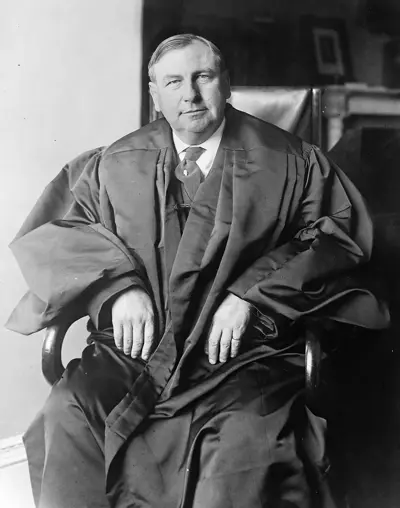
Harlan Fiske Stone was an American lawyer and jurist who served as an Associate Justice of the U.S. Supreme Court from 1925 to 1941 and then as the Chief Justice of the United States from 1941 until his death in 1946. He also served as the U.S. Attorney General from 1924 to 1925 under President Calvin Coolidge, with whom he had attended Amherst College as a young man. His most famous dictum was: "Courts are not the only agency of government that must be assumed to have capacity to govern."
