Erich von Falkenhayn Quotes
There has been a great deal of talk about the preservation of the people’s rights, but the Army constitutes not the least important part of the people.
The issue of whether the military has any rights per se in a democracy or is an institution established and controlled by the people is one that separates many countries today. In one philosophy—held by America and most industrial democracies—the military is completely subservient to and under the control of the people and their government. The other view held by many societies controlled by the military is that the military is a subset of the people with specific rights granted to it. In some countries the military can name representatives, can veto legislation and are considered a faction just like political parties. See China, Turkey, Argentina, and Indonesia for examples of the latter view.
Erich von Falkenhayn, 1861-1922, German General and Minister of War, Speech to the Reichstag, 1913
Sourced by: Eigen's Political and Historical Quotations


This was written during the George W. Bush Administration where the reaction to 9-11 was to curtail some civil rights and constitutional protections in favor of more national security. Bush was not the only President who eroded civil rights in a fear for National Security. FDR interned the Japanese Americans. Woodrow Wilson jailed pacifists who protested against the draft. John Adams passed the infamous Alien & Sedition Acts.

A state militia is necessary


These two states actually prohibited their legislatures from maintaining a standing army. Similar sentiments were in the constitutions or bill of rights of New Hampshire, Delaware, Maryland and Massachusetts but the option was left with the legislatures. A similar phrase appears in the Virginia Bill of Rights of 1776.


In 1776 General Charles Lee imposed a loyalty test on inhabitants of New York in the name of the new government. Four distinguished public men wrote this letter.

Many of the young men who were given this form to fill out, had never been in Japan and some did not even know there was an emperor there. Nonetheless the Japanese American divisions of enlistees were the most effective and most decorated fighting units for America while their parents who had not been born in America were still imprisoned in the internment camps. See {624010}.


The Army and the other power centers of the country did not appreciate this idea. He was assinated in a coup 4 year later.

The Muslim Brotherhood which had been elected after the Arab Sprint deposition of President Mubarak, had then begun to institute their own religious philosophy into what was becoming a theocratic government. Rights of Christians, and other non-Muslims as well as moderate Muslims, together with women, democrats and advocates for human rights and freedom were trampled. 30 million people demonstrated in the streets and the nation was about to have a civil war when the military, under el-Sisi, deposed the Muslim Brotherhood government. When the Brotherhood took to the streets, many with weapons, there was a clash where almost 1000 Brothers were killed as were almost 100 police. The general was addressing the Egyptians and the rest of the world explaining the reason for breaking up the demonstrations.


Marie Joseph Paul Yves Roch Gilbert du Motier

There is frequently a disagreement between the military and civilian leaders just as there are disagreements among most political personnel. Hawks, and people who have had experience in the military tend to think that military advice on military matters should be determinative with the President and Congress. Others tend to believe that military advice should be considered, but if it were always adhered to, there would be no point in having civilian control over the military. See {639667} for an example of when military leadership advice prevailed and it was a mistake.
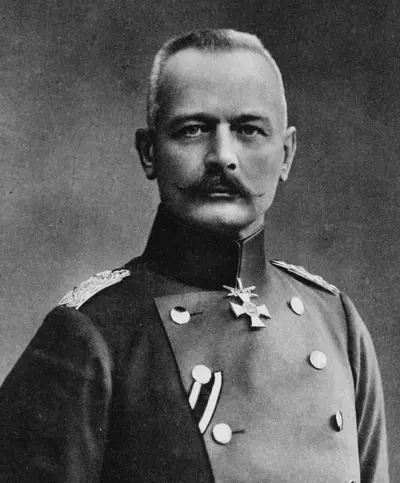
General Erich Georg Sebastian Anton von Falkenhayn was the second Chief of the German General Staff of the First World War from September 1914 until 29 August 1916. He was removed on 29 August 1916 after the failure at the Battle of Verdun, the opening of the Battle of the Somme, the Brusilov Offensive and the entry of Romania into the war on the Allied side undid his strategy to end the war before 1917. He was later given important field commands in Romania and Syria. His reputation as a war leader was attacked in Germany during and after the war, especially by the faction which supported Paul von Hindenburg. Falkenhayn held that Germany could not win the war by a decisive battle but would have to reach a compromise peace; his enemies said he lacked the resolve necessary to win a decisive victory. Falkenhayn's relations with the Chancellor Theobald von Bethmann-Hollweg were troubled and undercut Falkenhayn's plans.
