Josephus Quotes
Theocracy
Joseph ben Matthias. The term was coined by Josephus to refer to the fundamentalist, orthodox Jewish view of a proper state, as opposed to a secular government. The Jewish fundamentalist dream of a theocracy came down through modern times. There were ultra-orthodox Jewish groups who opposed the creation of the State of Israel on the grounds that it is not a theocracy and there are some who still want to see Israel transformed. The term became generalized and is applied to any state where the religion is the state and religious leaders dominate and control the state. The ultra orthodox Muslims, as in Iran, are generally the only religious group who have created theocracies or semi-theocracies as Islamic states. See {638106} for the context in which the term was first used.
Flavius Josephus, 37-105, Roman-Jewish General & Historian, Criticism of the Egyptian Apion, Quoted in Eric Nelson, The Hebrew Republic, 2010
Sourced by: Eigen's Political and Historical Quotations

Joseph ben Matthias. There a different kinds of theocracy, There can be a Pope, a King, or a Supreme Leader who acts as the chief magistrate using a religious tract as the law of the land. The Ancient Jews had a Republican Theocracy were the leaders were chosen by the people but they did not promulgate any laws. The Torah—the first 5 books of the Old Testament—was the law of the land. In comparison. 21st century Iran recognized the Koran as the source of Laws. However, their chief magistrate was a cleric—the supreme leader who is not elected but appointed by a few other clerics. None of the other Iranian leaders are chosen by the people because all candidates must be approved by the Supreme Leader in order to even stand for election. So the ancient Jews had a republican theocracy, while Iran was an autocratic theocracy.

Gabriel exaggerates in the sense that while the quotation is correct for many Muslims, it is by no means true of all. Iran for example is an Islamic theocracy, but Turkey is a 99 percent Muslim nation which is totally secular and in some ways is much more restrictive of Islamic teaching and practice than most secular democracies. The fundamentalist Muslim view of the state and religion is essentially the same as the ultra orthodox Jews and Christians. It is true that a greater proportion of Muslims believe in the merging of civil and religious law than Jews and Christians, but by no means all. The non Arab Muslims are much less likely to see the unity of state and religion.


This is a very important quotation as it focused on one critical difference between historical Islam and all the other major religions and fundamentally on the separation between church and state. In Islam there was a Caliph who was both the political ruler and the religious ruler. In comparison at the time, the Christians had a Holy Roman Emperor who was theoretically the overlord of all the Christian Kings but in reality he really could not exercise total or even much authority over all the other kings. At the same time, there was the Pope who was the religious leader of all the Christians. Since the distinction between Church and state was constantly in flux, the Christian Pope and Holy Roman Emperor were often at odds. The third Abrahamic religion, Judaism, had neither a secular leader or a religious one and no hierarchy other than local. Khaldun observed the theoretical advantage of Theocracy as a model, however he did not analyze the disadvantages among which were the assassination of many Caliphs and the laces. Even the Muslim Arabic states abandoned the idea of a Caliph in modern times until Iran adopted a Theocracy with a single Leader all powerful. However, all the other Arab nations wanted no part of a singular leader for all Muslim nations or even a single civil and religious leader within any other country. Al Qaeda however claimed to be fighting for a return to a Caliphate not only for the current Islamic Nations but for all nations which must be subservient to Islam.


This quotation illustrated the extreme polarization between the current fundamentalist Muslims, and the Muslim modernists and the West. Kamal Ataturk, the great leader and stateman who is the father of modern Turkey, is castigated by the author for leading the new Turkish parliament to depose the Caliph – the civil and religious autocrat, one of whom reigned from after the death of Muhammad till his abolishment in 1924. Most of the rest of the world credits Ataturk with being one of the great leaders of all time—one who led a democratic revolution which transformed Turkey into the only Muslim secular democracy, requiring pubic secular European type education for all children, giving women the right to vote (before the U. S. even), adopting a European alphabet and dress, and outlook on life—creating most remarkably a total cultural revolution with virtually no loss of life. No revolutionary leader, before or since has led so extensive a political and cultural revolution, and it was a bloodless revolution. Turkey, into the 21st century, was by far the most powerful, industrialized, scientific and modern nation of Muslims in the world and others were far behind. Yet many Islamic theologian still castigate Atatork for his great achievements as being against the will of God.


While this type of hate message is common with Hamas, it is notable this specific hate and violence propaganda was transmitted via a children’s TV show called “Tomorrow's Pioneers” using a Mickey Mouse-like character. Children call in to the show, many singing Hamas anthems about fighting Israel.


Jerusalem has been holy to the Jews, Christians and Muslims. It was the Capital of the ancient Jewish kingdom from ~1000BC. In ~960BC Solomon built the first Jewish Temple. Babylonians conquered and destroyed the temple which was rebuilt and completed in 68 BC under the Jewish King Herod and then destroyed by the Romans 2 years later. In 135 the city was sacked and the Byzantine Christians controlled the city. In 638 the Muslims conquered the city and built The Dome of the Rock Mosque on the ruins of the sanctuary of King David. In 1099 Crusaders conquered Jerusalem slaughtering the Muslim & Jewish inhabitants. In 1187 the Muslims retook the city and held it till the fall of the Ottomans in 1917. England ruled it until the 1948 partition; then Israel & Jordan ruled but Jews were not allowed to worship at the temple site. In the 1967 War Israel retook Jerusalem. Although Muslims can still worship at their Mosque, the President resents anyone but Muslims controlling the Holy City.

What makes this quotation very notable is the fact that Dr. El-Naggar is not even a cleric but a scientist. and yet in spite of his education, much broader than most Muslim men, he still thinks of the Koran as the only source of truth available to man. Observation, deduction, induction, experimentation all have no weight. Herein lies one basic difference between Islamic Fundamentalists on the one hand and Christian, Jewish, Hindu & Buddhist and other religion’s fundamentalists. All may accept their holy book as the revealed truth, but it is only the fundamentalist Muslim who believes that it is the ONLY source of truth and wisdom. A classic difference between the radical fundamentalist and the moderates is that moderates, like almost all religious people on earth, believe that there are other sources of knowledge, truth and wisdom besides their holy book.


In 2005 Rose published a number of cartoons some of which depicted the Muslim Prophet, Muhammad which offended many fundamentalist Muslims who had a tradition who had a tradition of never depicting the visage of the Prophet. A delegation of clerics demanded an apology from Rose and the country of Denmark, claiming that they and Islam, like other religions, were entitled to respect.
The mullahs had a great deal of power in Iraq and were among the most vocal opponents of democracy and freedom and instead argued for a Theocracy under Islamic law—Sharia which allowed almost no freedoms for the individual.


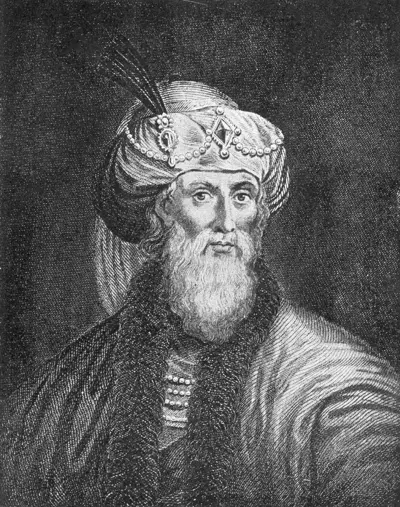
- Born:
- Nationality: Jewish & Roman
- Profession: Historian & General
