Mahmoud Ahmadinejad Quotes
It is inconceivable for anyone who calls himself a Muslim and who heads an Islamic state to maintain relations under the table with the regime that occupied Jerusalem.
Jerusalem has been holy to the Jews, Christians and Muslims. It was the Capital of the ancient Jewish kingdom from ~1000BC. In ~960BC Solomon built the first Jewish Temple. Babylonians conquered and destroyed the temple which was rebuilt and completed in 68 BC under the Jewish King Herod and then destroyed by the Romans 2 years later. In 135 the city was sacked and the Byzantine Christians controlled the city. In 638 the Muslims conquered the city and built The Dome of the Rock Mosque on the ruins of the sanctuary of King David. In 1099 Crusaders conquered Jerusalem slaughtering the Muslim & Jewish inhabitants. In 1187 the Muslims retook the city and held it till the fall of the Ottomans in 1917. England ruled it until the 1948 partition; then Israel & Jordan ruled but Jews were not allowed to worship at the temple site. In the 1967 War Israel retook Jerusalem. Although Muslims can still worship at their Mosque, the President resents anyone but Muslims controlling the Holy City.
Mahmoud Ahmadinejad, President of Iran, Interview on Iranian television, July 2006
Sourced by: Eigen's Political and Historical Quotations


This quotation helps to explain the religious revelry in military achievements in Islam.
In addition to Christians, Muslims and Jews, each of these has enclaves and sects who are as different from one another as they are from the other religions.

Joseph ben Matthias. The term was coined by Josephus to refer to the fundamentalist, orthodox Jewish view of a proper state, as opposed to a secular government. The Jewish fundamentalist dream of a theocracy came down through modern times. There were ultra-orthodox Jewish groups who opposed the creation of the State of Israel on the grounds that it is not a theocracy and there are some who still want to see Israel transformed. The term became generalized and is applied to any state where the religion is the state and religious leaders dominate and control the state. The ultra orthodox Muslims, as in Iran, are generally the only religious group who have created theocracies or semi-theocracies as Islamic states. See {638106} for the context in which the term was first used.

This quotation was used by Aga Kahn III in his famous speech to the League of Nations, October 6, 1937. It speaks of the unity of the Muslims, Jews and Christians from an Islamic scholar of the 13th Century.

This statement by The Prophet has been interpreted by Muhammad Abduh and other Islamic modernists and reformers as a call for co-existence and common ground between Muslims on the one hand and Christians and Jews on the other. However, some Muslim extremists interpret this sura to mean that the call is for the Christians and Jews to accept Islam and THEN there will be common words. There is in modern times, there is no Islamic Hierarchy like a Pope to make a definitive determination about such an interpretation so Muslims are split on the interpretation. In that sense Muslims today are like Protestants, Jews and Buddhists.


These kinds of inflammatory sermons are delivered with the approval of the king and royal family who crack down on any cleric who preaches what they do not approve of.
See {617157} for a similar legal opinion. The concern was that poor Muslims may desert their faith when they see how well housed the tolerated people, Christians and Jews, are. They might conclude that Christianity or Judaism is better at making people wealthy than was Islam. See {617162} for a Koranic support of the idea. The Western view of this is generally, that is what the marketplace of ideas is all about. In 21st century America, Jews and Mormons on the average were the wealthiest religious groups. The logic of al-Ramli is that Mormons and Jews—each only 6 percent of the population—should not be allowed to show their wealth, lest Roman Catholics for example—25 percent of the population—will convert from Catholicism to the other two religions. From a democratic point of view, the response should be, we so be it. That is their choice. But America is the living proof that the assumption of conversion and loss of faith is per se wrong. The Mormons and Jews are visibly more successful, yet there are very few Roman Catholics leaving their church and converting to the two wealthier religions. There are some, but not at any greater rate than people convert from “wealthier” religions.
See {617160} for a similar legal opinion. The concern was that poor Muslims may desert their faith when they see how well-dressed the tolerated people, Christians and Jews, are. They might conclude that Christianity or Judaism is better at making people wealthy than was Islam. See {617162} for a Koranic support of the idea. The Western view of this is generally, that is what the marketplace of ideas is all about. In 21st century America, Jews and Mormons on the average were the wealthiest religious groups. The logic of al-Ramli is that Mormons and Jews—each only 6 percent of the population—should not be allowed to show their wealth, lest Roman Catholics for example—25 percent of the population—will convert from Catholicism to the other two religions. From a democratic point of view, the response should be, we so be it. That is their choice. But America is the living proof that the assumption of conversion and loss of faith is per se wrong. The Mormons and Jews are visibly more successful, yet there are very few Roman Catholics leaving their church and converting to the two wealthier religions. There are some, but not at any greater rate than people convert from “wealthier” religions.
Although this verse illustrates the particular enmity that some orthodox Muslims have for Christians and Jews, philosophically the hostility it not unlike that some orthodox Christians had (and still have) for Jews. The theory was that among the more primitive people a certain “ignorance” was tolerable, but “People of the Book” were not ignorant but actually rejected the word of Muhammed or in the case of the Jews vis a vis the Christians, they rejected the word of Christ. The hate message is preached within some Christian circles about Jews and Muslims today, but the overt, visible, statement in the midst of the holiest of Scripture makes the Koranic version even more socially and ethically difficult in a pluralistic society.
The Jews, Christians and Zoroastrians were allowed to maintain their own religion and live as 2nd class citizens and pay a special tax, but ALL other religions were to be forced to convert.
His quotations are very important because he wrote many of the Islamic legal opinions that governed Muslim Spain and influenced the Arabs of North Africa. This is yet another example of the classic antipathy that many Muslims have for People of the Book—Christians and Jews.


He was referring to the religious extremists in the Middle East.

In the early stages of Islam, Muhammad had hoped to convert the Jews and others on the Arabian Peninsula. When they refused to be converted, he warred against them usually killing the men, and taking the women and children as slaves. The result was that non-believing tribes were “cleansed” from the Arabian Peninsula. The Muslims at the time preferred children as slaves. For then they could convert the children against their will. Adults in Islam must accept Islam in order to convert. Children are regarded as having no such maturity of decision making and therefore opposition to conversion may be ignored and they may be forced. Critics of Islam and those who argue that Islam is at odds with all other religions point to this quotation. They claim that it is the only religion whose founder and fundamental scriptures demand war against others for no other reason than that they believe in a different religion. The Catholic Church during the Crusades and the Inquisition had a similar philosophy as did Christian missionaries colonizing Africa later. One difference is that most Christians today repudiate the doctrine as against the true spirit and teachings of Christ and view it as historical error, while very few modern Muslims repudiate this quotation of the Prophet.

Gabriel exaggerates in the sense that while the quotation is correct for many Muslims, it is by no means true of all. Iran for example is an Islamic theocracy, but Turkey is a 99 percent Muslim nation which is totally secular and in some ways is much more restrictive of Islamic teaching and practice than most secular democracies. The fundamentalist Muslim view of the state and religion is essentially the same as the ultra orthodox Jews and Christians. It is true that a greater proportion of Muslims believe in the merging of civil and religious law than Jews and Christians, but by no means all. The non Arab Muslims are much less likely to see the unity of state and religion.
It is often said that Judaism, Christianity and Islam share the origin in Abraham. However, orthodox Muslims use this passage of the Koran to arguer that Abraham had nothing to do with Judaism or Christianity. The time line of Abraham—according to biblical time c. 4000 BC argues more for his Judaic origins, but Western religion has his sons splitting into the great faiths. Muhammed uttered these lines roughly 600 years after the birth of Christ.
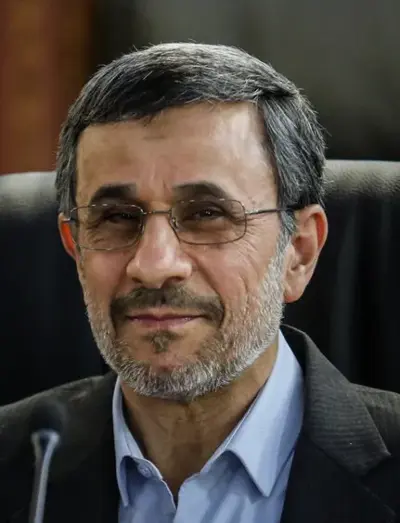
Mahmoud Ahmadinejad (Persian: محمود احمدینژاد, romanized: Mahmūd Ahmadīnežād [mæhmuːd(-e) æhmædiːneʒɒːd] (listen)), born Mahmoud Sabbaghian, is an Iranian conservative politician who served as the sixth President of Iran from 2005 to 2013. He was also the main political leader of the Alliance of Builders of Islamic Iran, a coalition of conservative political groups in the country, and served as mayor of Tehran from 2003 to 2005.
