Mohammed Arkoun Quotes
The politics of religion pursued in a large number of societies called Muslim make too many concessions to the forces of traditionalism, while favoring the adoption of all the benefits of material civilization. This results in dangerous mental cleavages, increasing backwardness in the systems of education, fruitless self-censorship, and the impoverishment of creativity in various domains of intellectual and cultural life.
Mohammed Arkoun, 1928–2010, Algerian / French Islamic Scholar & Reformer, “Present-Day Islam Between its Tradition and Globalisation”, Farhad Daftary (ed.)
Sourced by: Eigen's Political and Historical Quotations


The notion that Islam would be practiced by individuals was in the Ayatollah’s view insufficient. Islam must also control the government—the head.


In 2005 Rose published a number of cartoons some of which depicted the Muslim Prophet, Muhammad which offended many fundamentalist Muslims who had a tradition who had a tradition of never depicting the visage of the Prophet. A delegation of clerics demanded an apology from Rose and the country of Denmark, claiming that they and Islam, like other religions, were entitled to respect.

This quotation illustrated the extreme polarization between the current fundamentalist Muslims, and the Muslim modernists and the West. Kamal Ataturk, the great leader and stateman who is the father of modern Turkey, is castigated by the author for leading the new Turkish parliament to depose the Caliph – the civil and religious autocrat, one of whom reigned from after the death of Muhammad till his abolishment in 1924. Most of the rest of the world credits Ataturk with being one of the great leaders of all time—one who led a democratic revolution which transformed Turkey into the only Muslim secular democracy, requiring pubic secular European type education for all children, giving women the right to vote (before the U. S. even), adopting a European alphabet and dress, and outlook on life—creating most remarkably a total cultural revolution with virtually no loss of life. No revolutionary leader, before or since has led so extensive a political and cultural revolution, and it was a bloodless revolution. Turkey, into the 21st century, was by far the most powerful, industrialized, scientific and modern nation of Muslims in the world and others were far behind. Yet many Islamic theologian still castigate Atatork for his great achievements as being against the will of God.
Ahmad denied saying this although the reporter who wrote the original story insists that he did and she wrote it down at the time. Ahmad did not deny the statement when it first appeared in the Fremont Argus, but only did so several years later.

At the time, Muslim clerics had a great deal of influence and in many cases legal control over all facets of Turkish society much as exists in other Islamic societies today. They even controlled what was taught in the schools. Remarkably, without bloodshed, Ataturk broke both the power and the influence of the clerics on all official and public activities. Many Turkish Muslims even developed a type of reformed Islam with the relationship between the individual and the clerics one of parity much like Protestant churches in the West. At the same time there was a more orthodox part of the population and while they sent their children to religious schools, they also attended public schools so even the orthodox Muslims in Turkey learned science and modern subjects which are still not taught in most Islamic schools and madrassas.

Huqqani was specifically referring to Muslim religious scholars, but his point is more general and applies equally to some religious scholars and clerics of Christian, Jewish, Buddhist and other persuasions.


Gabriel exaggerates in the sense that while the quotation is correct for many Muslims, it is by no means true of all. Iran for example is an Islamic theocracy, but Turkey is a 99 percent Muslim nation which is totally secular and in some ways is much more restrictive of Islamic teaching and practice than most secular democracies. The fundamentalist Muslim view of the state and religion is essentially the same as the ultra orthodox Jews and Christians. It is true that a greater proportion of Muslims believe in the merging of civil and religious law than Jews and Christians, but by no means all. The non Arab Muslims are much less likely to see the unity of state and religion.

Bangladesh had fared very poorly as a part of Pakistan. When it revolted and became independent, it adopted a secular government whereas Pakistan had been, and is, a heavily Islamic state. However, the vast majority of Bengalis were Muslim and some were extreme fundamentalists. Rahman was under constant pressure to make the government more “Islamic” and while he did so somewhat, he tried to advocate for separation of church and state. Bangladesh is not as extreme as Pakistan which is not yet a theocracy but religious forces dominate every aspect of the society.


What was particularly unusual about this quote was that Cronkite had always been so circumspect about his own political views and opinions and rarely expressed personal criticism of any group or movement. When he was the national anchor for CBS News, he was so non partisan that he became the “most trusted man in America.” By 2007 however, most of the radical religious right had organized a serious movement which unlike other self interest groups which wanted to expand their rights or benefits, much of the radical religious right strove to curtail the rights of other Americans who differed from them as to religious interpretation, concepts and role of government, sound family structure and relationships, gender equality, sex, and personal freedom.


Joseph ben Matthias. The term was coined by Josephus to refer to the fundamentalist, orthodox Jewish view of a proper state, as opposed to a secular government. The Jewish fundamentalist dream of a theocracy came down through modern times. There were ultra-orthodox Jewish groups who opposed the creation of the State of Israel on the grounds that it is not a theocracy and there are some who still want to see Israel transformed. The term became generalized and is applied to any state where the religion is the state and religious leaders dominate and control the state. The ultra orthodox Muslims, as in Iran, are generally the only religious group who have created theocracies or semi-theocracies as Islamic states. See {638106} for the context in which the term was first used.
His views are a mix of modernism and fundamentalism. He favors democracy and elections but also favored the Taliban destroying the great ancient Buddha statues when he was called an idol worshipper for urging the preservation of art.
This quotation would be funny if it were not so serious. This major Islamic religious figure on television talks about the possible permissive killing of TV network owners for the crime of showing Tom and Jerry and Mickey Mouse Cartoons where anthropomorphic mice are sympathetic characters. He actually believes that Mickey Mouse is controlled by Satan.

One remarkable aspect of this quote is that most Western nations have the exact same perception he claims the Islamic word does of what the West is doing. While the Western nations think the defense is necessary and desirable, the Muslim nations fundamentally believe that Christianity and Judaism should and will be supplanted by Islam. To the Islamic fundamentalist religion is a zero sum game. Every person in the world who is not a Muslim is an attack on Islam in that God wants all to follow Islam and wants the faithful to make it so.

While not in the Koran, this attributed statement is the basis for the ban on non-Muslims going on a Hajj and going to the most holy Muslim places—Mecca, Mina, Muzdalifa, and Arafat as well as the anti-religious hostility to all religions but Islam which is present in some Muslim countries.
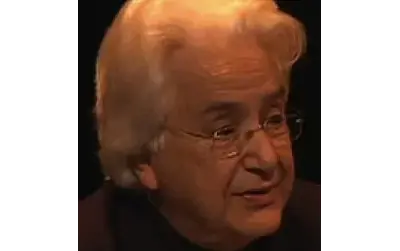
Mohammed Arkoun was an Algerian scholar and thinker. He was considered to have been one of the most influential secular scholars in Islamic studies contributing to contemporary intellectual Islamic reform. In a career of more than 30 years, he had been a critic of the tensions embedded in his field of study, advocating Islamic modernism, secularism, and humanism. During his academic career, he wrote his numerous books mostly in French, and occasionally in English and Arabic. He appeared on numerous occasions on French TV and magazines, on Berbère Télévision speaking in Kabyle, his mother tongue, and on Al Jazeera speaking in Arabic.
