Ludwig von Mises Quotes
The unpopularity of economics is the result of its analysis of the effects of privileges. It is impossible to invalidate the economists demonstration that all privileges hurt the interests of the rest of the nation or at least a great part of it.
Mises, Ludwig von. Human Action: A Treatise on Economics. Yale University Press, 1949.


This was an invitation to Snell to the “Front Bench.” This refers to the upholstered benches of Parliament where the members sit. The Front Bench for each party is reserved for the senior party officials and loyalists. The tradition is however, that Front Benchers have to support and defend the party on all things and must adhere to and vote with the party line. Backbenchers have more freedom and autonomy.


Charles Seymour was President of Yale University from 1937 - 1950.

In October 2025 (ahead of ongoing trade negotiations), the Ontario Provincial Government (Canadian) produced a video ad distributed in the US using a voice-over of the above quote from a 1987 Ronald Reagan Presidential Radio Address. The ad uses five complete sentences from the five-minute weekly address, but they are spliced together out of sequence. Also, while the ad implies Reagan was against tariffs, it omitted the context that he was using the radio address to announce new tariffs imposed on Japan by his administration but that they should be seen as an unavoidable exception to his basic belief in free trade as the key to prosperity. He said, “our commitment to free trade is also a commitment to fair trade.” President Trump accused the Ontario government of producing a fraudulent ad and of attempting to influence the US Supreme Court as it prepares to hear arguments about the legality of Trump’s tariffs. As a result, the Trump administration terminated trade negotiations with Canada.

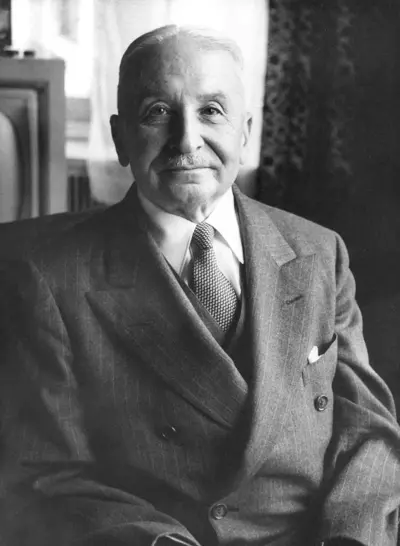
Ludwig Heinrich Edler von Mises was an Austrian School economist, historian, logician and sociologist. Mises wrote and lectured extensively on the societal contributions of classical liberalism. He is best known for his work on praxeology, a study of human choice and action.
