Colin Powell Quotes
The United Nations will spearhead our efforts to manage the new conflicts (that afflict our world)... Yes the principles of the United Nations Charter are worth our lives, our fortunes, and our sacred honor.


3rd Earl Russell of Kingston. The military weak nations agreed with him, but the militarily strong ones did not—especially America and England which had the Atomic Bomb when others did not.


Son of John Jay. Father of Harriet Beecher Stowe and Henry Ward Beecher


The Republican controlled Senate had turned down the ratification of the League of Nations presented by Democratic President Wilson, and looked like they would turn down any international treaty even if presented by a Republican President. This statement allowed the treaty ratification by only a few votes. However, after that the Senate turned down our participation in the Permanent Court of Arbitration at the Hague. See {640099}.


Actually it was the United States which insisted in the veto which required consensus of the great powers of the time. It was Russia which ended up using it far more often than any other nation.

One major problem at the time was that the Soviet Union was supporting and instigating revolutions in many parts of the world. When most nations of the UN wanted to provide peace keeping troops to quell the conflict, the Russians would veto and block the effort, Vandenberg wanted the UN to change the rules regarding the veto. The right of veto for the major nations was originally included in the UN Charter at the insistence of the United States, and many Americans did not want to give it up or have any exceptions lest there be more in the future. The Russians at that time also did not want to give up any of their veto powers. Another method that Vandenberg wanted to solve the Russian peacekeeping blockage problem was for America to engage in more collective security pacts so that action could be taken without UN Security Council unanimity by going around the UN.
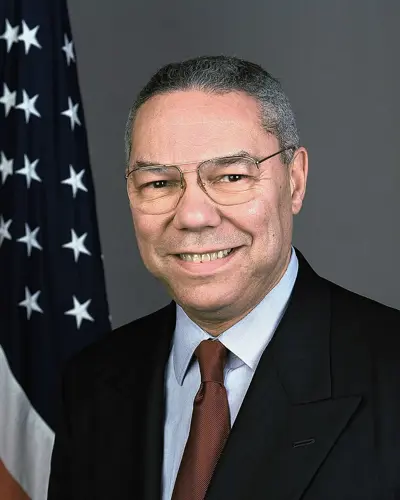
Colin Luther Powell is an American politician, diplomat and retired four-star general who served as the 65th United States Secretary of State from 2001 to 2005. Powell was the first African-American Secretary of State. Prior to the election of Barack Obama as president in 2008, Powell and his successor, Condoleezza Rice, were the highest-ranking African Americans in the history of the federal executive branch (by virtue of the Secretary of State standing fourth in the presidential line of succession). Powell served as the 16th United States National Security Advisor from 1987 to 1989 and as the 12th Chairman of the Joint Chiefs of Staff from 1989 to 1993.
