New Hampshire Quotes
The sudden and abrupt departure of his Excellency John Wentworth, Esq., our late Governor, and several of the Council, leaving us destitute of legislation, and no executive courts being open to punish criminal offenders; whereby the lives and properties of the honest people of this colony are liable to the machinations and evil designs of wicked men, Therefore, for the preservation of peace and good order, and for the security of the lives and properties of the inhabitants of this colony, we conceive ourselves reduced to the necessity of establishing A FORM OF GOVERNMENT to continue during the present unhappy and unnatural contest with Great Britain
The “abrupt departure” referred to the Tories. The phraseology is today almost comical were it not so serious a matter. This first New Hampshire Constitution was a very short one developed quickly out of necessity.
New Hampshire Constitution, 1776
Sourced by: Eigen's Political and Historical Quotations

This was the first proposal for a united American government. It provided for a “President-General” and a unicameral “Grand Council” with representation proportional to population.


Americans were by no means united in wanting to take up arms against Britain. Relatively few of the loyalist quotations have come down to us, but here is one. It also illustrates why some Americans wanted complete independence: So that they could escape their debts to English merchants. Most however had more noble and unselfish motives. As a matter of fact, the American Revolution is unusual in the sense that there were so many men of substance who sacrificed much of their material wealth for the American ideal. There were also the rogues and opportunists as Galloway describes.

Warren was killed shortly thereafter at the Battle of Bunker Hill.

Several years before the Battle of Bunker Hill, revolutionary activity had already broken out in the American colonies—See {634132} for an example. This law gave the British authorities much more “clout” in dealing with the “seditious” American activities. It protected English law enforcement officials from being tried in local Colonial courts for murder or assault in putting down insurrections. George Washington and other Patriots were outraged over this law. See {634131}.

Despite his warning---and that of others—all that they could get agreement upon had each of these three weaknesses. After winning the American Revolution, the new country found the Articles of Confederation and the Continental Congress completely inadequate and finally in 1787 there was a Constitutional Convention held in secret in Philadelphia to overcome the weaknesses of the existing structure of which the warnings of Rush were three of the problems that had to be fixed.

Fielding was fighting for England in the American Revolution and was stationed in New York after the war where there were many American Loyalists who supported the British. Most had their property confiscated and went to England or British possessions like Canada or the Caribbean. There was a spirit of vengeance the patriots had against the Tories.

This resolution of independence was voted upon a month before the Declaration of Independence. It was approved by 12 of the colonies but not by New York. The Congress appointed a committee to draft what became the Declaration of Independence and that was approved by all the colonies. The resolution was introduced by Richard Henry Lee on instructions from Virginia. The graphic is of Lee’s original notes.
Most Canadians supported the English despite the letter.

At the time of the American Revolution there were strong abolitionist forces working against slaver and the slave trade. Southern American slave-owners, the political leadership of the South, feared that England would force slavery reforms on their colonies. Hence, severance from England eliminated that threat. In retrospect, they were quite right for it was England which outlawed the slave trade and led the worldwide anti-slavery movement which had little effect on the new independent America and the political bias in favor of the south of the American compact caused slavery to survive in America, long after the vast majority of the population would have it ended. It took the Civil War to do it.


This was written more than a year before the American Revolution Battles began. It took time to ship the men and supplies to America and the British did not handle that task with much efficiency. See {636926} for another of the King’s statements.

2nd Earl of Guilford. This bill cut off all trade with the American Colonies. It was meant as pressure to cease the rebellion. It did not work.

A number of the British Parliament were opposed to using force to get America to accept British taxation and other rules. They thought the trade with America was excellent for both, and the military advantage of the combination was superior to any force on earth. To upset that over who had the right to tax and under what conditions seemed foolish. They counseled negotiations. It was thought at the time that Lord North, the Prime Minister, was perceived to be a hard liner who would not back down regarding America. This quotation describes papers that the professor found that proved that Lord North was not one of the hawks and did not want to send troops to America. However, the King was insistent as he and his hawkish advisors felt that England and the king would be weakened if the world could see America flouting the king. It was a “domino theory” of the effect on all the colonies. North wanted to resign but the king thought him the only competent man in the kingdom who could manage the government and would not allow North’s resignation. The Prime Minister, as a loyal servant of the King, executed the policy he thought unwise and used his political skill to marshal and maintain a majority for a hard line in Parliament. Apparently, he tried to resign over America on several occasions. The world would be very different place had he successfully resigned.


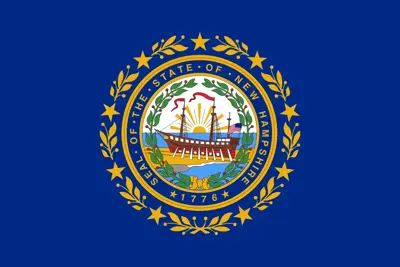
New Hampshire (/ˈhæmpʃər/) is a state in the New England region of the United States. It is bordered by Massachusetts to the south, Vermont to the west, Maine and the Atlantic Ocean to the east, and the Canadian province of Quebec to the north. New Hampshire is the 5th smallest by area and the 10th least populous U.S. state. Concord is the state capital, while Manchester is the largest city. New Hampshire has no general sales tax, nor income tax other than on interest and dividends. The New Hampshire primary is the first primary in the U.S. presidential election cycle. Its license plates carry the state motto, "Live Free or Die". The state's nickname, "The Granite State", refers to its extensive granite formations and quarries.
